

Can the Styrene Market Continue Its Rising Trend in August?
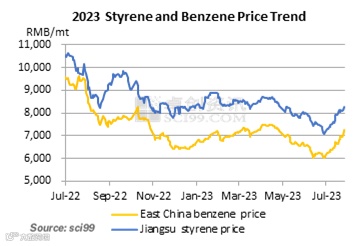
Styrene prices have increased by almost RMB 940/mt since the end of June, reversing the second quarter’s consistent declining trend. Following this, short sellers in the industry are compelled to reduce their positions. Will the supply growth remain below forecast in August? The main aspect that determines whether the price of styrene can climb further is whether the downstream demand during the customary peak demand season can be discharged in advance.
Three factors contributed to the increase in styrene prices in July. First, the price of crude oil continued to rise internationally, and the atmosphere on a macro level improved in July. Second, the supply increase came in lower than anticipated. Thirdly, exports that weren’t scheduled rose in July.
Climbing crude oil prices & improving the macro atmosphere
In the first part of July, there was a noticeable rise in the price of crude oil on the global market. Saudi Arabia offered to extend its oil production reduction, which helped to keep the oil market stable. In addition, the US CPI came in lower than anticipated, which caused the US dollar to decline. The interest rate hike could perhaps be put on hold in September, according to the market. The commodity market had a revival, which helped to fuel the ongoing climb in crude oil prices. In addition, the increase in oil prices also supported the rise in benzene prices.
Furthermore, the market atmosphere on a macro level also changed in July. The announcement of the impending release of pertinent documents to encourage consumption has improved the mood on the market, and the market is anticipating the economic meeting of the Central Politburo in July with relevant policies.
In August, the benzene market will benefit from the anticipated increase in styrene output. Furthermore, the coal-based benzene market in North China is relatively strong. On one hand, coal-based benzene supply is cut due to profit losses. On the other hand, it is anticipated that additional downstream plants would go into service, increasing the demand for benzene. As a result, the styrene market may receive cost support from the greater benzene market.
Less-than-expected styrene supply increment & falling port inventory
When predicting the supply and demand balance for July in June, it was expected that the domestic styrene output in July would be 1.38 million mt, and the social inventory was expected to see an increase of 50kt or so. However, unplanned changes have resulted in a lower-than-expected increase in styrene output and a decrease in port inventory.
Affected by objective factors, the prices of oil blending materials related to toluene and xylene showed a rapid increase, especially the prices of alkylated oil and mixed aromatic hydrocarbons, driving up domestic demand for toluene and xylene oil blending. Therefore, toluene and xylene prices gained, and the price of ethylbenzene correspondingly increased. For styrene producers, the benefits of producing ethylbenzene were better than those of producing styrene, leading to a decrease in styrene output. It is understood that the cost of the dehydrogenation process is approximately RMB 400-500/mt. When the price difference between styrene and ethylbenzene is greater than RMB 400-500/mt, producing styrene is more profitable, and conversely, producing ethylbenzene is more profitable. In July, it was roughly estimated that the production of ethylbenzene affected the styrene output of approximately 80-90kt, which was also one reason why the main port inventory did not increase.
Styrene units saw intensive maintenance in May and June, and the overhauled units were projected to be restarted in succession in July. However, several units’ restarts were delayed for various observable causes. Additionally, the newly added unit’s running rate was lower than anticipated. Additionally, unanticipated unit shutdowns at Tianjin Dagu Chemical and Sinopec Hainan Refining and Chemical decreased the output of styrene in July.
Currently, it is predicted that the styrene output in August may be 1,420kt, an increase of 110kt compared to July. After the rise in styrene prices in July, the profits from producing ethylbenzene weaken, and there is a certain risk. In August, Tianjin Bohai Chemical and Liaoning Baolai Chemical are anticipated to take maintenance at their units, but many units will be restarted at the same time.
Overseas unit shutdown & increasing styrene exports
Foreign styrene prices have rapidly risen as a result of the unforeseen outage of styrene units in the United States in July and the planned repair of units in Europe. Following this, the window for arbitrage between China and other nations opened, and merchants aggressively participated in exports. Around 29kt of exports were learned during the previous two weeks, the majority of which will be loaded for South Korea in August. Although Chinese goods were not sent directly to Europe, they did cover the supply deficit there after logistics were optimized. Currently, it is believed that the shutdown units in the United States will be restarted in late July or early August, while 2,000 kt/a capacity in Europe may remain in shutdown. If imports from China continue, it can largely offset the increase in China’s domestic output.
Will the market face negative downstream feedback or a positive trend during the peak demand period?
The market players believe that in addition to focusing on exports, negative feedback from downstream demand is the key to determining the maximum price of styrene. At present, downstream EPS and PS profits have already suffered losses, but the losses have been acceptable for the past two years, and the ABS industry still has profits. PS inventory is currently at a low level and the number of orders is still acceptable. EPS inventory is slowly increasing, with some enterprises having high inventory and sluggish orders. Overall, although the downstream situation is not optimistic, it is unlikely to have a negative impact on styrene prices yet.
As the customary peak demand season approaches, would there be a bullish feeling and replenishing demand for styrene in late August? As of right now, it’s believed that certain terminal manufacturers still have positive expectations for the Double 11 and Double 12 shopping festivals, and factories that make home appliances anticipate increasing their production schedules in September. Styrene prices are therefore anticipated to rise in August due to replenishment demand.
All information provided by SCI is for reference only, which shall not be reproduced without permission.
Please click "Read more" for the full article.