

China EPS Price to Remain Range-Bound in Apr
Preface: From mid-February 2023, EPS market price turned to be range-bound affected by costs, fundamentals and macro atmospheres. In March, the EPS market price first rose and then dropped, and the price fluctuation was limited. With the demand peak season in April coming, there are no effective factors to prop up the EPS market price at present.
From mid-February 2023, EPS market price turned to be range-bound affected by costs, fundamentals and macro atmospheres. Costs changed little, which gave limited support to the EPS market price. Thus, the price fluctuation was limited. Up to April 6, the prevailing EXW price for general materials in Jiangsu was RMB 9,450-9,700/mt in cash. The low-end price increased by RMB 250/mt or 2.72% W-O-W, and the high-end price rose by RMB 200/mt or 2.11% W-O-W. From the perspective of EPS prices in the past five years, EPS market prices fell from highs gradually and failed to fluctuate upward in line with the recovery of demand.
Costs are range-bound at present.
The styrene prices have an impact on the EPS market price. From February 10 to March 21, the prevailing styrene price in the Jiangsu market was RMB 8,170-8,720/mt. The correlation coefficient between the market price of styrene and EPS reached 0.73, showing a high degree of correlation. In addition, the spread between EPS general materials and styrene remained at RMB 1,000-1,300/mt, and the gross profit was limited. With positive and negative factors tangling, market participants held watch-and-see sentiments, which restricted the increment in styrene market price. EPS market prices were range-bound.
China’s EPS Unit Maintenance
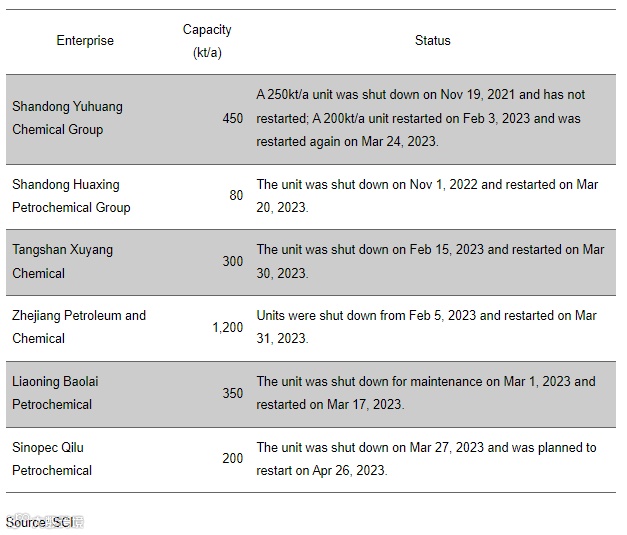
Entering March, styrene prices may first move up and then fall. In H1 April, styrene prices are likely to climb back by the anticipated inventory drop at main ports and increased international crude oil prices. However, medium and long-term market risks can not be ignored. Styrene output is expected to see an 11.92% M-O-M increase in April as some maintenance units are planned to restart and newly added units at PetroChina Guangdong Petrochemical and Zibo Junchen New Material are planned to be put into operation. Newly added PS and ABS units were put into operation from January to March, and their total capacity reached around 2,500kt/a. SCI reckons that styrene consumption will see a 4.68% M-O-M increment in April. Overall, the growth in styrene output may overpass that in styrene demand, so styrene fundamentals will possibly be weak.
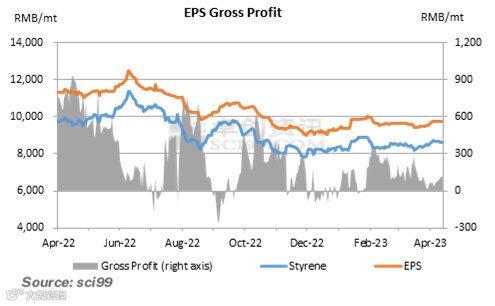
The growth in EPS demand failed to reach that in EPS supply
EPS demand was weak and failed to improve notably. EPS inventory showed an upward trend amid the mismatch between supply and demand. A couple of traders faced significant sales pressure. Entering February, EPS supply moved up gradually with the production resumption of EPS units after the Spring Festival holiday. Up to March, the EPS industrial operating rate reached over 50%. However, the demand underperformed. The recovery of downstream demand was slow.
In April, market players hold cautious attitudes toward EPS fundamentals. From the perspective of supply, some traders are expected to still face sales pressure amid ample supply. Market transactions should be concerned. Traders replenish inventory moderately and are active in cutting offers to promote sales. From the perspective of demand, the demand from the packing industry is tepid, and the overall operating rate in downstream industries is 50%-70%. The recovery of demand from the building insulation industry failed to meet expectations. Some downstream enterprises in Northwest China and Northeast China hold operating rates low. Downstream enterprises’ procurement fails to last amid tepid orders.
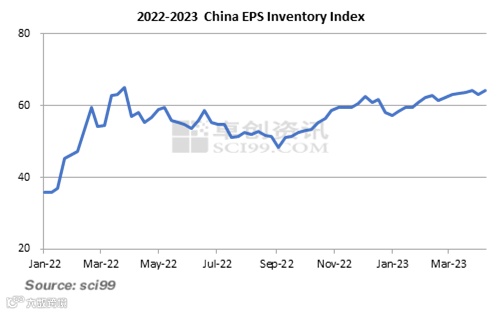
EPS market prices can hardly change significantly.
EPS market price may remain range-bound in April. First, the styrene market price fluctuates upwards temporarily but may weaken in H2 April. Second, there are uncertainties in the downstream demand growth. Downstream users show weak interest in purchasing and resist high prices. Market transactions are tepid. Moreover, some traders face sales pressure amid ample supply and lukewarm orders. In addition, players should pay attention to the changes in international crude oil prices and the commodity market.
All information provided by SCI is for reference only, which shall not be reproduced without permission.
Please click "Read more" for the full article.