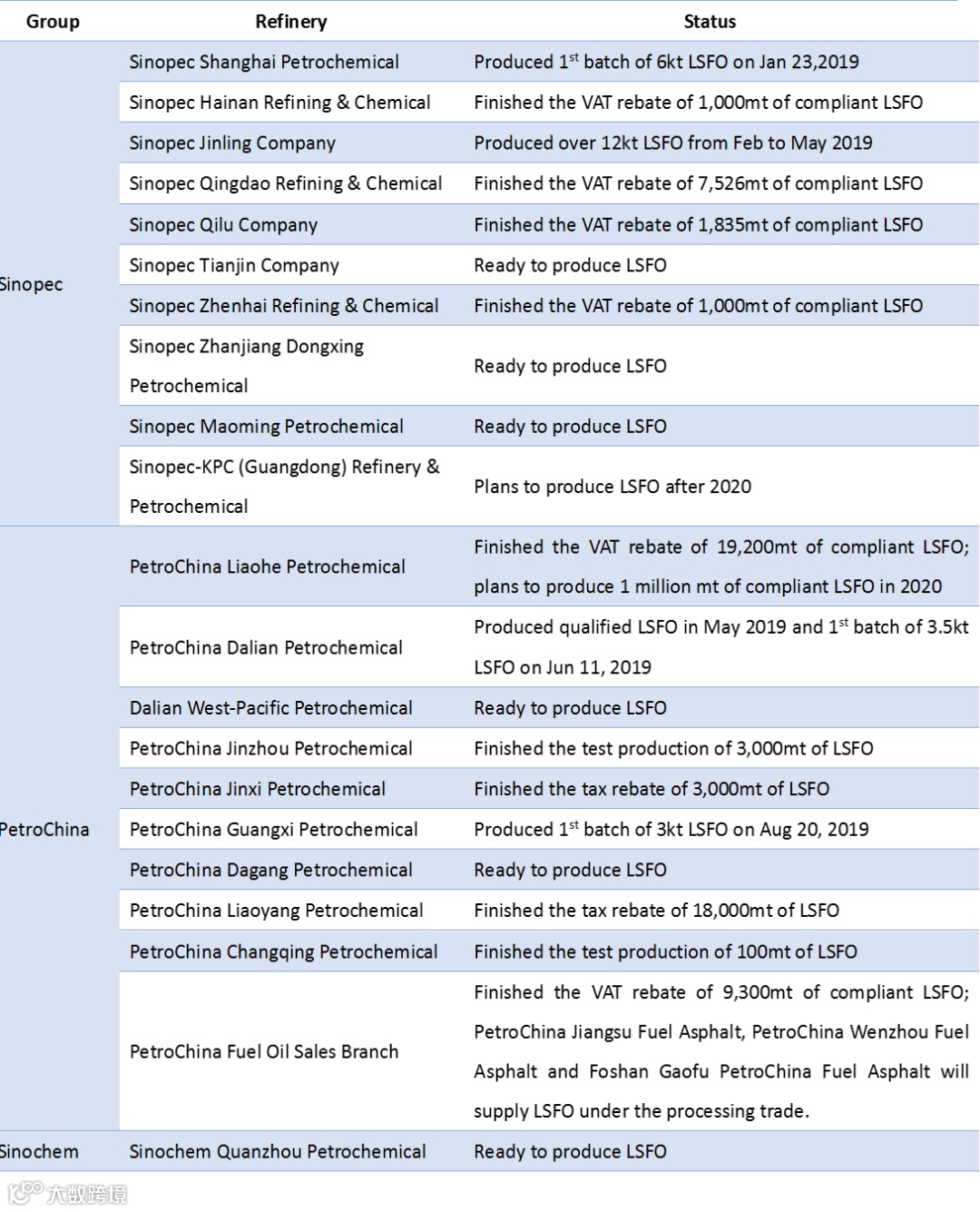
 Remarks: The above production statistics are based oninformation as of the beginning of April.
Source: China (Zhoushan) Bonded Bunker Monthly, Mar 2020
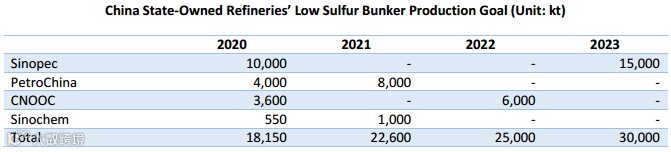
For refineries under PetroChina, PetroChina Liaohe Petrochemical would produce low sulfur bunker blending components via its CDUs, and that is the solution with the lowest production cost. CNOOC Ningbo Daxie Petrochemical, CNOOC Zhoushan Petrochemical and PetroChina International Company signed long-term export agreements. In February and March of 2020, Chinese refineries, including Sinopec Zhenhai, Sinopec Shanghai, Sinopec Jinling, PetroChina Liaohe, PetroChina Liaoyang, PetroChina Jinxi, etc., exported 185,000mt of fuel oil via Zhoushan.
There are three main channels to supply low-sulphur bunker. The first one is to produce low-sulphur bunker with low-sulphur crude oil. This solution will change the consumption structure of low sulfur crude oil grades. The second one is to use residue hydrogenation units to produce LSFO. This solution will influenced Chinese FCC units’ feedstock throughput and operating rates and then influence the output of gasoline, diesel and asphalt. The third one is to blend low-sulphur components.
It is expected that governments’ regulations on fuel oil export quotas will be similar to the regulations on gasoline and diesel export quotas. The second batch of non-state crude oil import quotas for 2020 were awarded last week by the Ministry of Commerce, with the total volume of 53.88 million mt. By now, the MOFCOM has awarded 157.71 million mt of non-state crude oil import quotas which was 8.29 million mt lower than the first batches for 2019. Current low crude oil prices benefit China’s independent refineries, and the independent refineries have high crude oil procurements. Some refineries are even pre-selling their products to keep sufficient capital for crude oil procurement. According to SCI, the complex crude oil refining margins at Shandong independent refineries averaged RMB 743.3/mt on April 15. In addition, some of the independent refineries use financial tools to avoid market sharp fluctuations and keep high profits. The second batch of crude oil import quotas for 2020 were issued about two months ahead of the issue time in 2019. This is regarded as a solution for governments to support the development of China’s independent refineries and allow the independent refineries to cope with the impacts from the coronavirus outbreak more flexibly.