



On January 22 China announced the value added tax rebate on fuel oil exports, and the value added tax rebate has been started since February 1. On February 14, the first batch of VLSFO which was produced by PetroChina Liaohe Petrochemical was exported with the tax rebate. And then, more and more refineries are preparing for the production of VLSFO, because the value added tax rebate policy significantly raises refineries’ production profits.
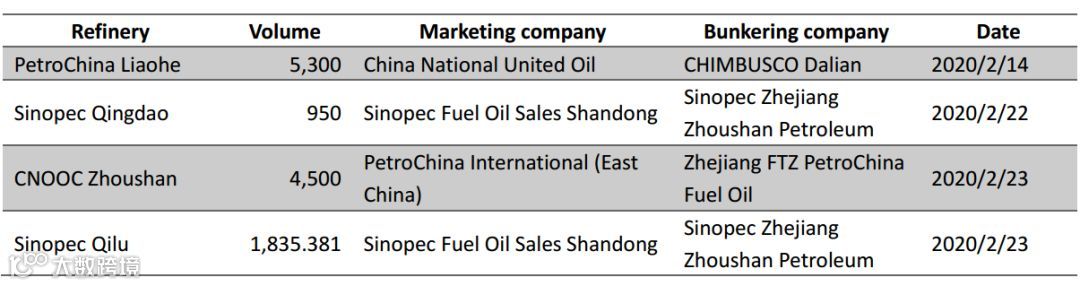 Besides, some private refineries are also actively preparing for the production of VLSFO, such as Hengli Petrochemical, Zhejiang Petroleum and Chemical, Shenchi Chemical and Lijin Petrochemical. Sources say that Zhejiang Petroleum and Chemical will sell its VLSFO to CHIMBUSCO. The value added tax rebate policy encourages more refineries to produce fuel oil for exports. According to PetroChina Liaohe Petrochemical, Liaohe Petrochemical would receive 2 million RMB from the tax rebate of its 5,300mt of fuel oil.
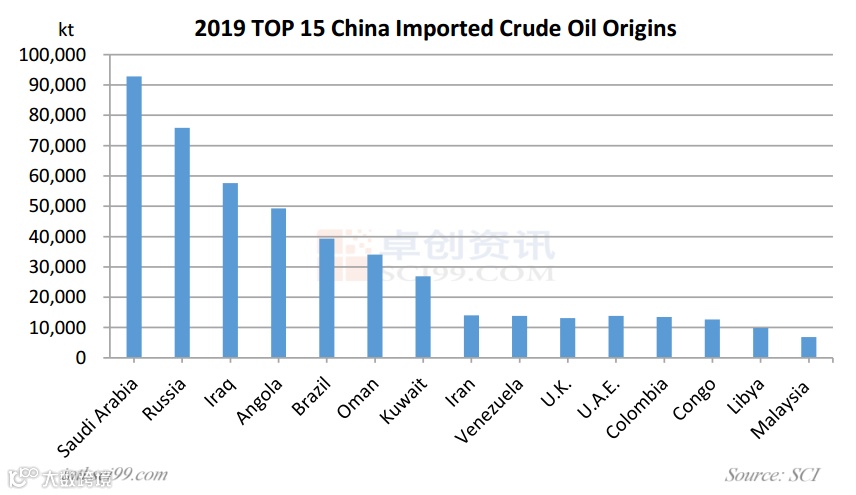
China enjoys advantages of VLSFO production. First, currently, China’s annual crude oil output is around 200 million tons, and nearly 80% of the crude oil is low-sulphur crude oil. Therein, the crude oil produced in Daqing, Liaohe, Xinjiang, etc. is ultra-low-sulphur crude oil. Moreover, the sulphur content in China’s imported crude oil from Russia is relatively low as well. Therefore, China’s LSFO production enjoys significant advantages in production scale and feedstock cost.
 Second, China’s hydrogenating capacity is excessive, and the capacity can be used in residual oil hydrodesulphurization to produce LSFO. It is easy for many middle and small scale refineries to produce marine fuel oil and marine diesel oil. Third, by producing bonded LSFO and MGO, the overcapacity in China’s oil refining industry will be relieved. Moreover, it is an important step to promote structural reforms in the supply side of the industry, optimize product and market structure, increase processing margins at refineries and reduce environmental pollution. Fourth, with the use of excessive capacity, China’s bonded marine fuel oil supply will no longer completely rely on the imports. That will reduce the logistics cost at China’s shipping companies and help China to become an important LSFO refueling center in the world.
