

Ivory Board Market Saw More Drops Than Rises in Q1 and May Hit the Bottom in Q2
Intro: In Q1, the ivory board market saw more drops than rises, and the industry profits were weak. After the Spring Festival holiday, paper mills actively attempted to raise prices. However, market demand recovered slowly, and the supply pressure remained high. The market trend was dominated by supply-demand fundamentals. In Q2, the market will enter a traditional demand slack season, and the supply-demand imbalance may become more prominent. The ivory board prices will probably gradually hit the bottom.
The market growth rate was lower than expected, and the overall price was in a 5-year bottom
In Q1, the ivory board market saw more drops than rises, and the quarterly average price dropped. According to SCI, the ivory board average price was RMB 4,761.89/mt in Q1, down 2.77% from Q4 of 2023 and 6.74% Y-O-Y. The market trend was mainly affected by the supply-demand imbalance caused by continuously released capacity and insufficient demand. Before the Spring Festival holiday, some market sellers cut profits to entice sales, so prices edged down in January. In February, the market was in a recovery stage, and the prices were stable. In March, with the recovery of market trading, downstream players showed more restocking demand, and paper mills raised prices by RMB 200/mt. Traders also attempted to uplift prices. However, downstream orders were insufficient, so the market price increase was neither implemented nor sustained as expected. The market prices corrected downward in H2 of March. Overall, from January to March, the average price was below the lowest level in the past five years. The market trended under pressure amid the oversupply situation.
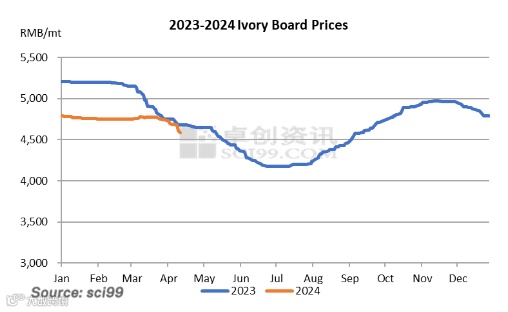
Supply-demand imbalance was aggravated amid strong supply and weak demand
Supply decreased Q-O-Q and increased Y-O-Y. In 2023, the 2,000kt/a of new ivory board capacity was put into production, laying the foundation for a strong supply situation in early 2024. With the continuous increase in paper mills’ operating rates, output also increased and market competition intensified. In Q1, the cumulative output of ivory board was 2,944.2kt, up 22.83% Y-O-Y. Affected by the Spring Festival holiday, some production lines were shut down for maintenance in Q1, resulting in a slight decline of 1.80% in output compared with Q4 of 2023.
Affected by the Spring Festival, demand in Q1 weakened Q-O-Q. Driven by the gradual recovery of the domestic consumption environment and the continuous increase in output, ivory board consumption was expected to increase by about 22.04% Y-O-Y in Q1 of 2024. However, from a Q-O-Q perspective, as most downstream customers took holidays during the Spring Festival and market demand recovered slowly after the holiday, consumption in Q1 fell by about 15.95% compared with Q4 of 2023.
It can be seen that in Q1 of 2024, the supply and demand of ivory board showed a simultaneous downward trend on a Q-O-Q basis, but the decrease in demand was slightly larger, and the market supply and demand pressure increased. From a Y-O-Y perspective, the supply increase was greater than the consumption increase. As market competition pressure increased, the ivory board prices moved down.

Industry profitability was poor, and paper mills’ price hikes had limited boost
In Q1 of 2024, the profit level of the ivory board industry first increased and then decreased, and the quarterly average gross profit rate increased overall. According to SCI, the average gross profit rate of ivory board in Q1 was -2.86%, an increase of 1.63 percentage points from Q4 of 2023. Although the average quarterly price of ivory board fell Q-O-Q, it was lower than the cost reduction, so the industry’s gross profit rate was slightly restored. However, the overall profitability of the industry was poor, and paper mills were relatively resolute in raising prices, which played a certain supporting role in the phased rise in prices in early March. Overall, the market trend was greatly affected by the supply and demand fundamentals, and the negative effects of the supply-demand imbalance had a clear diluting effect on the positive effects of paper mills’ price hikes.
The supply-demand imbalance is unlikely to alleviate in Q2, and ivory board prices may fall
Key Market Driver Assessment
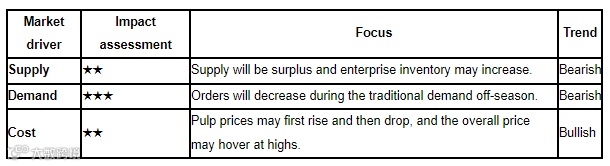
In terms of demand, the market will enter the traditional off-season in Q2, and there will be a seasonal downward trend in demand. The weakening of market orders has a greater impact on the market. Due to the increased sales pressure, paper mills may cut profits to sell to ensure their market share. At the same time, traders will become more risk-conscious, and they will continue to reduce prices to accelerate the destocking pace.
In terms of supply, newly added capacity will come online in Q2, and supply pressure will increase. There will be 300kt/a capacity of new units going to trial production at the end of April in Guangdong. Since the new capacity is mainly positioned as food-grade ivory board and high-end packaging paper, the impact on the commodity-grade ivory board market may be limited. However, as the impact on the food-grade ivory board field increases, this will also indirectly increase the supply pressure on the overall domestic ivory board market. Coupled with the recent increase in paper mill inventories and traders’ abundant resources, the oversupply situation will still be obvious.
In terms of costs, there is still bottom support for the ivory board market in Q2. Specifically, the main feedstock wood pulp prices may first increase and then decrease. However, compared with the price of ivory board, the cost will remain at a relatively high level, and there is still a certain bottom support for paper prices. The wood pulp market prices are predicted to fluctuate upwards supported by favorable factors such as narrowing supply, increasing demand, and rising import prices. However, the profits of domestic paper industries are weak, and they intend to press down the purchase prices, which may hinder the continuation of the rise in pulp prices.
Taken together, the ivory board market will enter the demand off-season in Q2, and supply pressure will become more prominent. The market is more likely to decline under pressure, and ivory board prices are expected to bottom out from April to June. As cost pressures are not alleviated significantly, industry profits are unlikely to improve significantly, which may restrict the decline in paper prices.
All information provided by SCI is for reference only, which shall not be reproduced without permission.
Please click "Read more" for the full article.