
China Oil Products Demand to Reach Over 342 Million Tons in 2024
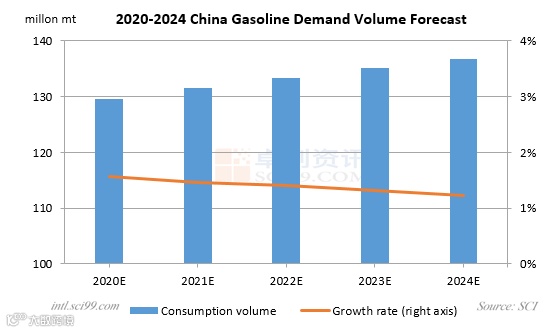 In recent years, China’s vehicle industry development slowed down, with the new sales volume softening. However, the vehicle parc will remain in an uptrend in the next five years, so the demand volume of gasoline will continue to increase, but the growth rate will decline. It is predicted that China’s vehicle par will reach 280 million in 2020, up about 8% Y-O-Y. In addition, the subsidy policy for new energy vehicles will end after 2020, which will curb the development of new energy vehicle industry. However, the implement of the Parallel Management Method of Average Fuel Consumption Limit of Passenger Vehicle Enterprises and New Energy Vehicle Points will support the development of new energy vehicles from the policy side. It is predicted that China’s new energy vehicle parc will surpass 4.5 million in 2020, up 27.7% Y-O-Y. Overall, China’s gasoline demand growth will slow down. In 2020, the gasoline demand volume is estimated to reach 130 million mt, up 1.57% Y-O-Y, and the proportion of the demand volume from vehicles will rise to 91.0%. The proportion from the motorbike industry is estimated at 4.6%, and the proportion from other fields will decline to 4.4% accordingly.
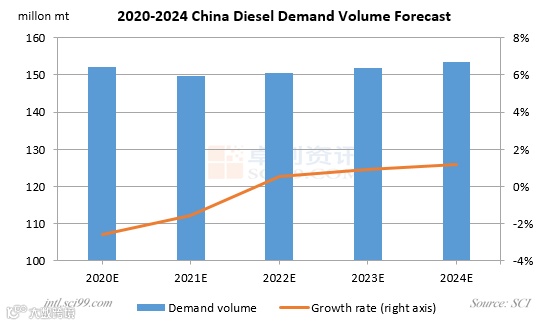 In 2020, China’s 13th Five-Year Plan will come to an end, and the 14th Five-Year Plan will be released. Thanks to the gradual easing of monetary policy and the steady growth of the real estate market, China’s economy could maintain a stable growth trend in the next five years. However, China’s economy will continue to be under pressure both at home and abroad, with the possibility of a further slowdown. China’s GDP growth rate is expected to be infinitely close to 6.0% in 2020, and the quarterly growth is likely to fall below 6%. In the next five years, China’s diesel demand may gradually improve due to the supply-side structural reform and the adjustment of domestic industrial structure. In addition, the Three-Year Action plan for Promoting the Adjustment of Transport Structure (2018-2020) is under steady progress, and the transportation of bulk goods will shift to the direction of railway and waterway transportation. This may curb the diesel demand to some extent. On the whole, SCI predicts that the diesel demand volume will be about 152 million mt in 2020, down 2.56% Y-O-Y. As for demand structure, the proportion of demand volume from transportation & storage & post fields will be 66.7%, and that from the industry field will be 8.1%.
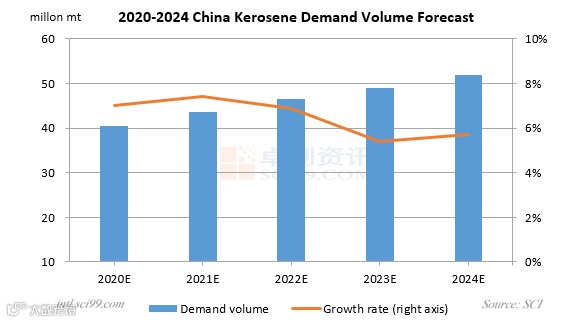 Due to the product feature of kerosene, theaviation field will remain as the major consumption field of kerosene in thenext five years. China has been reinstating aviation fuel surcharges for ayear, and the impact on the demand for jet fuel has weakened gradually. In thenext five years, China’s aviation industry will continue to develop steadily,so the demand for kerosene will also increase, but the growth rate could slipslowly with the base number enlarging. According to the 13th Five-Year Plan forthe Development of Civil Aviation in China, by 2020, the passenger turnovershall account for 28%; the total turnover of transport, passenger transport andcargo & mail transport shall reach 14.2 million ton-km, 720 million and 8.5million mt, increasing by 10.8%, 10.4% and 6.2% respectively. In addition, by2020, the six major airport clusters in Northeast China, North China, EastChina, Central and Southern China, Southwest China and Northwest China shall beimproved with more than 50 airports, and about 260 transportation airports andover 500 general purpose airports shall be built. SCI estimates that China’skerosene demand volume will total 40.50 million mt in 2020, up 7.03% Y-O-Y. Theproportion of the demand from the aviation field will rise to 91.18%, and theproportion from the industry and other fields will decline to 5.3% and 3.5%respectively.
Please click "Read more" for more information
Due to the product feature of kerosene, theaviation field will remain as the major consumption field of kerosene in thenext five years. China has been reinstating aviation fuel surcharges for ayear, and the impact on the demand for jet fuel has weakened gradually. In thenext five years, China’s aviation industry will continue to develop steadily,so the demand for kerosene will also increase, but the growth rate could slipslowly with the base number enlarging. According to the 13th Five-Year Plan forthe Development of Civil Aviation in China, by 2020, the passenger turnovershall account for 28%; the total turnover of transport, passenger transport andcargo & mail transport shall reach 14.2 million ton-km, 720 million and 8.5million mt, increasing by 10.8%, 10.4% and 6.2% respectively. In addition, by2020, the six major airport clusters in Northeast China, North China, EastChina, Central and Southern China, Southwest China and Northwest China shall beimproved with more than 50 airports, and about 260 transportation airports andover 500 general purpose airports shall be built. SCI estimates that China’skerosene demand volume will total 40.50 million mt in 2020, up 7.03% Y-O-Y. Theproportion of the demand from the aviation field will rise to 91.18%, and theproportion from the industry and other fields will decline to 5.3% and 3.5%respectively.
Please click "Read more" for more information

For more information please contact us at
overseas.sales@sci99.com
overseas.info@sci99.com
+86-533-6090596



 SCI99
SCI99