

Intro: The COVID-19 situation is still spreading in Brazil. Brazil is the largest merchant pulp producers in the world, and its pulp production is crucial to the stability of global pulp supply. With import and export data being exposed, myths regarding Brazilian pulp supply are clarified.
Brazilian pulp supply rose despite the spreading COVID-19 outbreak.
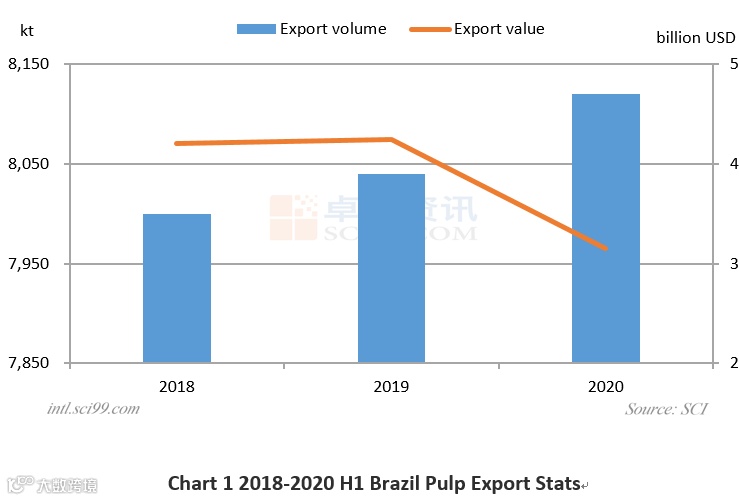
Pulp export price decreases constantly, but pulp mills’ profit is still decent
With the pulp export volume on the rise, the total export value decreases as the average export price comes down to $386/mt, down 29% Y-O-Y. Market participants are concerned about Brazilian pulp mills’ enthusiasm in production due to the falling pulp price. However, based on the Q1 financial reports released by major pulp producers in Brazil, due to the depreciating Brazilian Real, the export profit is still fairish in the short term. In Q1, the pulp cash cost of Suzano is BRL 596/mt, and the gross profit rate is around 46%; the cash cost of Klabin in the same period is BRL 693/mt, and the profit rate is around 40%. Therefore, the diminishing enthusiasm of Brazilian pulp mills in pulp production due to falling prices is a myth, while the fairish profit resulted from optimizing production processes combined with depreciating Brazilian Real is a fact.
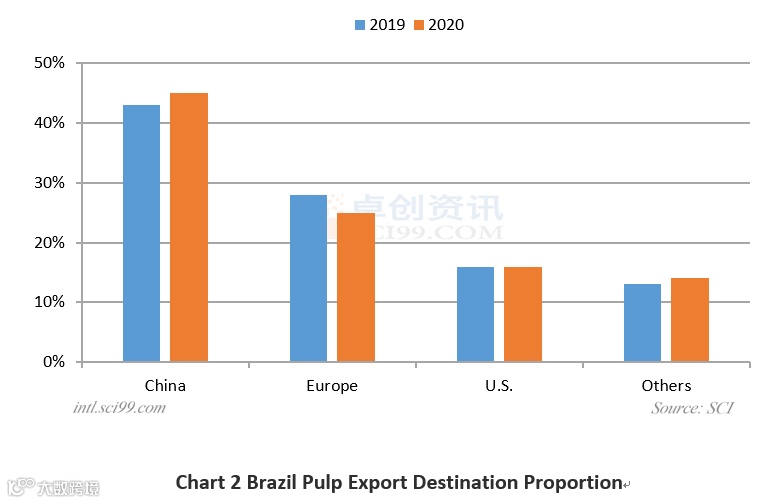
During the early stage of the global pandemic, news of toilet paper buying frenzy constantly appears frequently on media reports in Europe and North America, and Brazil has briefly diverted some of its attention to the European Market. However, as the COVID situation in China is quickly under control while the outbreak continues to spread in western countries, the focus of Brazilian pulp producers has shifted back to China. As seen in Chart 2, the proportion of pulp shipment from Brazil to China rises by 2% to 45% in H1 of 2020, while that to Europe drops by 3% to 25%. The main reason behind the demand drop in Europe is the graphic paper market slump. According to the data from EURO-GRAPH, the graphic paper demand of Europe is 6,983kt during the first 4 months of 2020, down 13.8% Y-O-Y. Even though the demand surged in the tissue paper section, it is short-lived. As it is shown in Chart 3, the operating rates of Chinese paper producers have stayed at a relatively stable level, leading to a constant pulp consumption. Thus, the pulp demand growth in Europe and North America may be a myth, but Brazilian pulp producers’ focus shifts to China is a fact.