

June Tissue Prices Likely to Inch Up
Intro: In May, China’s tissue market prices sustained an uptrend, and supply and demand improved limitedly. For the June market, it is advised to pay attention to tissue mills’ operating rates, cost changes, and tissue mills’ sales status in the mid-year shopping fest. It is predicted that tissue prices may maintain slight growth amid higher costs and the tug-of-war between sellers and buyers.
Tissue average price maintained an upward trend in May.
In May, China’s tissue average price continued to rise. As of May 31, the monthly average price of tissue was RMB 6,575/mt, up 0.71% M-O-M. In H1 of the month, affected by the May Day holiday, some tissue mills cut or halted production, resulting in tightened market supply. As a result, tissue prices in northern China inched up, and prices in southern China were relatively stable. In H2 of the month, tissue mills that were under shutdown and maintenance in Southwest China gradually resumed production, enhancing the market supply. So, tissue prices in Sichuan and Chongqing slightly moved down. As of May 31, the bamboo jumbo roll price in Sichuan and Chongqing was RMB 6,700/mt, down 0.74% M-O-M. In northern China, tissue prices continued to increase due to rising costs and unimproved operating rates. As of May 31, the wood pulp jumbo roll prices in Hebei and Shandong were RMB 6,750/mt and RMB 6,700/mt respectively, both up 0.75% M-O-M.
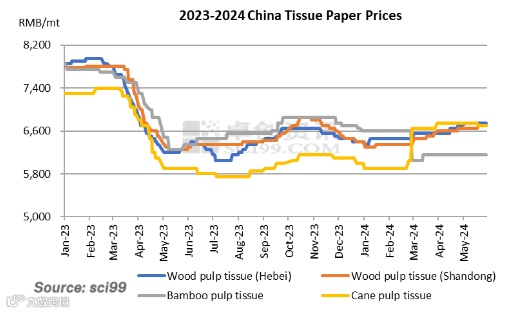
Looking ahead to the tissue market in June, it is advised to pay attention to the following aspects.
Cost: As of May 31, the tax-inclusive cost of wood pulp tissue was RMB 7,555/mt, up 2.23% M-O-M. However, the wood pulp tissue prices saw a limited increase, and the gross profit rate continued to decline to 0.32%, down 0.81 percentage points M-O-M. Currently, some tissue mills suffer weak profits or profit losses, and the cost fluctuations have a big influence on tissue prices. In June, the new round of HWP import offers continue to rise by $30/mt, giving swings to the spot pulp prices. As a result, tissue mills suffer heavier cost pressure, supporting tissue prices, and some medium and small-sized tissue mills may still attempt to raise prices.
Supply: In late May, tissue mills’ inventory gradually declined, but the downtrend was limited. In June, the rising costs may continue to hinder some tissue mills’ production enthusiasm. Some medium and small-sized tissue mills will probably continue to maintain a medium operating rate level, and medium and large-sized tissue mills have no maintenance schedules. The tissue output is likely to be relatively stable, giving no apparent support to the market.
Demand: Downstream converters’ orders decreased in April, and the market stayed in an inventory consumption period in May. Finished tissue goods prices lacked upward momentum, and some converters suffered weak profits. Therefore, downstream converters show limited stocking interest in the mid-year shopping fest, giving insufficient demand support. After the shopping fest, the finished goods inventory will be consumed somewhat, and downstream converters may purchase adequately.
In June, tissue supply may remain loose amid steady output, and downstream converters may purchase adequately, so the supply and demand fundamentals may slightly fluctuate. Pulp spot prices hover at highs, enhancing actual costs on tissue mills. It is predicted that tissue prices will likely continue to inch up in June.
All information provided by SCI is for reference only, which shall not be reproduced without permission.
Please click "Read more" for the full article.