

2024 Commodity Market Analysis and Outlook
Q1 is coming to an end. Commodity market continues the trend in Q4 of last year. The main driving logic of the market has not changed. Judging from SCI Commodity Price Index, Industrial Products Index or Agricultural Products Index, as of March 8, they all closed down year-on-month. Commodity Price Index, Industrial Products Index and Agricultural Product Index fell by 8.99%, 8.13% and 11.08% year on year respectively compared with in 2023.
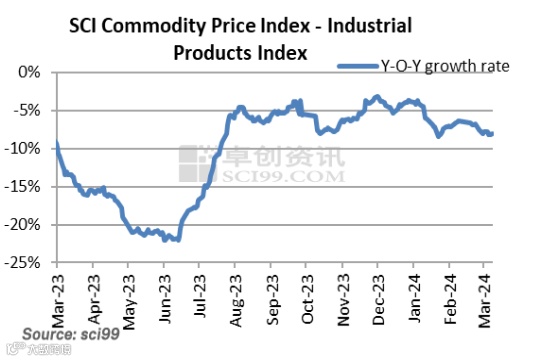
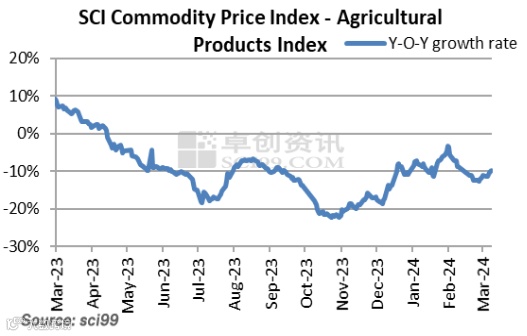
Commodity prices stay low in Q1
Seen from the reasons behind the trend, the market is mainly affected by the gap between expectations and reality, or the state of being worse than expected after comparison between strong policy expectations in the early stage and weak feelings.
In terms of industrial products, since January, black commodities have contributed the most to the decline. As of last weekend (March 8), coking coal and coke had fallen by more than 15% from early 2024 and by 18% and 12% year on year respectively compared with last year. The prices of some building materials are also in a downward trend. In some industries, more than 40% of all players are suffering losses. Manufacturing companies have the strong will on price upturn. Some companies have set a baseline for price settlement in the hope of following the principle of "raising prices when prices are rising but holding prices steady when prices are falling" (i.e. prices above the baseline are effective for settlement but prices below the baseline are replaced by the baseline for settlement) in March using the baseline as a reference.
Seen from industrial products to petrochemicals, according to the Petroleum & Chemical Industry Prosperity Index data jointly issued by SCI and the China Petroleum and Chemical Industry Federation, in January 2024, the industry continued its prosperity recovery trend, rising in prosperity; but in February, as production slowed during the Spring Festival, the Prosperity Index fell.
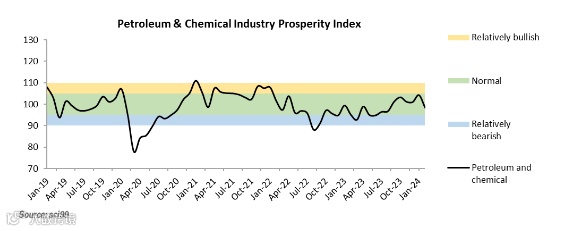
The manufacturing industry is restricted by a number of factors: On the one hand, since December 2023, new orders placed with some companies have reduced. As the Spring Festival approached, an increasing number of companies shut down for the Festival. Some companies stopped production earlier than in previous years but resumed work later than usually. Industry operating rate dropped for various reasons. Secondly, due to cold waves and snowfall in January and February, transportation was restricted to some extent. Inventory turnover in companies declined. In March, as the temperature are rising, outdoor construction for housing projects restarts and infrastructure projects increase, which will drive the recovery of related commodities. The Petroleum & Chemical Industry Prosperity Index is expected to rebound in March 2024. Close attention should be paid to further news from the Federal Reserve as well as the impact of geopolitical uncertainties on petroleum and chemicals.
From the perspective of agricultural products, as various agricultural products are in abundant supply in China, their prices are unlikely to rise in the future. Besides, weaker demand than expected even after improvement is also one of the important constraints. Looking at global markets as a whole from January to February, both food prices and grain prices were on a downward tendency. In animal husbandry, in Q1, swine prices fluctuated slightly due to reduced production capacity in some regions as a result of severe losses in the previous year and the move to put re-fattened swine on the market to save some. However, supply and demand are not optimistic in the future: give the pressure from swine to be slaughtered on supply in the market as well as deferred storage of frozen poultry, market prices are less likely to keep rising in the event of an imbalance between supply and demand.
For all commodities as a whole, as there was a lack of objective data for guidance due to delayed release of macro data in Q1 (most macroeconomic data from January to February were released in March), market players were more driven by "events or data". Prices were highly volatile. Based on their own perceptions, market players were even less confident in the future market. At this time, the temperature difference effect might be more obviously reflected.
Focus on the future. It is expected that commodity prices will most likely be in an upward trend
Intensively released policies in Q1 have a leading role in supporting confidence and stimulating consumption throughout the year. Overall, amid interest rate cuts by the Federal Reserve during the year and improvement in the domestic capital market, it is expected that commodity prices will most likely be in an upward trend during the year.
Looking at those factors influencing trends throughout the year, the current market is primarily concerned about keywords including "two sessions", "policies", "consumption", and "market confidence". The 2024 government work report set China's economic growth target at around 5% and CPI target at 3% for the year, to the extent of underpinning the overall market.
Involution in the automobile industry continues to exist. Profit margins are declining year by year. For NEV companies, the first priority for survival or development is improving profitability, which depends on rising output and sales. Therefore, in the cycle of "output/sales - price - profit", price cuts have become the only solution now for promoting sales and production.
Even so, from the full-year policy perspective, policy highlights presented in Q1 are not lacking in support for improving commodities throughout the year. One good example is that on March 13, the State Council issued the Action Plan for Promoting Large scale Equipment Renewal and Trade in Consumer Goods. As the policy requirements are being implemented, market confidence has gained support to some extent. It is probable that some commodities will have their prices rising. As noted in the plan, a large number of basic materials, such as various types of steel, plastics, rubber, copper and aluminum, will be used in infrastructure renovation, recycling of home appliances, or production equipment or energy-saving equipment in various industries, resulting in lots of demand. It is expected that the steel industry will directly benefit, and copper is very likely to rise in H2 2024. As to the aluminum industry, attention should be paid to the entry of Russian aluminum into China, an event that may lower aluminum prices. As policies are implemented gradually in Q2 & Q3, there may be ups and downs in the process, including production capacity reduction and carbon peaking and carbon neutrality, with different regional characteristics. Also given factors such as employment, tax, and cash flows, which are very important to local governments, it is expected that all sides will compete with each other. Overall, how various policies are implemented, how they boost the overall demand for commodities and how they work out on the market need to be initially verified in Q3.
As to energy, the overall cost core of crude oil is expected at $80/barrel throughout the year. Oil prices will basically stand at around $75-79/barrel in Q2, rise in Q3, but may face other uncertainties in Q4. The key factors are reflected in the following aspects: on the demand side, the demand in the U.S. and Europe is looking good, and China's travel consumption is also considerable. Overall demand is improving, but supply is tight. In addition, Red Sea geopolitics has led to tighter transportation capacity and higher costs. The U.S. election is another focus of concern. Once Trump takes office again, there is a high possibility that tax rates will rise. Overall, new uncertainties may increase in Q4.
In agricultural products, taking hogs as an example, in Q2, the market cost core is rising slowly and less likely to rise in a large quantity. Given that the production capacity for broilers and eggs is at a historically high level, their consumption can substitute for pork consumption. Taken together, market prices generally go up in Q2, and are expected to reach a yearly high in Q4.
To sum up, commodity prices may first drop and then rise throughout the year. Q2, 2024 is expected to be at an important, critical stage when policies come into force, but how well they work remains to be verified in Q3. It is expected that commodity prices will most likely have an upward tendency in H2.
All information provided by SCI is for reference only, which shall not be reproduced without permission.
Please click "Read more" for the full article.