

China Calcium Carbide Market Overview&Forecast
Preface: In 2023, China’s calcium carbide supply was stable-to-rising. Semi-coke prices fell, dragging down the cost. The main downstream PVC industry was in the doldrums, showing weak demand for calcium carbide. Therefore, calcium carbide prices moved down. In 2024, the supply and demand of calcium carbide may both increase. Calcium carbide prices will likely dip amid oversupply. In the second half of 2024, if matched downstream projects are put into operation and PVC powder prices go up, the calcium carbide price will be supported.
Calcium Carbide Annual Key Indicators
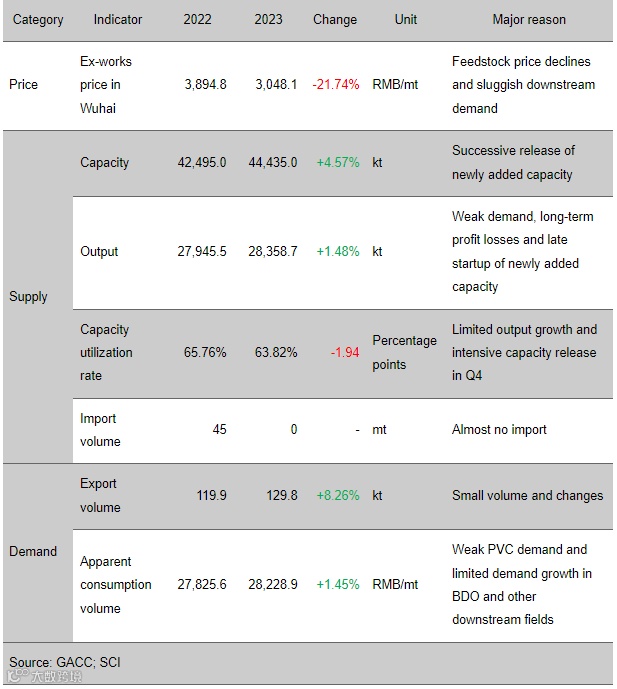 Calcium carbide prices moved down due to oversupply and declined costs.
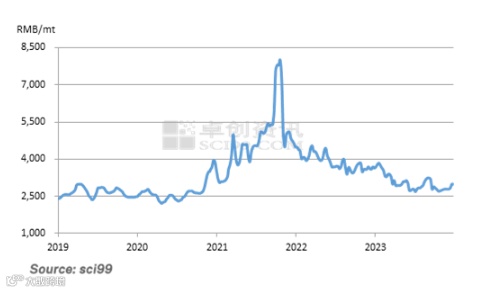
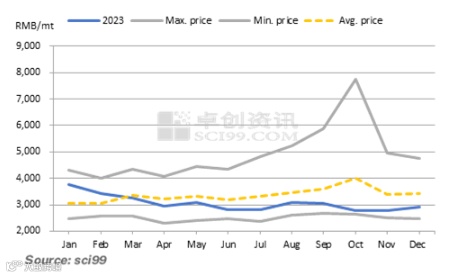
In 2023, with the continuous decline in upstream coal prices and underperformance of downstream industries such as the PVC industry, the price of calcium carbide continued to decline. In early July, it fell to the lowest level since 2021. After Q3, prices began to fluctuate upwards, but the average price remained low. According to SCI, in 2023, the average EXW price of calcium carbide in Wuhai was RMB 3,048.09/mt, down 21.74% from 2022.
Specifically, the price of calcium carbide continued to decrease before slightly rebounding in the first three quarters. It reached a high point in mid-January and then declined, hitting the lowest point of the year in early July. This was mainly because the price of the main downstream product PVC continued to drop, low operating rates led to poor demand, and the demand further declined during concentrated turnarounds. Therefore, the supply-demand imbalance was notably seen. Additionally, declines in the price of feedstock semi-coke also accelerated the downtrend of the calcium carbide price. In Q3, prices fell again after fluctuating upwards. The upward trend was mainly due to the continuous rebound in the price of feedstock semi-coke, which increased the production cost of calcium carbide. Furthermore, the concentrated PVC unit turnarounds came to an end, but around August, the calcium carbide operating rates were low, and the market faced a supply shortage, driving prices up. From September to early November, the supply shortage situation improved, with continuous ample supply and unstable demand, so the price declined again and gradually returned to the lowest level within the year. From mid-November, calcium carbide operating rates decreased, and the demand slightly recovered. In addition, power supply instability in Inner Mongolia and Ningxia in December caused a decrease in output, and the snowy weather affected transportation, so calcium carbide prices continued to rise, with the ex-works price returning to RMB 3,000/mt.
2019-2023 China Calcium Carbide Price
2023 Calcium Carbide Price and 5-Year Price Comparison
Calcium carbide output rose Y-O-Y with the new capacity release.
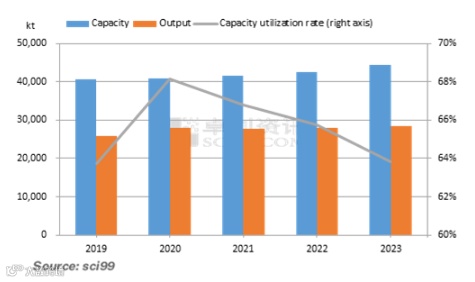
From 2019 to 2023, the calcium carbide market first saw oversupply, and then the supply and demand shifted to a tight balance. Afterwards, the tug-of-war between supply and demand became severe again. After both prices and profits broke historical records in 2021, the release of newly added calcium carbide capacity accelerated. Additionally, some integrated projects had their calcium carbide come online earlier than the matched downstream PVC and BDO units. Coupled with the fact that the main downstream PVC industry has been weak since H2, 2022, the supply and demand relationship for calcium carbide is fragile, leading to a continuous decline in price since H2, 2022. In 2023, newly added calcium carbide capacity reached 2,420kt/a, and some small units or those that had been shut down for a long time with a total capacity of 550kt/a were eliminated. Capacity reductions due to upgrades or internal capacity replacement amounted to 220kt/a. Some enterprises’ capacity adjustments involved an increase of 290kt/a. Ultimately, China’s designed calcium carbide capacity reached 44,435kt/a in 2023, up 1,940kt/a or 4.57% Y-O-Y.
In 2023, the calcium carbide prices ratcheted down. Thus, producers suffered profit losses for most of the year and even experienced more severe losses. Under this drag, the operating rates at producers in production continued to decline, with some producers remaining offline throughout the year or maintaining low operating rates. Additionally, new capacity went into production intensively in end-Q3 and Q4 of 2023, which collectively lowered the annual level. The capacity utilization rate of the calcium carbide industry in 2023 was at 63.82%, a decrease of 1.94 percentage points from 2022, marking the lowest level in the past four years. New projects came online intensively in end-Q3 and Q4 of 2023, contributing little to the total output. According to SCI, based on non-full sample data, the calcium carbide output in 2023 was 28,358.7kt, a Y-O-Y increase of 1.48%, with a five-year CAGR of 1.69%.
2019-2023 China Calcium Carbide Capacity, Output and Capacity Utilization Rate
As the operating rate of the main downstream PVC industry dipped, calcium carbide demand was in the doldrums.
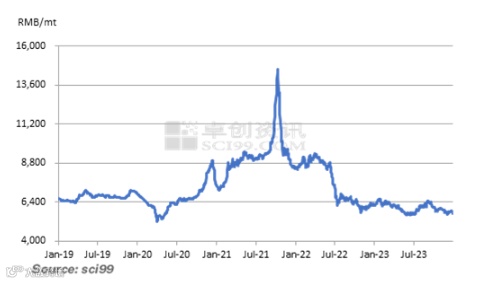
In 2023, the PVC powder market faced challenges. Some new units were put into operation, while the demand recovery failed to meet expectations. As the inventory remained high amid oversupply, PVC powder prices hovered at historical lows, and profits at enterprises shrank constantly. In this instance, calcium carbide-based PVC enterprises cut operating rates or held operating rates low for the long term, dragging down the calcium carbide demand.
2019-2023 China PVC Powder Price
2022-2023 China Calcium Carbide-Based PVC Powder Operating Rate

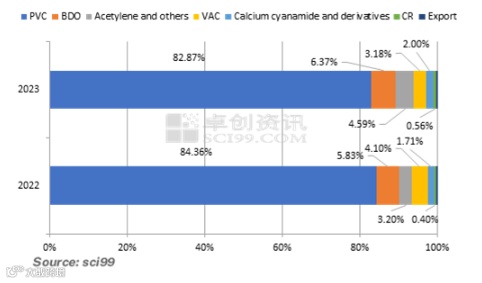
The calcium carbide-based PVC powder industrial operating rate moved, and the PVC paste operation was unstable. In 2023, the calcium carbide demand from the PVC industry dropped by 1.49 percentage points to 82.87%. New BDO units were put into operation in 2023, so the demand from the BDO industry increased by 0.55 percentage points to 6.37%, but it failed to support the calcium carbide market notably.
2022-2023 Calcium Carbide Downstream Consumption Proportion
The PVC market was sensitive to changes in calcium carbide prices amid severe profit losses.
Profit losses at PVC powder producers who outsourced calcium carbide intensified in 2023. The average profit at PVC powder producers who outsourced calcium carbide in Shandong was RMB -710/mt, down RMB 306/mt.
Caustic soda prices saw a downward trend in 2023. Taking the 32% ionic membrane caustic soda market in Shandong as an example, the average price was RMB 842.15/mt, down 22.33% Y-O-Y. In addition, liquid chlorine prices hovered at lows. Thus, the profits of chlor-alkali units underperformed. The profit at chlor-alkali enterprises that are matched with their own power plants in Shandong was RMB 76.22/mt, down 90.76% Y-O-Y. The profit at chlor-alkali enterprises that are not matched with power plants in Shandong was RMB -283.59/mt.
The integrated profit at chlor-alkali enterprises dropped notably and remained negative for a time. Chlor-alkali enterprises were more sensitive to changes in calcium carbide prices amid higher cost pressure. Once their feedstock arrivals were ample, they cut purchasing prices to ease cost pressure, which weighed on the calcium carbide market.
Semi-coke prices moved down, dragging down the cost, but profit losses from producing calcium carbide intensified.
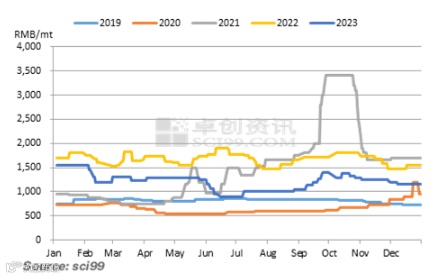
In 2023, amid declining coal prices and the continued poor performance of the downstream calcium carbide industry, the price of semi-coke trended down and then moved sideways. In Shaanxi, the ex-works price of medium-grade semi-coke initially dropped from RMB 1,550/mt to RMB 900/mt in June, then rose again to RMB 1,300/mt driven by an uptick in coal prices, before falling to around RMB 1,150/mt. In 2023, the annual average price was RMB 1,212/mt, down 27.4% from 2022. The average production cost of calcium carbide dropped by RMB 365.9/mt, thereby causing the bottom price of calcium carbide to continuously move downward beyond the initial market expectations.
2019-2023 Semi-Coke Price Trend
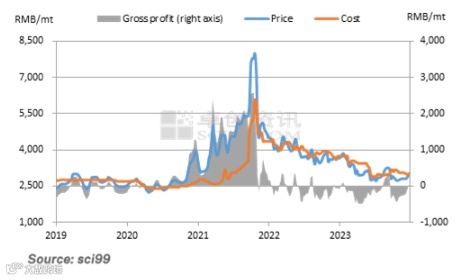
In 2023, although the costs related to calcium carbide production, such as electricity prices and semi-coke prices, declined, the demand continued to be weak, and the industry surplus persisted. The selling price of calcium carbide continuously dropped to a relatively low level in recent years, leading to profit losses in the calcium carbide industry for most of the year, with the maximum loss exceeding RMB 400/mt. Data from 2023 shows that, taking Wuhai as an example, the theoretical gross profit of calcium carbide enterprises was RMB -178.34/mt, down 74.19% from 2022.
2019-2023 China Calcium Carbide Gross Profit
China calcium carbide prices are likely to go down in 2024.
The main drivers for the calcium carbide market in 2024 are supply, demand, feedstock costs and the PVC price. It is expected that the supply growth will be larger than demand growth in the first half of 2024, and the supply will remain surplus, weighing on the calcium carbide price. In the second half of 2024, if matched downstream projects are put into operation and PVC powder prices go up, the calcium carbide price will be supported.
2024 Calcium Carbide Major Price Drivers
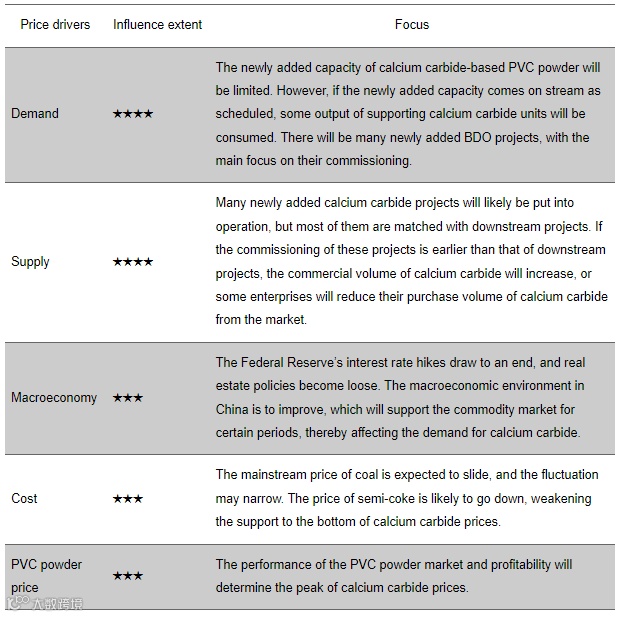
Supply: The calcium carbide furnaces that have been put into production in 2023 will gradually resume normal production in 2024. In 2024, around 1,500kt/a of newly added calcium carbide projects will come online, so the overall capacity of calcium carbide will continue to increase. Some of the projects are matched with downstream units, so the commercial volume of calcium carbide is limited. However, many projects are not matched with downstream units, or the matched downstream units are not put into operation temporarily, so some calcium carbide will be circulated in the market in the first half of 2024. On the whole, the commercial volume of calcium carbide will be ample in the first half of 2024 though the operating rates of units under production will be lower than that in 2023 caused by weak prices. In the second half of 2024, the commercial volume of calcium carbide will tick down as the matched downstream units and BDO projects come on stream. Therefore, the supply of calcium carbide will likely be tight in some periods.
Demand: In 2024, there will be a few newly added projects of calcium carbide-based PVC powder, and they will be basically integrated units, which will have a limited impact on calcium carbide demand. Moreover, the operating rates of PVC powder enterprises under production may decline slightly due to heavy cost pressure and fiercer competition, which may dampen the improvement in the calcium carbide market. As for BDO, there will be many newly added projects in 2024, but the support to the calcium carbide demand will be limited in the first half of 2024 because the growth in the first half will be larger than that in the second half.
Feedstock: The mainstream price of steam coal may go down in 2024 with a loose relationship between supply and demand in China in the next few years, and the fluctuation range in 2024 will be significantly narrower than that in 2023. Under this circumstance, it is expected that there is little possibility of notable changes in electricity prices, but the price of semi-coke will likely drop, reducing the support to the bottom of calcium carbide prices.
On the whole, it is reckoned that the calcium carbide price will fluctuate downwards in the first half of 2024 due to the imbalance between supply and demand, weak feedstock prices, and the soft PVC powder market. In the second half of 2024, the calcium carbide market may see improvements as the demand recovers and the macro environment improves. However, since prices are expected to remain low most of the time, the annual average price is predicted to be lower than that in 2023. In H1, 2024, calcium carbide prices will possibly run below costs. During the intensive PVC unit maintenance period, calcium carbide prices may hover at annual lows. In H2, 2024, with the commissioning of newly added downstream units, the calcium carbide market may improve gradually as supply pressure will likely weaken.
All information provided by SCI is for reference only, which shall not be reproduced without permission.
Please click "Read more" for the full article.