

Pulp Market Expected to Decline in H2 of 2024 After a Bullish H1
In H1 of the year, the wood pulp spot market price showed an uptrend affected by multiple factors such as constant overseas supply disruptions, market pulp shipment diversions to Europe and North America and the bullish BSK futures price affected by anticipated supply tightening. In H2, the supply hike is expected to outweigh demand growth and buyers continue to show resistance, the pulp price may head down under pressure. However, due to uncertainties in new capacity ramp-up, potential supply disruptions and the financial attributes of the product, the price drop may be limited.
In H1 2024, the imported wood pulp spot market ascended and then showed signs of decreasing, and the price was generally at a high level. The trend slightly differed from the forecast of SCI’s 2023-2024 China Pulp Market Annual Report, mainly due to continuous unexpected supply disruptions such as port strikes, gas explosions, etc. In addition to the influence of the products’ financial attributes, the imported wood pulp spot market generally increased from April to May.
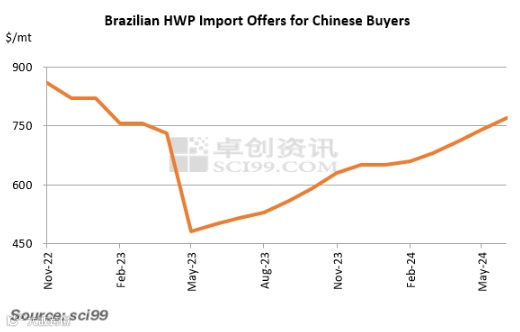
The pulp market soared in Q1 of the year affected by supply disruptions, anticipated supply tightening and cost increases due to constantly rising import offers. The price spread between HWP and SWP also narrowed. In Q2, the market reached a high level and went sideways. The market rose notably from February to May without showing signs of off-season characteristics in April and May but started to head down in late May. According to SCI, as of late June, the average market price for imported SWP in China in H1 of 2024 was 6,153.23 RMB/mt, down 2.96% Y-O-Y; the average market price for imported HWP was 5,431.91 RMB/mt, up 7.07% Y-O-Y; the average market price for imported UKP was 5,480.30 RMB/mt, down 4.12% Y-O-Y; and the average market price for imported CMP was 4,163.92 RMB/mt, down 13.31% Y-O-Y.
In H1 of 2024, the imported HWP market price increased (since HWP accounts for the largest proportion in terms of imports and downstream consumption, the following price analysis will focus on HWP). In H1 of 2024, the average market price for imported HWP in China was 5431.91 RMB/mt, up 7.07% Y-O-Y. Compared to historical levels, the HWP price from March to June of 2024 was above the 7-year historical average.
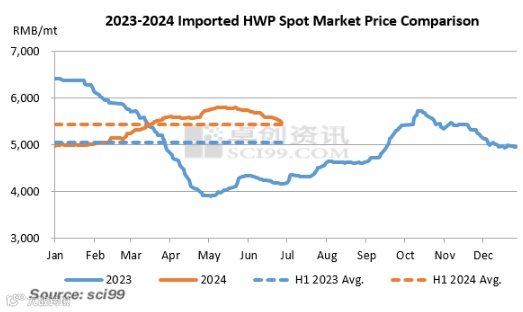
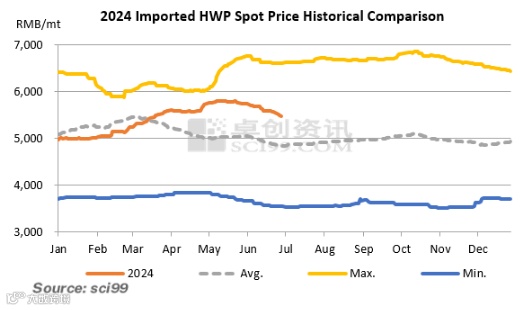
From February to May, the price hike was apparent. After the price drop in Q4, 2024, the market supply-demand imbalance improved somewhat. However, in late May, the pulp market supply and cost factors started to project a higher influence on the market price. Market pulp sellers announced price hikes for March in late February, starting a strike of price hikes in the following months, and pulp producers in China also raised ex-works prices. In addition, the port strike in Finland and the anticipated rail worker strike in Canada boosted the bullish sentiment in the market. In late May, restricted by the poor profitability in downstream paper industries, wood pulp import offers lost upward momentum, ending the bullish phase in H1 of the year. From late May to mid-June, the pulp spot market edged down narrowly. As maintenance schedules were completed at pulp producers, the market supply increased, but tepid downstream demand saw limited improvement. The poor profits of paper production led to tepid trading in the pulp market, and the supply-demand imbalance became more prominent. The pulp market was still on a downtrend as of late June.
In H1 2024, the pulp market dealing price hovered at highs, mainly affected by rising import offers, anticipated lower import supply, and low profits in paper production.
Spot players were reluctant to sell and raised prices due to rising import costs and low profits.
In H1 2024, the imported HWP industry gross profit fluctuated but was apparently higher than that in H1 2023. Taking Brazilian HWP as an example, as of late June, the average gross profit rate of the HWP in H1 2024 was -0.08%, up 15.99pp Y-0-Y. Therein, the average cost in H1 2024 was RMB 5,512.53/mt, down RMB 474.30/mt or 7.92% Y-O-Y. The imported HWP spot price (Suzano in the Shandong market) was RMB 5,508.04/mt, up RMB 465.07/mt or 9.22% Y-O-Y. Due to comparatively lower import costs and rising spot prices, the industry gross profit rate increased Y-O-Y but was still below the breakeven line. Besides, due to constantly rising import offers, the cost pressure on spot players mounted from May to June. Therefore, sellers raised spot prices and became reluctant to sell at lows. In the meantime, the pulp consumption was higher Y-O-Y, supporting the high spot market price.
Pulp consumption increased but was restricted by low paper production profit
From the demand side, in H1 2024, the wood pulp demand was 21,159.9kt, up 2.90% Y-O-Y. Although the consumption increased due to new paper capacity, the pressure from low profitability restricted capacity release. Besides, more frequent market-related maintenance was also seen in response to inventory pressure. Therefore, the wood pulp consumption growth was restricted.
The wood pulp consumption volume rose by 2.88% Y-O-Y in H1 2024. The consumption was supported by the launch of new capacity in downstream tissue, P & W paper and ivory board industries. However, due to rising pulp prices and ineffective paper price hikes, the gross profit rates of downstream players hovered at lows. The theoretical gross profit rates of downstream industries were in the range of -8.15% and 2.81% as of late June, down 1.89-11.08pp Y-O-Y. The low profits hampered the release of new capacity and restricted operating rates of existing capacity, as well as pulp consumption and procurement.
As for exports, according to GACC, the wood pulp export volume of China totaled 54.8kt during the first 5 months of 2024, up 20.54% Y-O-Y. In June, entrepot trade was hindered by rising shipping freight and higher wood pulp import costs. Besides, the wood pulp export volume was small compared to the overall demand, with a share of only 0.30%. Therefore, pulp exports have limited influence on total demand.
Pulp prices hovered at highs despite Y-O-Y higher market supply
In H1 2024, the wood pulp market total supply soared by 9.68% Y-O-Y, but the increase in supply was mainly bolstered by higher opening inventory, and the increase in domestic production and import volume was relatively limited. Due to high imported market pulp prices, domestic pulp producers maintained relatively high production. However, as the operating rate was already high last year, and there was limited pulp capacity expansion, the wood pulp output increased narrowly by 1.48% Y-O-Y. However, the opening inventory in 2024 was 62.04% higher compared to that last year. Paper mills mainly consumed low-priced volumes ordered previously, and spot procurement declined. In the meantime, paper mills with new capacity expansion also prepared stock in advance, contributing to the high pulp opening inventory.
From the perspective of pulp imports. According to GACC, the wood pulp import volume totaled 11,501.1kt during the first 5 months of 2023, up 3.84% Y-O-Y. The import volume for H1 of 2024 is estimated to be 13,602.1kt, up 2.72% Y-O-Y. The proportion of imported wood pulp over total supply has marginally decreased and is expected to be 51.64% during H1 of 2024, down 3.50pp Y-O-Y. The decrease in import volume was caused by supply disruptions in Finland and Canada, lower market pulp shipments to China, low profitability in paper production in China and buyers’ resistance to high-priced resources.
In H1 of 2024, the market supply increased apparently, but the pulp price deviated from market fundamentals affected more by the market sentiment changes from overseas supply disruptions as well as the high concentration ratio on the supply side.
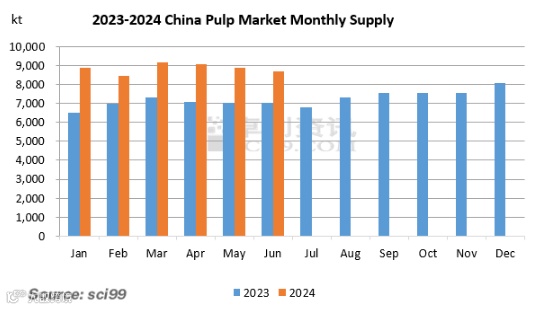
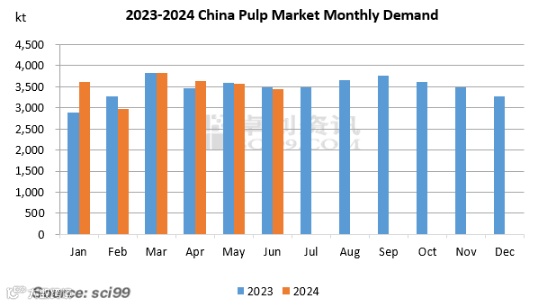
In summary, the China wood pulp market supply and demand both increased, and the supply increment was greater than that of demand. However, due to the influence of overseas supply disruptions on market sentiment, and the market price deviated from fundamentals. The market started to head down in late May affected by narrowing demand growth and poor profits In paper production.
Looking ahead into H2 2024, factors affecting the wood pulp market mainly include the launch of new pulp capacity on the supply side, the economic recovery process in China which will boost pulp demand, exchange rate fluctuations, adjustments in import offers and the trend at the SHFE BSK futures market.
The status of new pulp and paper capacity may vary, and pulp supply growth may significantly outpace demand
On the supply side, the planned new pulp capacity in H2 of 2024 may total 12,167kt/a. Affected by supply-demand imbalance and the prospect of profitability, the commissioning of some lines may be delayed, but if the planned new pulp capacity can be launched within the year, the market competition will intensify. Besides, the restocking cycle in Europe may come to and end, and the wood pulp shipments to China may increase. At this point, the 2.55 million ton/a Cerrado project in Brazil and the 1.8 million ton/a capacity in Fujian of China are expected to be launched soon. In addition to the stable production of existing capacity, the wood pulp output and import volume of China may increase by 13.06% and 5.31% respectively in H2 compared to those in H1.
On the demand side, with the implementation of policies in effect and further policy support anticipated, the Chinese economy is expected to improve marginally, boosting consumption and the demand for pulp. As for new paper capacity, in H2 of 2024, the planned tissue and ivory board capacity and the release of previously launched capacity may contribute to 928.6kt of wood pulp consumption in theory. On the whole, the market supply-demand imbalance may be alleviated in H2 of the year, but the market may continue to be oversupplied. Therein, the market supply is expected to rise by 7.85% from H1, reaching 28,406.6kt, while the total demand may rise by 4.58% to 22,126.3kt.
The capacity ramp-up in Brazil, exchange rate fluctuations and weak bargaining power of Chinese buyers may still project uncertainties in the market.
Due to constant hikes in import offers and RMB depreciation, the import costs may still hover at highs, lending support to the spot market. In H2 2024, the launch of new capacity may destabilize import offers, but due to the weak bargaining power of Chinese buyers as well as questionable capacity ramp-up and potential production swing to dissolving pulp by Bracel in August, the downtrend may be relatively limited. Besides, participants’ sentiments on the pulp market in H2 2024 still vary, so fluctuations in the BSK futures market will still have a real-time influence on the spot market.
HWP price may go against traditional seasonality
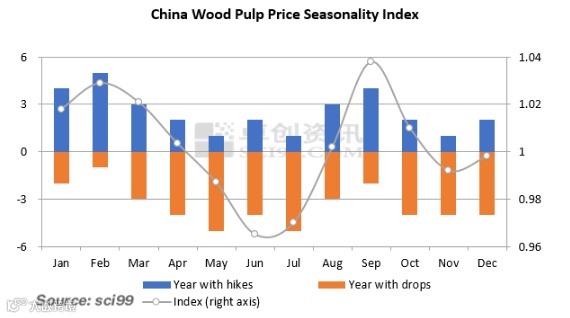
The HWP price tends to display seasonal patterns. As seen from the seasonal index based on 7-year historical data, the HWP price tends to be bullish in Q1 and Q3 and bearish in Q2 and Q4. However, considering the price situations in the HWP market and domestic economic recovery, the HWP price may go against the traditional seasonality and start to head down in Q3. In Q4, the market may go along with the seasonal pattern.
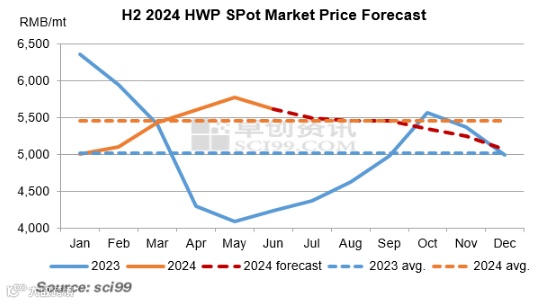
SCI still holds the price trend forecast for H2 2024 in the 2023-2024 China Pulp Market Annual Report. The pulp market is expected to be stable-to-decreasing, and the downtrend may persist in Q4. It is estimated that the pulp market will head down in H2 2024, but as the pulp price has risen to a high level, the decrease in the average price may be relatively narrow. The average market price of imported HWP may hover within RMB 5,100-5,600/mt, and the average price may be RMB 5,391.67/mt in H2 of the year, down 0.74% from that in H1 but 8.36% higher Y-O-Y. The highest price is likely to appear in July, while the lowest point may appear in December.
Risk disclosure: overseas economic decline exceeds expectations, unexpected supply disruptions, higher-than-expected import volume, uncertainties in demand recovery, exchange rate fluctuations, delays in new capacity, futures market fluctuations, etc.
All information provided by SCI is for reference only, which shall not be reproduced without permission.
Please click "Read more" for the full article.