

Operating Rate Records a Low, Supporting PP Market
Preface: PP demand performed mediocrely in April, but high feedstock cost and snug supply pushed up PP mainstream prices slowly. Especially the PP industry experienced intensive maintenance in April when monthly operating rates recorded a low.
In 2024, China’s PP industry operating rates mostly hovered at lows around 78%, while the monthly operating rate was merely 75.39% in April, a historical low. PP output was 2,698.5kt in April, down 6.6% M-O-M. The supply pressure was alleviated, and market price of PP got support.
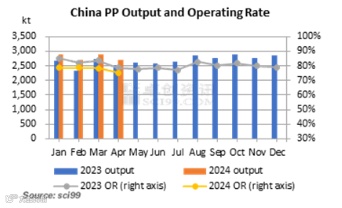
China’s PP operating rate was at lows in April. First, the intensive maintenance seasons for PP units approached, from April to May. Second, more units underwent unplanned shutdown and operating rate reduction due to high cost and weak demand. Especially in April, feedstock prices stayed high. Besides, PP demand was not strong because of reduced overseas orders and downstream users’ cautious sentiment in China. Thus, the number of units undergoing unplanned shutdown increased notably. The above two points have become the main reasons for the further operating rate decline in April.
Intensive turnarounds alleviated PP supply pressure, and also made supply in a structural tight situation. PP raffia and low-MFR copolymer especially in North China, East China, South China and other regions have been tight so far, supporting PP prices notably.
Relatively low operating rates of PP units underpinned the PP market price from supply, despite relatively lackluster downstream demand. PP mainstream prices inched up slowly.
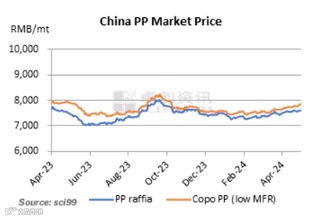
China’s PP market prices fluctuated upwards at first but then moved sideways in April. The average price of PP raffia in East China was RMB 7,566.25/mt in April, up 1.56% M-O-M but down 0.39% Y-O-Y. PP mainstream prices also went up due to eased supply pressure and passable cost support in April. The price of crude oil fluctuated at highs, giving passable cost support to PP prices. The overall supply pressure in PP market was alleviated with intensive unit maintenance, and there was structural tight supply in some regions, supporting the PP market price. As for demand, the downstream hand-to-mouth purchase of PP was accelerated, as the feedstock inventory of some downstream factories dropped gradually to a low. That pushed up PP market prices as well. However, the follow-up of effective demand was relatively short, which frustrated the players again. The price of PP first declined slightly and then moved sideways because of high cost support.
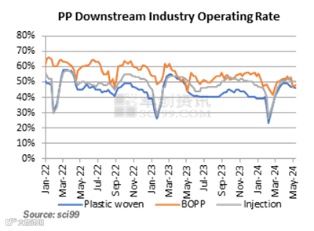
The monthly average operating rate at plastic woven and injection product enterprises registered an M-O-M increase, while that at BOPP film enterprises declined. New orders at PP downstream enterprises remained largely flat M-O-M, but the inventory of finished products stayed high with slowdown in consumption. Besides, downstream industry profits continued to decrease with PP prices inching up. Therefore, downstream processors lacked enough confidence and resisted high-priced feedstock, which hindered the further price increase of PP.
The 450kt/a PP unit at Grand Pacific Petrochemical Phase I was officially put into use in early May, and it was arranged to produce qualified product of HP550J-Q. The 1# line unit with capacity of 450kt/a at Qingdao Jinneng New Material Phase II is also planned to be put into use in May. At Huizhou Lituo New Material, the second PP production line with capacity of 150kt/a is projected to come on stream at the beginning of May. The 150kt/a PP unit at Anhui Tianda Petrochemical is expected to be put into operation in end-May.
China’s domestic PP output is expected to shift upwards M-O-M since some new units are projected to be put into operation, despite intensive unit maintenance. As for import, the import volume is expected to drop slightly due to higher overseas prices than China’s domestic one in the short run. Imports have shrunk but modestly. Hence, the overall PP supply pressure is expected to increase in May. The PP output loss caused by maintenance may be 562.6kt next month, down 8.73% M-O-M. Meanwhile, The PP output will increase to 2,950kt or so in May.
As for demand, the PP demand may remain relatively stable, and downstream users may purchase mainly on a hand-to-mouth basis due to limited new orders. The PP industry is gradually entering the demand off-season, when the demand is estimated to drop, suggesting softer support for PP prices. Downstream enterprises will probably show limited interest in buying unless the finished product inventory declines and profitability improves. Downstream plants will continue to show resistance to high-priced resources. All of these will limit price increase in May, and the demand will likely weaken especially in mid-to-late May. SCI predicts that China’s PP market prices will probably be range-bound at first but then move downwards in May.
All information provided by SCI is for reference only, which shall not be reproduced without permission.
Please click "Read more" for the full article.