

ABS Market to Fluctuate Upward in H2, 2024
Introduction: The ABS market recovered from its low point in H1, 2024, as a result of an improved supply and demand structure and a stronger cost-driving force. The policy of expanding demand in the second half of the year is being intensified, which will support the strengthening of the Chinese economy’s resilience and perhaps spur fresh development in downstream consumption in automobile and home appliances sectors through trade-in and other initiatives. Producers are cautiously regulating actual output due to the impact of loss reduction strategies caused by the delayed commissioning of certain new units, and a staged recovery of the fundamentals is anticipated. Furthermore, commodities benefit somewhat from the anticipated strengthening of interest rate reduction in the Americas and Europe. The transmission of ABS costs may increase, and there is potential for price growth. However, due to weak improvement in fundamentals, the upward space may be relatively limited.
China’s ABS market fluctuated upward in H1, 2024, with prices rising first and then falling. The market trend is consistent with the SCI forecast in the 2023-2024 China ABS Market Annual Report. However, due to the strong upstream markets and the unexpected reduction in production by domestic ABS producers, the fundamental contradiction gradually eased, and the cost-driving force increased, which raised market risk appetite. This leads to a discrepancy between SCI's judgment of the position of the current average price increase and the actual situation. From January to June 2024, the average price of HI-121H in the Yuyao market was RMB 11,115.24/mt, an increase of 1.67% compared to the same period last year. On June 28, the HI-121H price in the Yuyao market closed at RMB 11,350/mt, an increase of 12.94% compared to the beginning of the year
The second part of April marked the peak of the ABS market in H1, 2024, with HI-121H reaching RMB 11,800/mt in the Yuyao market. The ABS market as a whole showed a volatile and upward trend from January to April. Cost assistance combined with better-than-expected fundamentals facilitated the market to rebound from the bottom. First, the rising prices of styrene, acrylonitrile and butadiene underpinned the ABS market. Second, the operating rate constantly dropping as maintenance increased more than expected. Third, seasonal demand from downstream home appliances and other sectors was healthy. Partial demand was released earlier and consumption was considerable in the peak season. The continuous improvement of market expectations boosted the price. May and June saw a continuous increase in supplies due to redesigned production. However, the demand presented a declining trend. The ABS market fell gradually as the supply-demand structure weakened and costs inched down. The lowest ABS market prices were recorded in H2 January at RMB 10,050/mt. The spread between the highest price and the lowest price was RMB 1,750/mt in H1, 2024.
Chart 1 2023-2024 China ABS Monthly Average Price
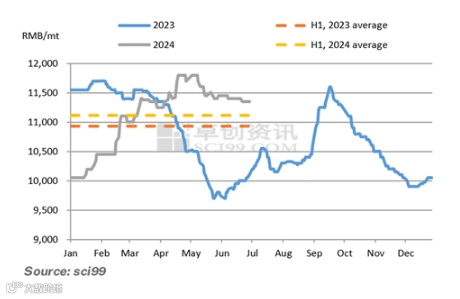
Chart 2 2020-2024 China ABS Monthly Average Price
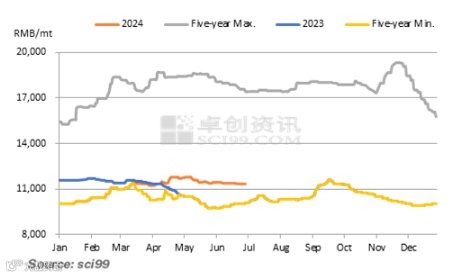
The upward correction of the ABS market after bottoming in the first half of the year is related to the narrowing of supply growth and the stage recovery of demand, as well as the rising prices of crude oil, styrene, and other commodities influenced by the macroeconomic environment.
ABS production profit declined first and then went up
The mainstream production process of ABS in China is the emulsion process, and the main feedstock includes styrene, acrylonitrile, butadiene, etc. In the first half of 2024, prices in feedstock markets fluctuated upwards, so the support to the ABS market increased from the cost side. However, because the fundamentals were weaker than the upstream products, ABS cost transmission met resistance. The ABS production profits were negative in H1, 2024, averaging RMB -913.99/mt, down RMB 876.54/mt or 2,340.56% Y-O-Y. The average cost was RMB 11729.84/mt, up RMB 1,093.21/mt or 10.28% Y-O-Y. The cost pressure was high as increments in ABS prices were not as large as those in costs.
Chart 3 2022-2024 China ABS Cost and Profit Comparison
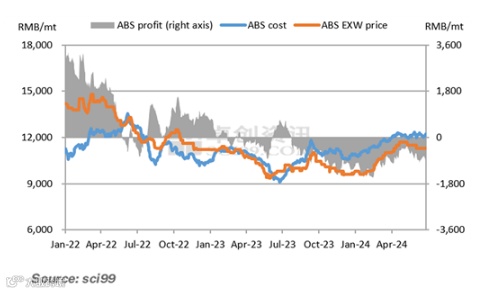
Crude oil is an upstream feedstock for many basic chemical products. Its price trend has a significant impact on the chemical products such as styrene, acrylonitrile, butadiene, and ABS. In H1, 2024, international crude oil prices first rose and then fell. As of June 27, the average price of WTI in the first half of the year was $78.79/bbl, a Y-O-Y increase of 5.21%, while the average price of Brent was $83.39/bbl, a Y-O-Y increase of 4.17%. Geopolitics continue to impact the market, and concerns about the comprehensive escalation of the Middle East issue in April led to oil prices hitting a new high for the year. However, the supply side has not been substantially affected, and oil prices have begun to recoup geopolitical risk premiums. In addition, expectations of tight supply have eased, and oil prices have been fluctuating and falling since late April. The OPEC+ meeting early in June sent out a signal to increase production, which exacerbated market pessimism and sent oil prices plunging to a two-quarter low. The fluctuation and increase in crude oil prices from January to April strongly boosted the ABS industry chain. During this period, upstream butadiene prices hit a new high in 2022, and styrene and acrylonitrile prices also rose to a temporary high, which backed up the price of ABS. However, due to the slightly weak supply and demand fundamentals in the ABS industry, its overall upward trend and speed were slower than those in the upstream markets. The industry profitability was poor with production of general materials suffering comprehensive losses and the profit of high-end materials hovering around the cost line.
Slowing supply growth and improving demand in the ABS industry facilitate the price rebound
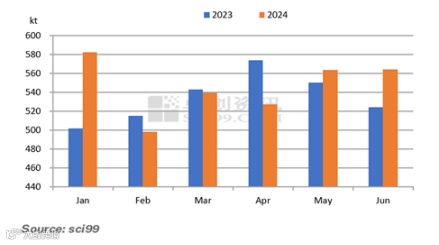
The ABS industry was still in the peak period of capacity expansion in 2024. However, because of the production losses, some new units were delayed in production. In H1, 2024, three units were put into operation. In addition, Ningbo LG Yongxing’s capacity has been revised. The total newly added capacity was around 780kt/a. As for output, the total output from January to June reached 2,863.7kt, up 4.61% Y-O-Y. The industry operating rate dropped from 65.32%, but the large capacity base still lifted the output. The total import volume from January to June 2024 was estimated at 503.1kt, down 4.70% Y-O-Y. The total supply of ABS was estimated at 3,366.8kt, up 3.10% Y-O-Y.
Chart 4 H1, 2023-H1, 2024 China ABS Monthly Supply Volume
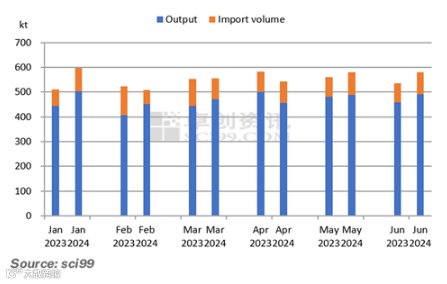
Chart 5 H1, 2023-H1, 2024 China ABS Monthly Apparent Consumption Volume
Downstream demand from the home appliance industry was relatively optimistic
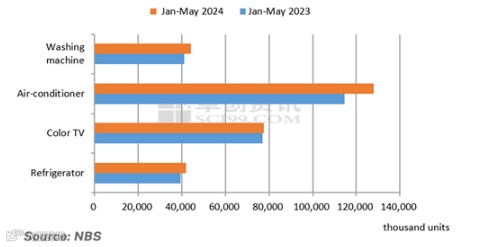
The home appliance industry performed well in H1, 2024. Sales of home appliance products were robust in China’s domestic market, supported by the trade-in policy, intelligent upgrades, demand brought about by previously completed projects, etc. In addition, under the expected impact of global high-temperature weather, the production and sales of air conditioners, refrigerators and other products have increased Y-O-Y. According to data from the National Bureau of Statistics, from January to April, the output of room air conditioners, refrigerators and freezers increased by 17.60%, 14.10% and 27.30% Y-O-Y respectively. The demand recovery was slow from the toy and daily industries as well as the building insulation sector. According to data from the National Bureau of Statistics, real estate development investment in China decreased by 9.8% Y-O-Y from January to April, and the overall market as a whole was going through an adjustment phase. The domestic apparent consumption of ABS is expected to reach 3,274.8kt in H1, 2024, up 2.07% from the same time the previous year. Exports are expected to total 92kt. Nonetheless, the overall supply-demand contradiction of ABS was not as noticeable because the rate of supply increase was reduced. This has somewhat supported ABS prices at the bottom, particularly from March to April when domestic maintenance grew and the market supply pressure progressively lessened, both of which have boosted the driving power behind rising ABS prices.
Chart 6 2023-2024 Home Appliance Output Comparison
H2, 2024 ABS market outlook
Upstream crude oil and styrene prices may gain strength first and then weaken, and the cost conduction may be enhanced again
Global crude oil prices are expected to follow a trend of first rising and then falling in the second half of the year. It is possible for oil prices to climb initially before declining due to a combination of tight supply and higher demand in the third quarter and lower output and lower demand in the fourth quarter. Market expectations for the Federal Reserve’s interest rate reductions in H2, 2024 have been reinforced by signs of decreasing U.S. inflation in the second quarter and the eurozone leading the way in interest rate cuts. It is very likely that the Federal Reserve will begin reducing interest rates in September or November, and no more than two rate reductions are anticipated. OPEC+ may increase production in the fourth quarter, but geopolitical concerns remain a hidden risk. Furthermore, whether the expectations for the peak summer consumption season can be met has a crucial impact on the trend of oil prices. It is predicted that the oil prices may show a trend of strengthening in the third quarter and falling in the fourth quarter. In the third quarter, players need to pay attention to the actual demand performance. If peak season predictions are not met, there is a significant downward risk in oil prices. Oil prices may fall to their lowest point of the year in the fourth quarter, as production rises and demand falls. In addition, the inventory levels of crude oil and refined oil products have significantly rebounded compared to last year, and the "ceiling" above oil prices is anticipated to be lower than it was in September of last year. However, geopolitical uncertainties may cause oil prices to rise more than predicted.
The upstream benzene supply remains restricted. From a cost and supply standpoint, the benzene market may fluctuate at highs overall. Under the strong cost support, the styrene market has the potential to increase. As for the butadiene market, given the ample supply and fresh capacity projected to be released in downstream industries, the butadiene market may fall in the second half of the year, but the decrease may not be large. The acrylonitrile market is projected to continue its periodic fluctuations, with the price fluctuation range possibly lower than that in H1, 2024.
In the actual production of ABS, the amount of styrene used is the highest, and the ABS price is more susceptible to fluctuations in styrene and benzene prices. Given that July falls within the customary off-season for demand and the unit restarted after maintenance, the tight supply of benzene could gradually improve. The benzene and styrene markets are also experiencing a phased correction and consolidation. With the downward trend of cost support, the ABS market may adjust downwards. August and September mark the beginning of the peak demand season, so demand is anticipated to pick up and the macroeconomy may continue to improve. The cost may provide increasing support, and prices in the industrial chain may see tentative rises. The onset of the customary demand off-season in the fourth quarter could cause the styrene market to decline from its peak, which would then have an impact on the ABS market.
Slower capacity expansion coupled with resilient demand may underpin the ABS market in H2, 2024
The newly added ABS capacity was 780kt/a in H1, 2024. As of June 2024, China’s ABS capacity reached 8,295kt/a. It is predicted that 1,210kt/a new capacity may be put into use in H2, 2024. Affected by the supply-demand contradiction and the low profits, some units may be put into use in stages or postponed. The overall capacity expansion slowed down in 2024. Besides, the production pressure persisted. Thus, it is predicted the supply increase will be limited in H2, 2024.
On the demand side, China’s economic recovery is becoming more differentiated, and demand-boosting policies are intensifying. The consumption demand for ABS-related terminal products remains resilient. Furthermore, China’s downstream industries, such as home appliances and new energy vehicles, are benefiting from an improving global economic outlook. The export markets for downstream home appliances, new energy vehicles, toys, and other products will still unleash their potential. According to recent statistics from numerous international credible climate monitoring agencies, the average global ocean surface temperature has consistently established new records throughout the same time span. The influence of the El Nino phenomenon is becoming clearer, and demand for refrigeration equipment such as air conditioners, fans, and refrigerators is projected to rise further. Downstream demand for durable products is gaining strength.
The ABS export volume is relatively small, but in the past two years, the Y-O-Y growth rate has been considerable. In today’s highly competitive local market, more producers are looking into export potential. Southeast Asia, Europe, and South America have become the development directions for many exporters. However, the high ocean freight and stable downstream product orders have led to a slightly slower increase in the export market development. Furthermore, certain domestic enterprises’ export qualifications and talent reserves need to be enhanced, making large-scale export growth difficult to achieve. The export dependence degree in the first half of the year is expected to be nearly 3.21%, with a slight increase of 1.12% compared to the same period last year. Due to the small total amount, it has no significant effect on alleviating the domestic ABS supply and demand pressure. ABS export volume is expected to increase in the second half of the year, and export dependence may also increase marginally.
Although ABS supply is projected to increase, there is little room for sustained improvement in supply growth because of the high costs and production losses. Thus, periodic positive demand feedback is expected to boost market prices. The advancement of home appliances and the prevalence of new energy vehicles may result in increased consumption of daily necessities. ABS consumption is projected to be resilient. Therefore, the supply-demand structure may improve.
The likelihood of an increase in ABS prices in September is higher due to their seasonal nature.
ABS prices fluctuate seasonally. In recent years, with the expansion of industry capacity and changes in global consumption trends, the likelihood of ABS prices rising in China in the first half of the year has decreased, while market volatility is expected to rise in August, September, and October. The market will enter the slow season from November to December, increasing the likelihood of price decreases. Based on changes in upstream market prices such as crude oil, as well as the domestic economic recovery process, the ABS market is projected to follow the aforementioned seasonal volatility pattern in the second half of the year.
Chart 8 2023-2024 China ABS Monthly Average Price
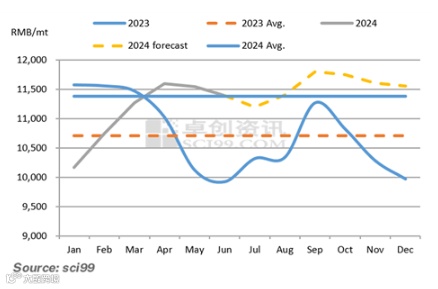
Under the expectation of high cost support and fundamental recovery, the mainstream ABS market price is expected to fluctuate and rise in the second half of the year. It is expected that a new capacity of 810-1,210kt/a will be put into use in theory, with some capacity coming online later, thus there will be limited actual output increment. On the demand side, the promotion of a "trade-in" policy for home appliances/automobiles and other products, combined with the impact of the replenishment cycle through channels, may keep demand for durable consumer goods in the downstream ABS household appliance and automobile industries stable. As a result, there is potential for the supply and demand structure to improve. As a result, there is potential for the supply and demand structure to improve. Furthermore, from a macroeconomic standpoint, the Eurozone economy’s slow recovery, regular beneficial measures such as China’s reserve requirement and interest rate reduction, and an upward resurgence in macroeconomic expectations have all contributed to a positive outlook for commodities prices.
Based on the above analysis, SCI maintains the trend projection for the second half of the year in the 2023-2024 China ABS Market Annual Report, predicting that the ABS market will see volatility and increasing expectations in H2, 2024. The supply and demand structure may continue to deteriorate in July, and there is a significant likelihood of cost reductions, putting downward pressure on ABS market prices. From August to September, costs may rise, and demand for ABS replenishment may recover. Meanwhile, PetroChina Jilin Petrochemical may conduct maintenance. The fundamentals are projected to strengthen, and the market may have a rebound potential in the current term. The contradiction between supply and demand in the fourth quarter may once become prominent again along with the downward driving force of costs. The contradiction between supply and demand in the fourth quarter may resurface, and the cost may be pressured downward. The ABS market may be corrected downward in the fourth quarter. The mainstream price of HI-121H in the Yuyao market may fluctuate in the range of RMB 11,200-11,800/mt. Based on seasonal patterns, the high point of the second half of the year is likely to occur in September and October, and the low point may occur in July and August.
All information provided by SCI is for reference only, which shall not be reproduced without permission.
Please click "Read more" for the full article.