

2024 Witnesses Narrower Price Fluctuations in the Propylene Industrial Chain
Introduction: In 2024, as supplies continued growing, some products in the propylene industrial chain saw a transition from short supply to oversupply. Profits from producing most products remained negative, exerting larger pressure on enterprises and leading to unstable production of units. Influenced by the increased supply and low profits, product price fluctuations narrowed notably. In the future, the supply growth in the propylene industrial chain may slow down, and the supply and demand may rebalance. However, the profitability of the propylene industrial chain may remain weak in 2025, supporting product prices from the bottom, and prices may stay range-bound.
Underpinning support of profits for prices strengthened, and price fluctuations narrowed.
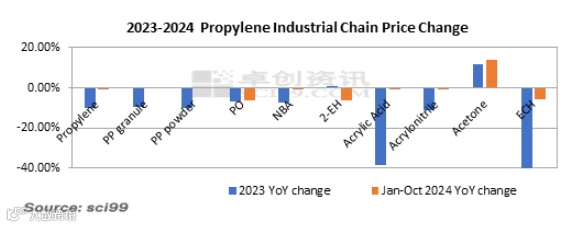
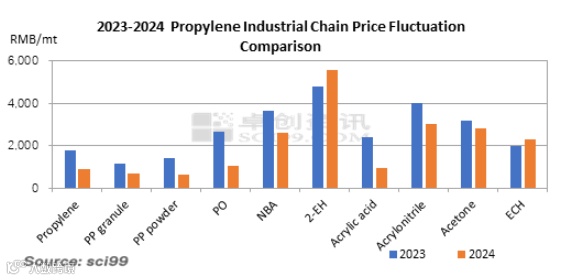
In 2024, price fluctuations of the propylene industrial chain narrowed notably YoY. In 2023, prices of propylene, PP and acrylonitrile fell by about 10%, and those of acrylic acid and ECH even dropped by 40% or so. The larger supply pressure was the main reason for price declines. However, in 2024, most products within the propylene industrial chain saw smaller YoY price changes, especially for propylene, acrylic acid, acrylonitrile and ECH. In 2024, the downward pressure on prices exerted by supply remained, while the bottom-supporting effect of negative profits on prices was more obvious within the propylene industrial chain, so the price fluctuation range was reduced.
Supply continued to grow in line with sustained capacity release.
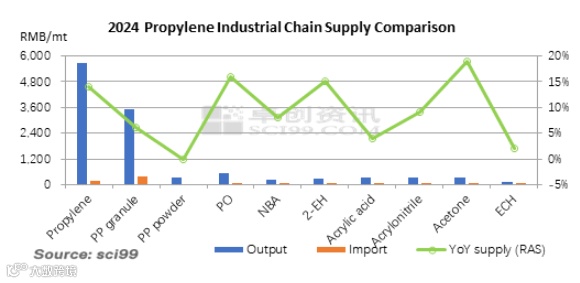
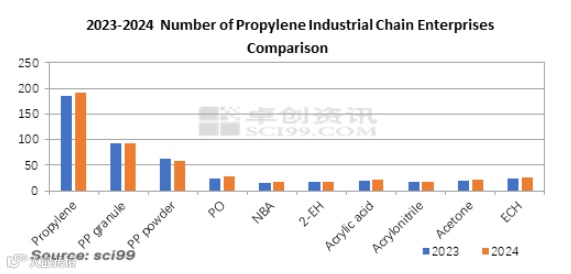
In 2024, the newly added capacity of the propylene industrial chain remained large, the supply continued to grow, and the number of enterprises increased YoY. Within the year, the supply of propylene, PO and acetone is expected to increase by more than 10%.
As for the newly added capacity of propylene, most are PDH units. The newly added capacity at Formosa Industries (Ningbo), Ningbo Haiyue New Materials, Fujian Zhongjing Petrochemical, Jinneng Chemical (Qingdao) and Zhenhua Oil were released. As a result, PDH capacity is predicted to take up 32% of the total propylene capacity, ranking top. Propylene downstream industries also saw large newly added capacity, and the number of downstream enterprises rose YoY, indicating fiercer competition.
The overall profitability of the propylene industrial chain underperformed.
In 2024, profits of propylene and most derivatives remained negative, and the overall industrial profitability was relatively weak. From January to October, profit losses of PDH units were RMB 830/mt.
In 2023, profits from producing propylene via different technologies declined YoY and were in losses. In 2024, profit losses of MTO and PDH units further increased, although profits from producing oil-based and coal-based propylene rose slightly, and coal-based propylene made a small profit. Therein, increased profit losses of PDH units led to frequent Production fluctuations, exerting a large impact on propylene supply and price trends. Among propylene derivatives, the profit from producing oxo-alcohols was favorable, and the overall profit of PO went up slightly despite periodical profit losses. Profits from producing other propylene derivatives remained negative for a long term, and the underperforming profits of some derivatives resulted in load cuts and shutdowns of units, thus exerting some influence on demand for propylene. In general, the weak profitability of the propylene industrial chain played an increasingly notable role in the unit operation, and the underpinning support of profits for prices of propylene and its derivatives strengthened. This is also one of the factors leading to smaller price fluctuations in the propylene industrial chain.
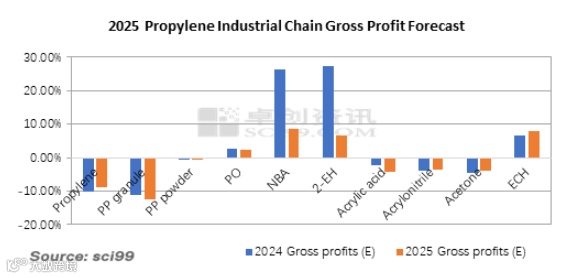
The profitability of the industrial chain may hardly improve with large newly added capacity to be released.
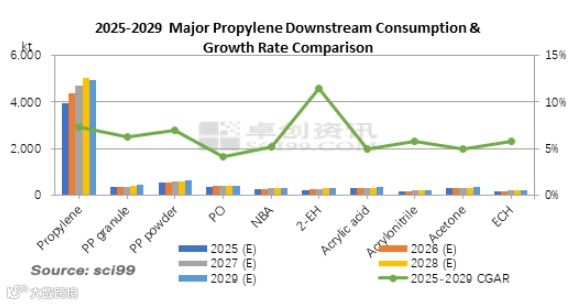
In the future, there will be a large amount of capacity to be released, and the profitability of the industrial chain may remain weak. In the next five years, over 50 propylene units with a total of about 30,000kt/a are scheduled to be put into operation, while the actual release of newly added capacity may fall short of expectations due to the failure of capacity release and the capacity replacement. The newly added capacity of propylene downstream enterprises will be released, indicating an increment in demand for propylene, while the growth rate may slow down, and the propylene industry will be in balance.
Benefiting from current the favorable profit of 2-EH, more oxo-alcohols units are planned to come online, contributing the most to propylene demand growth. However, from H2, 2024, the newly added capacity of oxo-alcohols was gradually released, leading to drops in product profits. In 2025, gross profits of oxo-alcohols are expected to decline notably, and those of other products may remain weak, so the overall profitability of the propylene industrial chain may hardly improve. The continuous capacity expansion will intensify the oversupply of the propylene industrial chain and exert downward pressure on product prices. Meanwhile, low profits may underpin prices to a larger extent, and product prices of the propylene industrial chain may fluctuate slightly.
All information provided by SCI is for reference only, which shall not be reproduced without permission.
Please click "Read more" for the full article.