

Propylene: Analysis of 2024 Market Price New Characteristics Changes
Introduction: In 2024, the price trends in the propylene market have shown many new characteristics. Due to notable supply pressure throughout the industry chain and a decline in profitability, the price propylene has remained low, with reduced price fluctuations. Additionally, differences in product scale, specifications, and storage capacities among companies have led to an increased price gap in the mainstream market. Some characteristics of the propylene price changes are expected to continue for some time.
In 2024, the supply-demand imbalance in the propylene market has become more pronounced, and the profitability of the industry chain has declined. Influenced by multiple factors, the propylene price trends have diverged from previous patterns. Throughout the year, propylene prices have deviated from their usual seasonal patterns, with smaller fluctuations and sustained low price centers. The gap between high and low prices in the market has widened, and many new characteristics of price fluctuations have emerged.
High Supply Pressure, Low Market Price
In the past five years, the production capacity of propylene and its downstream products has continued to expand, leading to simultaneous growth in market supply and demand. However, since supply growth has outpaced demand, the pressure of oversupply in the propylene industry has become increasingly evident. From January to August 2024, China added 4.08 million tons of new propylene capacity, with domestic propylene production increasing by 13% year-on-year. However, actual downstream consumption only grew by 9%, meaning supply continued to outpace demand, intensifying the pressure of oversupply and keeping the price low.
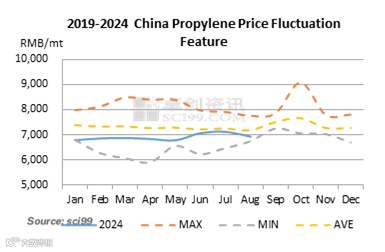
Intensifying Supply-Demand Game and Narrowed Price Fluctuation
Over the past decade, the fluctuation range of propylene prices has been shrinking, especially in the last five years. In 2024, this narrowing was particularly noticeable, with the largest fluctuation from January to August being RMB 900/mt, RMB 850/mt less than in 2023, and RMB 2,150/mt less than in 2020. The market experienced mainly small fluctuations, without clear directional trends, which is closely related to increased oversupply pressure and cautious sentiment among market participants due to weaker profitability in the industry chain.
In 2024, the oversupply pressure in the propylene industry chain intensified. Aside from propylene, many derivatives also faced increased supply pressure. As for profits, coal-based propylene saw slight improvement, but oil-based, methanol-based, and propane-based propylene remained in notable loss, with further declines in the profitability of methanol-based and propane-based propylene. Among propylene derivatives, only NBA and 2-EH had relatively healthy profits, while most others remained in long-term losses or low-profit states. Consequently, downstream acceptance of propylene prices has weakened.
For manufacturers, the oversupply of propylene has increased sales pressure, forcing them to offer discounts to boost sales. However, given the losses faced by producers, there is limited willingness to offer notable discounts, making it difficult for prices to rise or fall notably. Downstream factories, on the other hand, are less eager to procure, as some propylene derivatives are becoming more readily available and terminal demand is insufficient. This cautious approach to procurement has contributed to the narrowing of price fluctuations.
In 2024, the supply pressure in the propylene industry chain has increased, with more companies adjusting their operating rates to influence market trends. At the same time, the overall profitability of the industry chain remains weak, and some products are experiencing notable losses, which has impacted the operational enthusiasm of the enterprises to some extent. The number and frequency of fluctuations in both propylene and downstream facilities have noticeably increased year-on-year. These fluctuations have had a considerable impact on propylene prices, with the overlapping volatility between upstream and downstream facilities intensifying the supply-demand dynamics. This has led to cautious trading sentiment among market participants and caused continued price fluctuations, making it difficult for propylene prices to establish a clear directional trend.
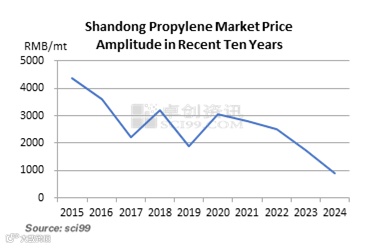
Seasonality Not Evident in 2024
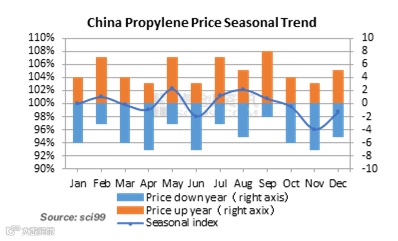
Propylene prices usually exhibit some seasonality. Historically, prices tend to fluctuate at low levels in the first and second quarters, rise in the third quarter, and fall in the fourth quarter, with price peaks generally occurring in September or October and lows at the beginning or end of the year. Although unexpected events can disrupt this pattern temporarily, seasonal trends tend to repeat over long periods.
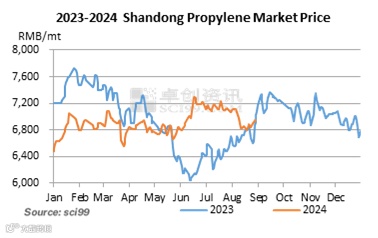
In 2024, the price peak is likely to occur in June, with the average price in Shandong reaching RMB 7,295/mt, and the lowest point likely in January, with the average price in Shandong at RMB 6,475/mt. Given the impact of shutdowns in multiple PDH plants, the propylene market in Shandong saw a spike in June. However, with a notable increase in production capacity in the second half of the year, it's estimated that even if prices rise in September-October, they will struggle to surpass the June peak. Similarly, even if prices fall in November-December, they are unlikely to drop below the January low. This contrasts with 2023, where the highest prices were in January and the lowest in June, reversing the trend for 2024. Weak terminal demand also means that the typical “Golden September and Silver October” boost for propylene demand will be less noticeable, further blurring seasonal trends.
Price Discrepancy Across Regions
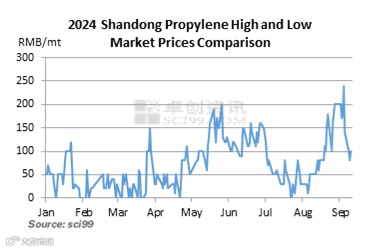
In 2024, propylene prices in different areas of Shandong have diverged, leading to a widening gap between high and low market prices. The primary trading areas for propylene in Shandong are in northern Shandong, with price assessments based on deliveries in Zibo, Dongying, Binzhou, and Weifang. These areas have concentrated volumes of propylene and downstream procurement. However, differences in production scale, product specifications, storage capacities, and business strategies among companies in Zibo and Dongying have led to price discrepancies, expanding the price gap.
In Dongying, where independent refineries are predominant, there are about 15 enterprises selling propylene. However, many do not sell notable volumes of propylene due to small production scales. Independent Refinery mainly produce refined oil, with propylene as a byproduct, typically producing less than 100,000 tons per year. Storage capacities are also limited, requiring continuous sales. Although the quality of propylene produced by independent refinery is generally adequate for polymerization, PDH plants typically produce higher quality products.
From the perspective of the Zibo region, compared to Dongying, there are fewer production enterprises, but some companies have ample product volumes. In recent years, with the commissioning of multiple PDH units in Zibo, most of the propylene in the region now comes from these units. PDH units primarily produce propylene with hydrogen as a byproduct. First, a single PDH unit has a larger propylene production capacity, equivalent to the capacity of 5-10 local refining units, ensuring stable and abundant propylene supply. Second, PDH units are equipped with large propylene storage tanks, providing strong storage capacity and making their prices more resilient to declines. Additionally, the propylene produced by PDH units has superior quality, which is favored by downstream factories that require higher raw material standards. In terms of business operations, some PDH enterprises sell propylene purely for external use, while others are integrated with downstream derivative products. These companies rely on both propylene and its derivatives as their main revenue sources, and therefore have limited willingness to offer price concessions during market downturns.
Overall, looking at 2024, due to the combined influence of various factors, propylene producers in Zibo are more likely to attract large buyers and traders, resulting in relatively higher propylene prices compared to Dongying. This has widened the price differential, with the gap between high and low prices occasionally reaching or exceeding RMB 200/mt. Looking ahead, since the commissioning of China ZhenHua Oil’s 750,000 mt/year PDH unit in Dongying, supply pressure in Dongying has further increased. At the same time, Zibo Qixiang Tengda Chemical is modifying its 700,000 mt/year PDH unit, which will further reduce propylene output in the future. This will lead to continued divergence in propylene supply between Dongying and Zibo, and in the short term, the significant price gap in the Shandong market is likely to persist.
All information provided by SCI is for reference only, which shall not be reproduced without permission.
Please click "Read more" for the full article.