

Significant Growth in China’s Petrochemical Exports in Nov 2024
Introduction: Amid the ever-changing global economic landscape, China’s petrochemical exports have garnered great attention. In November, 2024, China’s petrochemical exports saw a marked increase, with exports of methanol, butyl acetate, TDI, PC, etc. reaching new highs in recent years. The main factors contributing to this growth include shifts in international supply and demand dynamics, domestic oversupply, mature export channels, and decreasing trade costs. However, there are still various challenges in the export process, which somewhat limits export stability and growth potential.
Petrochemical Exports See an Increase in November
In November, the total export volume of major petrochemical products monitored by SCI increased by 18.96% M-O-M. Many products experienced relatively abundant domestic supply and moderate demand, and combined with identified export arbitrage opportunities, exports were boosted to grow.
The export volume of MTBE, for instance, surged by 138% M-O-M. The main drivers for this growth included a persistent gap in international demand for MTBE and mature export channels. Additionally, growth in MTBE exports helped alleviate the pressure from domestic oversupply, which was the key driving force for domestic MTBE plants to export actively. In the gasoline market, Chinese domestic consumption remained sluggish in November, but as international demand grew, gasoline exports increased by 88% M-O-M. Due to the rise in toluene prices in Asia, export arbitrage opportunities resurfaced, and the export volume of toluene continued to grow with a 77% increase from the previous month.
On the other hand, the export volume of lithium hydroxide dropped by 30% M-O-M, primarily owing to production cuts, stronger-than-expected Chinese domestic demand growth, international demand variations, as well as adjustments in export tax rebate policies. Similarly, changes in domestic and international demand, production costs and profits, and trade policy adjustments led to a 20% M-O-M decrease in polyester chip exports. As for diesel, demand temporarily improved in November, with tight domestic spot supply over some time. Besides, the appreciation of the exchange rate eroded diesel export margins. Eventually, diesel exports fell by 17% M-O-M.
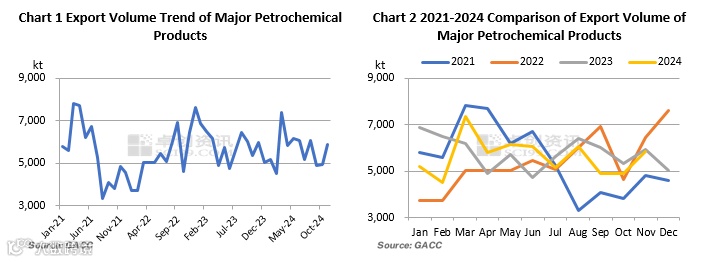
Exports of Major Petrochemical Products Reach Near Five-Year Highs in November
Among the 62 key petrochemical products closely monitored by SCI, 48% saw export volumes in November at or above the 80th percentile of the past five years, indicating that exports of petrochemical products were at a high level.
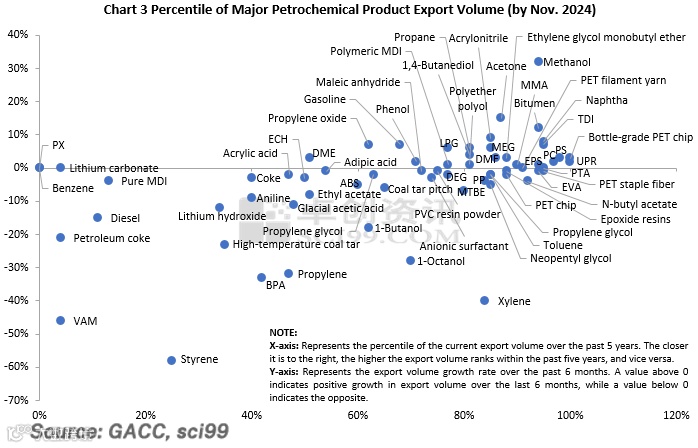
Methanol: 59.1kt, marking the highest monthly export level in the past three years.
Butyl acetate: significantly higher than in the same period in the past five years.
TDI: 38.6kt, continuing to set new records.
Bitumen: 83.2kt, up 104.94% M-O-M and 66.33% Y-O-Y, reaching the highest level in the past 6 years.
PC: 43.9kt, up 32.39% Y-O-Y.
PS: at a high level compared to the past five years.
EPS: 23.5kt, a relatively high level compared to the past five years.
MMA: at the higher end of the five-year range.
PTA: 432kt, reaching a historical high.
Polyester staple fiber: at a five-year high, with a considerable year-on-year increase.
Polyester filament yarn: 351.9kt, down 4.01% M-O-M, but up 5.79% Y-O-Y.
Bottle-grade polyester chip: 554.1kt, up 17.42% M-O-M and 16.55% Y-O-Y, reaching the highest level in nearly three years.
In summary, China’s petrochemical exports in November, 2024 saw great growth, with several products hitting new highs in recent years. This growth was largely driven by changes in international supply and demand dynamics, domestic oversupply, mature export channels, and trade cost reduction. Looking ahead, China’s petrochemical exports will face more complex opportunities and challenges. Under the “Trump 2.0” scenario, international trade uncertainties are increasing, and the growth of overseas demand is expected to slow, leading to a decline in trading orders. Additionally, fluctuations in the exchange rate of the Chinese Yuan will make export cost and profit management more challenging. Coupled with the continuous release of domestic new capacity and intensifying market competition, as well as the growing product homogeneity, China’s petrochemical exports may face certain pressure in the future.

All information provided by SCI is for reference only, which shall not be reproduced without permission.
Please click "Read more" for the full article.