

China Synthetic Rubber Import Trade Partner Analysis – U.S.
Introduction: The U.S. is one of the global leading producers of synthetic rubber. Affected by the trade friction, China’s synthetic rubber imports from the U.S. in 2023 dropped by over 70% compared with 2017. As the proportion of synthetic rubber imports from the U.S. has diminished, the expectations of adjustments in tariff of the U.S. may have limited influence on China’s synthetic rubber imports.
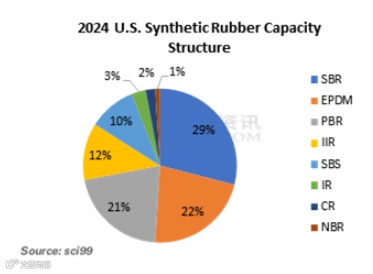
The synthetic rubber capacity in the U.S. accounted for around 15% of the global total.
According to SCI, the U.S. is one of the leading producers of synthetic rubber in the globe, with the capacity accounting for around 15% of the global total. The SBR capacity accounts for around 29% of the total synthetic rubber capacity in the U.S., ranking first. The EPDM and PBR capacity takes up around 22% and 21% respectively, ranking second and third. The IIR and SBS capacity accounted for around 10%-12%, and the IR, NBR, and CR capacity is relatively low.
After 2020, the U.S. had no newly added synthetic rubber capacity. South Korea is the major SBR import trade partner of the U.S.. In 2023, around 67kt of SBR was exported from South Korea to the U.S.. From January to September 2024, the export volume of SBR from South Korea to the U.S. has reached 60kt, and it is expected to rise to around 80kt in 2024, hitting a record high. After 2020, the U.S. annual import volume of PBR from South Korea was around 10kt, but it was lower than 6kt in 2022. It is projected that it may rise to around 10kt in 2024.
The U.S. is the largest source of South Korea’s trade surplus. If South Korea tries to reduce the surplus in the future, the probability of South Korea’s SBR and PBR resources back to China is not high. The main reason is that China may lead the globe in the capacity expansion of synthetic rubber, and China's synthetic rubber industry chain cost advantage is significantly better than South Korea. Thus, despite that some of the high-performance SSBR may be exported to China, the probability of the other SBR and PBR resources returning to China is expected to be not high.
2017 and 2023 China Synthetic Rubber Import from U.S. Comparison
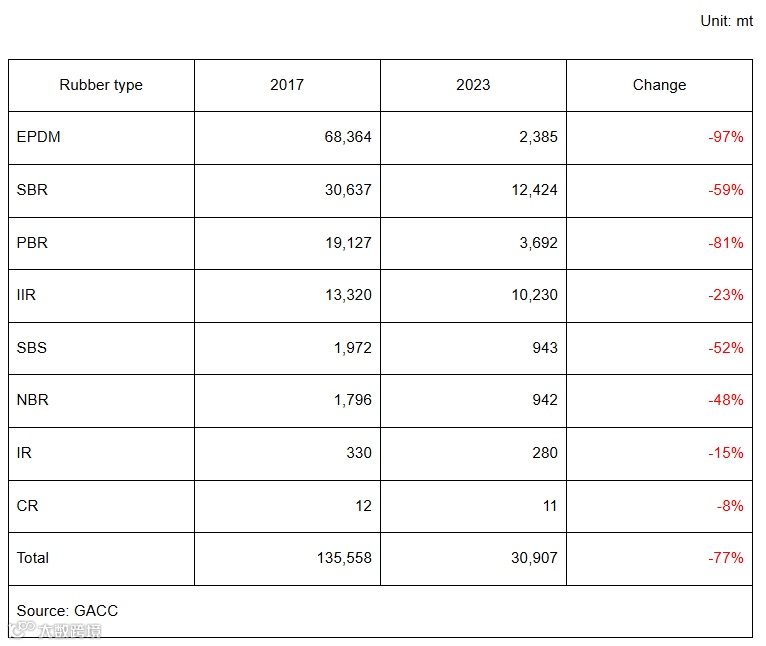
In 2017, China’s synthetic rubber imports from the U.S. were over 130kt.
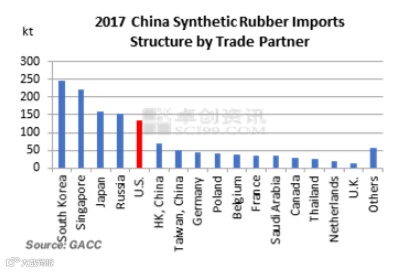
According to GACC, China’s total synthetic rubber imports were around 1,360kt in 2017, hitting a record high. The top 5 trade partners were South Korea, Singapore, Japan, Russia and the U.S.. China’s synthetic rubber imports from the top 5 trade partners accounted for 67% of the total. At that time, China’s import dependence of synthetic rubber was still high. China’s synthetic rubber imports from the U.S. were around 136kt. The imports of EPDM, SBR, PBR, and IIR took up 97% of the total synthetic rubber imports from the U.S..
China’s synthetic rubber imports from the U.S. in 2023 dropped by 100kt or 77% from 2017.
According to GACC, China’s total synthetic rubber import volume was around 1,250kt in 2023, down around 7% from 2017. The top 5 import trade partners were Russia, South Korea, Saudi Arabia, Japan, and Singapore, the synthetic rubber imports from which accounted for 79% of the total. At that time, China’s import dependence of synthetic rubber edged down.
In 2023, the changes in China’s synthetic rubber import trade partners compared with 2017 were as follows. First, Russia moved up by three spots among import trade partners. Saudi Arabia moved up by seven spots. Singapore and Japan slipped by 3 and 2 spots. Second, China’s synthetic rubber imports from the U.S. declined by 77%.
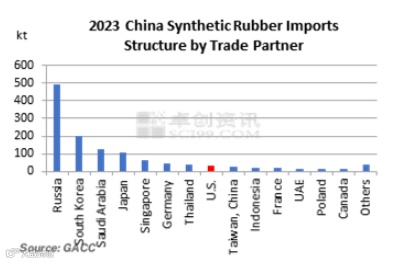
The Sino-U.S. trade friction in 2018 and the international situation changes in 2022 led to changes in the global trade flow of synthetic rubber. At first, the proportion of China’s synthetic rubber imports from Russia rose significantly, which increased from 11% in 2017 to 39% in 2023. Second, that from South Korea dropped from 18% to 16%. Third, that from Taiwan, China and Poland declined by 100% and 60% respectively. That from Germany changed limitedly.
If the U.S. has further strong adjustments in tariffs in the future, the direct impact on China’s synthetic rubber imports is expected to be relatively limited. If South Korea and Japan try to cut trade surpluses with the U.S., the probability of their synthetic rubber resources back to China may be not high. Despite some high-performance resources, the other synthetic rubber resources are not likely to return to China. The proportion of synthetic rubber imports from the U.S. has slipped from China’s total synthetic rubber imports. If there is a new tariff strategy in the U.S., the proportion is likely to shrink further. If the international situation is effectively eased in the future, the proportion of China’s imports from a certain European country may shrink somewhat. The expected redistribution of the synthetic rubber resources of a certain European country is expected to reconstruct the global and China’s synthetic rubber trade flow. (Opinions are for reference only and at your own risk.)
All information provided by SCI is for reference only, which shall not be reproduced without permission.
Please click "Read more" for the full article.