

Impact of Tariff Escalation on the Styrene Industrial Chain
Following the U.S. tariff announcements, China imposed additional tariffs on U.S. imports, escalating trade tensions. This impacts the styrene industrial chain across multiple dimensions.
On April 3, the U.S. unveiled reciprocal tariffs: 1) 10% baseline tariffs globally; 2) Additional tariffs targeting the top 60 trade deficit partners - 34% for China, 20% for EU, 46% for Vietnam, 32% for Taiwan of China, 214% for Japan, 26% for India, 25% for South Korea, 36% for Thailand, and 31% for Switzerland. Baseline tariffs took effect on April 5, reciprocal tariffs will be on April 9. A 25% auto tariff started on April 3; auto parts will be on May 3. Exemptions include gold, copper, pharmaceuticals, semiconductors, and wood products. China faces cumulative 54% tariffs after existing 20% duties.
The tariff issue directly impacts global economic conditions and end-user demand, with weakening macro sentiment and falling international crude oil prices already evident. Styrene, being financially sensitive, faces direct downward pressure. For styrene’s feedstocks, China’s benzene market may see indirect bearish effects from the reciprocal tariffs, while ethylene prices could gain moderate support. Styrene’s import and export flows remain largely unaffected. As for downstream PS, EPS and ABS, minimal direct America-China trade volume limits immediate impacts. However, domestic demand for these materials may be weakened, as end products like home appliances and automobiles face steep tariffs. Notably, 50-60% of China’s appliance consumption relies on exports, predominantly white goods to the U.S. market. This export contraction may ultimately reduce demand for styrene-based derivatives.
The tariff effect on styrene costs.
Constrained by limited capacity expansion due to its byproduct nature, the benzene market has maintained a supply-demand gap driven by robust downstream demand. In 2024, China imported 4,310kt of benzene, with an import dependency of 17%. South Korea, the world’s largest benzene exporter, supplied nearly half of China’s imports over the past five years. In 2024, 71% of South Korea’s benzene exports went to China, while 20% flowed to the U.S. The U.S.’s 25% reciprocal tariff on South Korea is expected to raise Korean export costs, likely diverting more benzene shipments to China.
By 2025, South Korea’s benzene exports to the U.S. have already declined by an average of 23.4kt monthly compared to 2024. Firstly, recovering profit at the U.S. toluene disproportionation units in late 2024 boosted domestic benzene supply, projected to rise by around 50kt monthly in 2025. Secondly, weak U.S. blending oil demand and increased European benzene availability for transatlantic arbitrage further reduced Korean exports to the U.S. Looking ahead, sluggish blending oil demand in Q2 and Q3 and rising Chinese benzene capacity may pressure Korean shipments, though China’s import dependency is expected to persist near-term. Overall, reciprocal tariffs may amplify bearish pressures on China’s benzene market as Korean exports shift from the U.S. to China.
For ethylene, China’s 2025 import dependency stands at 6.43%, with negligible U.S. imports. China's ethylene exports are also minimal, which is 77.6kt in 2025. Tariffs thus have limited direct trade impact. However, ethane is a key feedstock for China’s ethane cracking and mixed alkane cracking units and the U.S. tariffs on ethane could raise production costs for domestic ethylene plants. This may lift ethylene prices and potentially disrupt operations at three styrene plants integrated with these ethylene units, indirectly affecting styrene supply.
The tariff effect on styrene imports and exports.
China’s styrene trade saw declines in both imports and exports in 2024. The styrene imports dropped 48.44% YoY to 407.6kt and the import dependency was 2.55%. The styrene exports fell 32.39% to 247.4kt with the export reliance at 1.55%. The import and export volume already had a marginal effect on the market. In addition, China-America trade accounted for 0% of total imports and exports in China, resulting in no direct tariff impacts. The U.S. is a major styrene exporter to Europe and North America. South Korea is now a net importer sourcing styrene from China and Japan after phasing out domestic units. The above also shows negligible ripple effects on China’s styrene market.
The tariff effect on styrene downstream sectors.
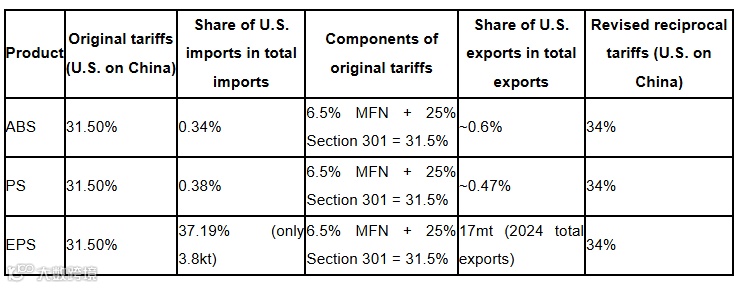
For downstream PS, EPS and ABS sectors, trade flows primarily involve Asia, Southeast Asia, Europe, and South America. Therefore, the tariff impacts little on these sectors.
Regarding end-products, electronics/appliances (including home appliances) account for 50-60% of domestic PS/ABS demand. Exports represent 50-60% of China’s appliance consumption, with white goods (e.g., air conditioners, refrigerators, washing machines) heavily reliant on the U.S. market. The U.S. tariffs on Chinese appliances have risen to 45% (cumulative), sharply raising export costs for large appliances. Smaller items like kettles and irons face 56.7% tariffs, threatening order losses and margin compression. This cost pressure weakens domestic demand for PS, EPS and ABS sectors, echoing challenges in automotive and other sectors.
Higher tariffs directly inflate export costs. If Chinese enterprises fail to offset the pressure, the exports to the U.S. market’s competitiveness will erode, risking displacement of low-margin products. While leading enterprises may relocate capacity, financially strained SMEs face existential risks. The U.S. tariffs on Southeast Asia also narrow the cost advantage for relocated Chinese producers, indirectly reinforcing China’s domestic supply chain resilience. With exports driving a significant share of appliance consumption, mid-to-long-term sector disruptions are inevitable.
In summary, tariffs pose near-term headwinds for the styrene chain, challenging global production and trade flows. Supply chain realignments and redirected trade patterns remain uncertain, demanding corporate focus on cost control, risk diversification, and operational agility. While challenges dominate, opportunities may emerge from adaptive strategies. The evolving reciprocal tariff landscape and global responses warrant close monitoring.
All information provided by SCI is for reference only, which shall not be reproduced without permission.
Please click "Read more" for the full article.