

China PBR & SBR Market Overview in Q1 2025 and Forecast in Q2
In Q1 2025, the average market price of HCBR 9000 in North China was RMB 13,950/mt, and the average market price of ESBR 1502 in North China was RMB 14,623/mt. As for the PBR market, the highest price of Q1 appeared on February 7 at RMB 14,650/mt, while the lowest price occurred on January 2 at RMB 13,150/mt. In terms of the SBR market, the highest price of Q1 was RMB 15,300/mt occurring on January 13, while the lowest price was RMB 13,800/mt on March 27.

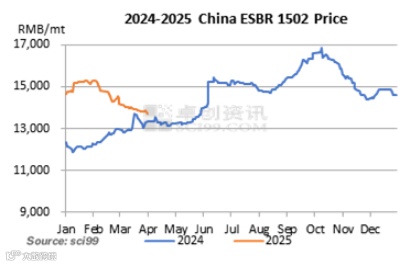
China’s PBR and SBR prices showed inverted V-shaped trends in Q1.
In H1 of Q1 2025, the PBR and SBR market prices mainly trended up. In early January, the natural rubber price edged down, slightly narrowing the price spread between natural rubber and synthetic rubber, but the price spread still bolstered the synthetic rubber prices. In terms of cost, the restart of some butadiene units was postponed, so the butadiene supply underperformed. Besides, the downstream stockpiling before the Spring Festival holiday started ahead of time. Thus, the butadiene price perked up, putting stronger cost pressure on the PBR and SBR industry. The rise in cost drove up the PBR and SBR prices. At the same time, it also accelerated the unit shutdown at PBR producers, leading to a decline in the PBR supply. With the Spring Festival approaching, downstream industries gradually lowered their operating rates and shut down some units for the holiday. The decline in rigid demand offset part of the support in the market. Thus, the PBR and SBR prices grew steadily.
After the Spring Festival holiday, the PBR and SBR market prices dropped from highs. As for the cost, the butadiene supply was expected to rise, and spot butadiene dealings at high prices were unsmooth. Besides, the butadiene producers for merchant sales faced stronger sales pressure. Thus, the butadiene price moved down, weighing on the PBR and SBR market atmosphere, thereby dragging down the spot PBR and SBR prices. The natural rubber price dropped with the supply rising, affecting the synthetic rubber market atmosphere. As for supply, the newly added PBR unit at Shandong Yulong Petrochemical went into production successfully and the products were sold normally. With the profits recovering, some PBR units were restarted in succession, resulting in a rise in the PBR supply. The SBR supply was stable at highs. Downstream operating rate hit an annual low during the Spring Festival holiday, leading to a decline in rigid demand. After the holiday, downstream users showed resistance to purchasing synthetic rubber when the prices were falling, and they held bearish sentiments in the synthetic rubber market. Overall, the PBR and SBR prices trended down after the Spring Festival holiday.
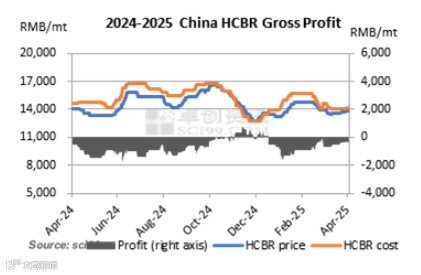
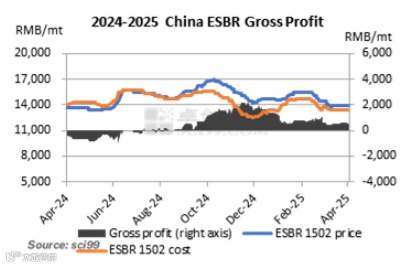
In Q2, the PBR and SBR prices are predicted to mainly fluctuate downwards.
In Q2 2025, China’s market price of PBR is expected to move down, and the SBR market price is predicted to mainly fluctuate downwards, with the monthly average price in May rebounding slightly.
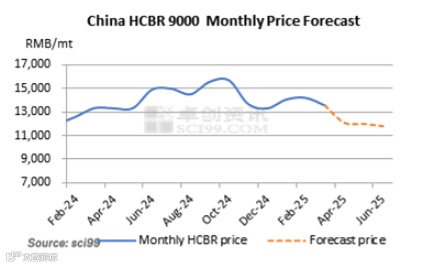
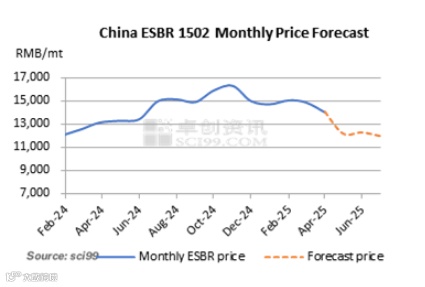
As for the macro environment, in April, the U.S. introduced the reciprocal tariff policy and raised tax rates for different countries. In response, China has taken countermeasures. The overall commodity market sentiments have been suppressed, which may continue to drag the market for some time in the future, and it may be difficult to drive up the commodity market. Under the influence of the commodity sentiments, the prices of PBR and SBR decreased notably and may go downwards in the short term.
The natural rubber price is predicted to fluctuate downwards in Q2. The bearish factors in the macro environment may strongly drag down the natural rubber market. Downstream users are expected to be cautious about receiving goods, weighing on the natural rubber price. In May, it is expected to be the global production slack season of natural rubber, so there may be some support from the supply side.
In terms of cost, the butadiene price is likely to move down without strong support, failing to drive up the synthetic rubber market.
Regarding supply, based on the unit maintenance plan, the PBR output is expected to drop first and then rebound, bolstering the PBR market limitedly. The SBR output may decrease somewhat in May, underpinning the SBR market, but the support may not last long with units being restarted.
In terms of demand, Q2 is the traditional tire market slack season. Besides, the bearish macro environment may also weigh on the tire production in Q2. Thus, the tire output is expected to show a downtrend. Under the influence of the global economic situation, the high growth in tire exports may further slow down, curbing the tire output to some extent, and the tire inventory will likely pile up.
Players are advised to pay attention to the changes in the macro environment and cost.
All information provided by SCI is for reference only, which shall not be reproduced without permission.
Please click "Read more" for the full article.