

Tariff Easing Lifts EPDM Demand Modestly, Prices to Stay Weak
Introduction: On the afternoon of May 12, China and the U.S. jointly released the Geneva Economic and Trade Joint Statement, announcing a temporary tariff easing that is expected to drive a phased recovery in downstream EPDM demand. The supply tightness is alleviated, and the substantial increase in domestic downstream demand is not obvious. In the short term, the market price of EPDM may experience moderate downward adjustments.
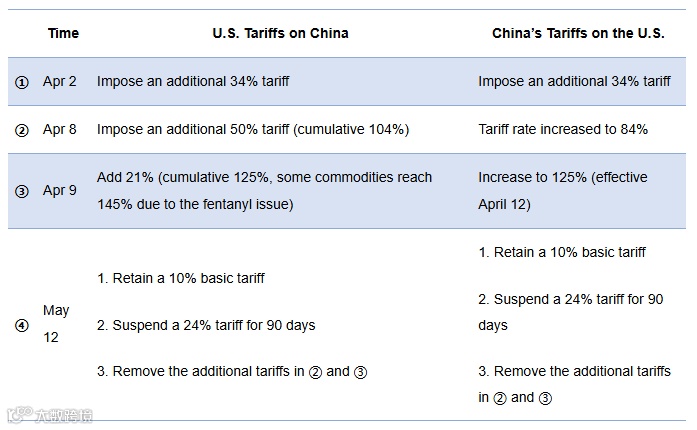
Following two days of negotiations, the high-level China-U.S. trade talks have achieved substantive progress with significant bilateral tariff reductions. Under the agreement, the U.S. will remove 91% of its additional tariffs, while China will reciprocally lift 91% of its retaliatory tariffs. The U.S. will also suspend 24% of its reciprocal tariffs, with China likewise suspending 24% of its countermeasures. Meanwhile, both sides retain the right to impose the remaining 10% tariffs on these goods in accordance with their respective regulations. This agreement effectively reduces the U.S. tariff rate on affected Chinese goods to 30%, while China’s tariffs on specified U.S. products will stand at 20-25%, significantly mitigating the impact on bilateral trade volumes.
However, it is worth noting that the joint statement mentions a 90-day pause, suggesting that this may not be the final outcome. For now, the agreement only provides temporary relief on tariff costs for goods traded within this 90-day window.
Table 1 U.S.-China Tariff Timeline
Export cost reduction to drive phased demand recovery
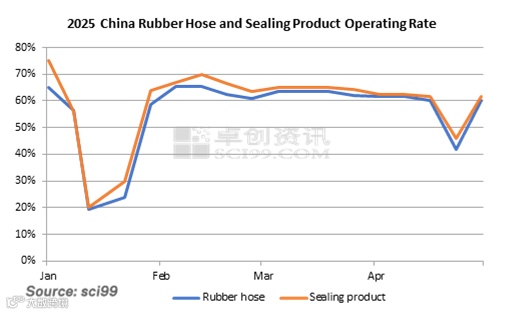
EPDM offers excellent resistance properties, making it ideal for outdoor and high-temperature applications such as automotive sealing systems, coolant hoses, wiper blades, lubricant additives, roof waterproofing membranes, door/window seals, conveyor belts, wire/cable insulation, and washing machine seals. The U.S. is a key export destination for China’s EPDM downstream products. After the U.S. imposed a 145% tariff on China, China’s exports to the U.S. fell, reflected in widespread declines in downstream operation rates. According to SCI, by the end of April, the average operating rate in the rubber hose industry was around 60%, down 3.5 percentage points from March. The conveyor belt industry saw an average operating rate of 60%, a decline of 13 percentage points from March. The sealing products industry operated at 62%, down 3.5 percentage points from March. This contraction in downstream industries has created a negative feedback loop for the EPDM industry sector. (Note: The downstream operating rates are based on SCI’s partial sample data.)
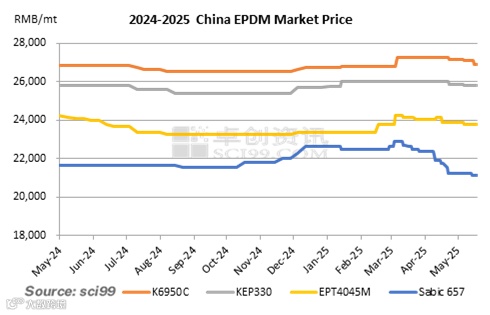
However, the critical progress made in tariff negotiations on May 12 is expected to reduce export costs for downstream enterprises, potentially facilitating a phased recovery in orders that could stimulate some demand rebound for EPDM. Additionally, with China-U.S. trade relations returning to early-April levels, market sentiment is likely to experience moderate short-term improvement. As of May 19, China’s EPDM market price averaged RMB 23,087.5/mt, down 0.38% from late April. This marginal softening reflects: first, eased supply tightness amid ample Saudi-origin spot availability; second, limited demand-side improvement from tariff changes - while some export orders showed recovery, most domestic downstream orders remained weak.
Reduced supply expectations to stabilize EPDM market price
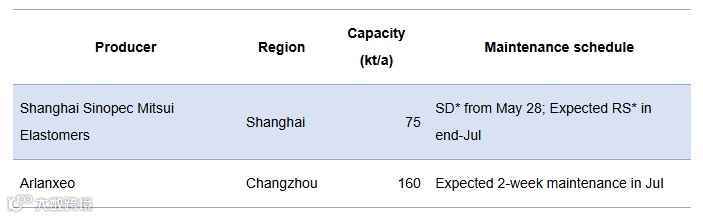
From the supply side, Shanghai Sinopec Mitsui Elastomers plans to begin maintenance at the end of May, while Arlanxeo schedules shutdown maintenance for July, leading to expectations of reduced supply. Additionally, low spot inventory of certain grades in the circulation chain also supports relatively stable selling prices in the market.
Table 2 EPDM Unit Maintenance Schedules
Short-term EPDM prices to trend flat-to-down; medium-to-long-term uncertainties persist
In the short term, within the next 90 days, tariff tensions between the two sides may ease temporarily, and the market may return to being driven by fundamental logic. A recovery in macro sentiment, reduced supply expectations, generally low inventory levels at domestic factories, and upcoming maintenance plans will support EXW prices of EPDM. With stable costs at market traders, the room for price adjustments to accommodate weak demand will be limited. There is also some room for recovery in downstream EPDM demand during the 90-day window. Overall, short-term EPDM prices are expected to remain steady stable-to-weakening, with limited volatility.
In the medium-to-long-term, given the 90-day policy window, the post-window tariff landscape remains contingent on subsequent negotiations. Notably, a 25% tariff under Section 232 has already been imposed on certain auto component exports to the U.S. since May 3, which will constrain the potential magnitude of demand recovery even if modest improvement occurs. Furthermore, as planned unit maintenance concludes, current supply tightness is expected to gradually ease. This could reignite the supply-demand imbalance in the coming months. In conclusion, the medium-to-long-term EPDM market faces high uncertainties, heavily dependent on post-90-day negotiations and operational trends in EPDM and upstream units.
All information provided by SCI is for reference only, which shall not be reproduced without permission.
Please click "Read more" for the full article.