

Will PP Prices Grow with Increase in Crude Oil Values?
Highlights: The rapid escalation of geopolitical tensions in the Middle East has driven a significant increase in crude oil prices, significantly bolstering PP prices from the cost side. Concurrently, the upward trend in PP futures prices has provided a boost to the spot market, lifting mainstream prices in the spot market. In the short term, international crude oil prices may spiral at highs, and PP prices may be stable-to-rising slightly. However, constrained by weak supply-demand fundamentals, the upward movement of PP prices is likely to be limited. In the medium and long term, a potential price pullback after a significant rally may be seen in the PP market.
China’s PP market prices gained ground slightly in the middle of June. As of June 13, PP raffia prices in North China averaged RMB 7,135/mt, up RMB 100/mt from the end of May. Besides, raffia prices in East China and South China averaged RMB 7,130/mt and RMB 7,185/mt respectively, up 1.06% and 0.84% from end-May. The price growth was mainly driven by a surge in crude oil values. Besides, the PP futures prices ramped up, underpinning the spot market as well. However, the growth rate was restricted by soft supply-demand fundamentals.
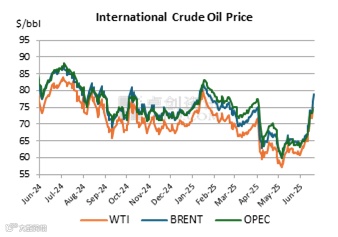
Sino-U.S. trade consultations have significantly revived macro risk, supporting a rebound in oil prices from lows. Coupled with the rapid escalation of geopolitical tensions in the Middle East, concerns over oil supply have intensified, driving international crude prices to surge broadly. As of the close on June 13, WTI crude prices rose by 7.26%, while Brent crude prices gained 7.02%. International crude oil futures prices recorded their largest single-day gain in over three years. The substantial rally in international crude oil prices has significantly strengthened cost support for the PP market and bolstered market sentiment.
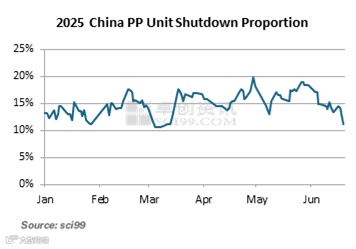
The unit maintenance intensity weakened as PP units at Sinopec Ineos (Tianjin) Petrochemical, Shaoxing Sanyuan Petrochemical (old line) and Sinopec SABIC Tianjin Petrochemical have resumed production recently. As of June 13, the proportion of PP unit shutdowns was 13.37%, down 4.99 percentage points from end-May. Moreover, newly added capacity at ExxonMobil Chemical and Shandong Jincheng Petrochemical was released steadily, so the PP supply turned ample. In terms of demand, limited new orders still constrained the buying appetite of downstream processors with the demand slack season underway. Downstream processors also showed limited acceptance of high-priced feedstock. In summary, relatively weak fundamentals lent limited support to the PP market price.
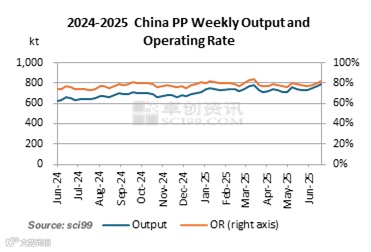
Overall, the rise in crude oil prices and the increase in PP futures prices have boosted sentiment in the spot market, propelling an increment in mainstream PP prices. However, the off-season characteristics in downstream PP fields remain evident, and downstream users showed limited acceptance of post-price-hike supplies. A sluggish trading atmosphere hindered the PP price growth rate. In the future, PP price movements may temporarily detach from fundamentals. As geopolitical tensions continue to escalate, crude oil prices are expected to fluctuate at highs, providing strong cost support for PP. This may sustain a modest rise in PP market prices. In the medium to long term, the oil market may still face oversupply pressure and experience a downtrend, dampening the PP price slightly. Simultaneously, the fundamental supply-demand imbalance may continue to dampen the PP market. Therefore, PP prices are likely to lose ground after increasing in the future.
All information provided by SCI is for reference only, which shall not be reproduced without permission.
Please click "Read more" for the full article.