

H1 2025 China Transition into Net PP Exporter
Introduction: China’s PP industry is undergoing a shift from net importer to net exporter. In H1 2025, the import dependence degree continued to decrease, while export volume kept growing, strengthening the net export momentum. Shipping costs, tariff policies and foreign exchange rate fluctuations persistently impact the import and export business, while domestic capacity expansion, low-priced competitiveness and export market diversification serve as primary drivers for import and export changes.
Phenomenon that overseas PP prices were higher than China’s domestic prices was compounded, leading to continuous declines in import volume.
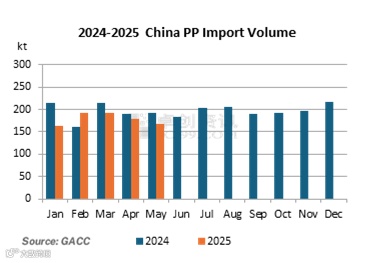
From January to May 2025, China’s PP imports fell by 5.13% year-on-year, with monthly imports (except February) decreasing to varying degrees. China’s PP market prices fluctuated downwards before June, enlarging the spread between the domestic and overseas prices. Against this backdrop, some major suppliers provided limited quotations to maintain their Chinese market share. Downstream factories showed low procurement interest in imported materials amid ample domestic supply and stagnant order growth, while only a few producers who conducted processing and assembling trade provided with raw materials made just-needed purchases. Additionally, the strengthening U.S. dollar value further dampened domestic buyers’ enthusiasm. Consequently, China’s PP import volume continued to shrink in H1 2025.
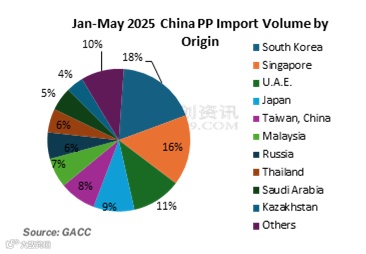
In terms of import origins, China’s PP shipments from the U.A.E., a European country and Thailand increased during the period. High-end special grades remained primarily sourced from South Korea and the U.A.E. However, persistently high costs coupled with profit losses led to reduced operating rates at overseas PP producers, diminishing shipments to China. Besides, ample supply and low prices in China constrained the number of quotations from overseas suppliers. As a result, the share of imports from South Korea and Singapore slightly declined compared to the same period last year, indicating a continued weakening of China’s import dependence degree.
Low-end FOB offers advantage and changes in exchange rates boosted PP export growth.
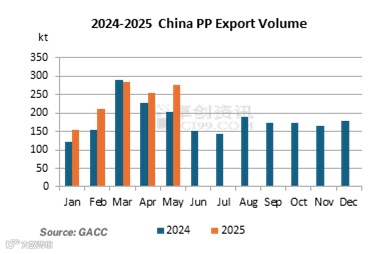
From January to May 2025, China’s PP exports recorded a cumulative year-on-year increase of 21.57%, with exports exceeding imports for three consecutive months (March–May). As new capacity from domestic producers like Baofeng, ExxonMobil (Huizhou) and Yulong Petrochemical gradually came online, domestic supply remained ample. China’s PP producers proactively lowered prices to alleviate inventory pressure, achieve sales targets and expand market share. Starting in May, some producers further reduced FOB prices to maintain export competitiveness, after additional pressures emerged, including rising propane tariffs and a significant surge in ocean freight costs. Concurrently, the strong U.S. dollar exchange rate widened the export arbitrage window, sustaining robust PP export momentum in H1 2025.
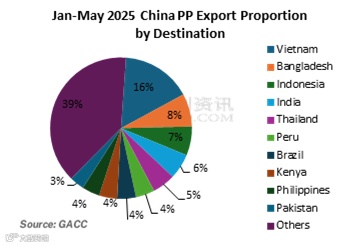
Regarding export destinations, Southeast Asia, South Asia and South America remained the primary markets. Among Southeast Asian partners, Vietnam, Indonesia, Thailand and the Philippines were still major partners of China’s PP exports. Therein, exports to Vietnam reached 210kt between January and May 2025, accounting for nearly half of total exports, which highlighted its strong market potential. In June, soaring freight costs forced the closure of long-distance shipping routes, intensifying competition in short-sea export markets, particularly within Southeast Asia.
In South Asia, India and Bangladesh remained key export partners, both registering over 30% year-on-year volume growth. As price transparency increased, Southeast Asian markets faced intensified competition and squeezed profit margins, and market players gradually shifted focus to other high-potential regions. Additionally, frequent maintenance shutdowns at producers across South Asia in H1 2025 created export opportunities for Chinese suppliers. However, weakening demand and growing local supply later allowed Southeast Asian producers—benefiting from geographical advantages—to erode China’s market share in South Asia.
Since 2023, South America has emerged as a stable export destination with consistent annual growth. Yet Brazil’s imposition of a 13% export tariff in 2024 reduced shipments by nearly 20% year-on-year. Conversely, China’s PP exports to Peru increased, with more volumes expected via the Chancay Port in the future. Nevertheless, the long shipping routes to South America undermine logistical stability amid volatile freight costs, leading to reduced export volumes in June.
Africa demonstrated significant export growth, concentrated primarily in East and West African ports. Exports to Kenya, Nigeria and Tanzania recorded notable year-on-year increases. Exports were mainly homopolymer grades, and this concentrated product mix is unlikely to diversify in the near term.
It is predicted that overseas suppliers will still provide limited quotations to China, given a narrow arbitrage space. Accordingly, China’s PP import volume may remain in a downtrend. For exports, soaring freight costs will hinder long-haul shipments and intensify competition in short-sea markets. However, Southeast Asia enters its demand dull season with weak orders, where arbitrage margins remain insufficient. Shipping freight on certain routes may drop at the end of June, which may create export opportunities to Latin America and South Asia. Generally, China’s PP export volume may decrease in June. In H2 2025, imports may continue to increase, while exports will probably keep climbing. Overall, the trend of falling imports and rising exports is expected to persist in H2 2025, accelerating China’s transition to a net PP exporter.
All information provided by SCI is for reference only, which shall not be reproduced without permission.
Please click "Read more" for the full article.