

SBR Price to Edge Up in May After Industrial Chain Prices Bottoming Out in Apr
Introduction: In early to mid-April, the prices of the products in the SBR industrial Chain fell rapidly, affected by the tariff issue. The prices of butadiene, SBR, PBR, and natural rubber all moved down to different degrees. In late April, the prices of the SBR industrial chain rebounded slightly, but the growth was limited without strong bullish factors. The expected strong cost will likely drive up the SBR price in May.
The prices of the industrial chain fell rapidly. The feedstock price saw the largest increment.
With the introduction of related policies of “reciprocal tariffs”, the capital risk-haven sentiments in the commodity market warmed up. In early April, the prices of multiple futures varieties fell by the daily limit. The price of synthetic rubber futures witnessed a total decrement of RMB 2,655/mt. Dragged by the bearish sentiments, the prices of the SBR industrial chain moved down beyond expectations. Therein, the market price of feedstock butadiene fell by over 20%.
The supply-demand gap of butadiene enlarged. In April, the butadiene units at ExxonMobil Huizhou Chemical and Wanhua Chemical Group (Phase II) gradually ran normally. The scheduled maintenance of some butadiene units was postponed. Thus, the spot butadiene supply increased. Affected by tariffs, orders at some glove enterprises decreased, curbing the operating rate of NBL units. The overall demand in the NBL industry declined, weighing on the butadiene consumption. Thus, the butadiene price trended down under pressure, and the decrement was the largest compared with the prices of other products in the industrial chain. With the fall in the butadiene price, the cost of SBR and PBR production declined. Yet, as the related policies of tariffs strongly affected the market sentiments, the price of synthetic rubber futures decreased beyond expectations. Besides, the downstream purchasing atmosphere of SBR and PBR was relatively weak, accelerating the fall in the prices of SBR and PBR. With the macro trading risk heating up, the price of natural rubber futures slid. At the same time, the weather in domestic production areas was favorable, so the area of rubber tapping in Yunnan gradually enlarged, driving up the expectations of new field latex. However, the demand improved limitedly. The macro environment and the fundamentals were both weak. Thus, the natural rubber price moved down. Under the influence of related policies of tariffs, the downtrends in the prices of the SBR industrial chain were mainly affected by the fall in the butadiene price, the weak demand, and the fall in the related product prices.
The prices of the products in the industrial chain rebounded after falling.
In mid-to-late April, the prices of the products in the SBR industrial chain rebounded after falling, but the demand curbed the increment. Only the natural rubber price saw a downtrend.
SBR: Only the SBR unit at PetroChina Lanzhou Petrochemical took maintenance. The SBR unit at Shen Hua Chemical Industrial ran at a lower load. Yet, the spot SBR resources circulating in the market were stable. Besides, the demand failed to improve. Overall, the SBR price faced headwinds in rebounding.
PBR: The PBR units under maintenance were restarted or were expected to be restarted. Yet, the operating rate of the tire industry dropped, so the demand failed to improve. The fundamentals weighed on the PBR price.
BD: In late April, some players replenished butadiene when the price was low. Besides, with the Labor Day holiday approaching, some downstream users had some rigid demand for replenishment. Besides, a butadiene unit in Shandong was expected to take turnarounds in May. Thus, the butadiene price stopped falling and edged up.
NR: Under the influence of the bearish macro environment, the market risk appetite cooled down, and accordingly, the natural rubber price fell notably.
From late April, the prices of the SBR industrial chain recovered, but there was still some pressure as the speculative demand failed to improve.
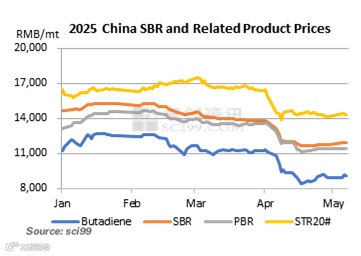
In May, the SBR price is expected to inch up driven by cost.
Supply: In May, the SBR supply is likely to drop by 6.7% MoM. From April 26, the SBR unit at PetroChina Lanzhou Petrochemical began to take maintenance and is expected to be restarted in late May. The unit at Hangzhou Yibang Rubber may be shut for maintenance for 30 days from May 20. From May 6, the old unit and the new unit at Shen Hua Chemical Industrial may both maintain two-line production, resulting in a rise in the SBR output. Overall, the operating rate of the SBR industry is estimated at around 70%, which is a relatively high level since 2020. Thus, the supply is expected to fail to drive up the SBR price.
Demand: The operating rate of the semi-steel tire industry is likely to trend down in May, so the demand for SBR may fail to improve. First, some semi-steel tire enterprises suspended production for the Labor Day holiday, and the duration lasted for 3-7 days. The average duration was longer than that in the same period of 2024. Second, sources said that the export orders in May are expected to be mediocre, weakening the support for the operating rate. Thus, the daily operating rate may move down slightly. Third, the production and sales at various semi-steel tire enterprises may diverge. It cannot be ruled out that the enterprises under high inventory pressure may further control their operating rates.
Cost: China’s butadiene market price is expected to ramp up in May, but the growth may be limited. As for demand, with some downstream units being restarted, the demand for butadiene is likely to increase. Yet, the operating rate of butadiene crackers may be relatively high in May, and newly added butadiene capacity will likely contribute to the output. Thus, China’s butadiene supply is expected to increase, but the increment in supply may be smaller than that in demand. Overall, the fundamentals may bolster the butadiene price in May. However, considering the oversupply in May, the increment in the butadiene price is likely to be limited. The uptrend in the butadiene price will likely drive up the SBR price in May.
NR: The natural rubber price is predicted to fluctuate downwards in May, and the average price may edge down MoM. As for supply, based on the normal seasonality, both domestic and overseas producing areas may see a large-scale resumption of rubber tapping. Given normal weather conditions and the high feedstock prices that boost the enthusiasm for rubber tapping, the expectation of new natural rubber output is significantly increasing, and the natural rubber price is likely to be under pressure. On the demand side, the foreign trade environment still restricts the export orders of enterprises. Coupled with the May Day holiday, the high inventory of finished products in enterprises may curb the overall operating rate. Downstream procurement may still mainly focus on replenishing inventories at low prices based on rigid demand, and there is a lack of improvement in demand. Therefore, there is a lack of core positive factors for the natural rubber price. However, as it is the off-season for domestic imports, social inventories are likely to decrease. Coupled with the support from the overseas feedstock cost side, there is support at the bottom of the natural rubber price. Overall, China’s natural rubber market may fluctuate weakly in May, weighing on the SBR market atmosphere. Yet, the natural rubber price may remain around RMB 2,000/mt higher than the SBR price, underpinning the bottom of the SBR price.
In summary, SCI reckons that the SBR price is expected to inch up in May, but the increment may be limited. First, there may be a lack of strong support in the SBR fundamentals, which is likely to curb the growth in the SBR price. Second, the cost may bolster the SBR price. Third, some traders will possibly replenish SBR resources at current prices, underpinning the bottom of the SBR price in the short term. Attention should be paid to the influence of the macro sentiments on the SBR price.
All information provided by SCI is for reference only, which shall not be reproduced without permission.
Please click "Read more" for the full article.