

Sino-U.S. PE Trade Trends and Tariff Impact
Introduction: From 2023 to 2024, the United States maintained its position as China’s principal source of PE imports. In 2024, due to geopolitical tensions and the lag in economic recovery, China’s PE import volume from the U.S. decreased by 117.4kt sequentially but still maintained the largest trading partner status with a 17.24% share. After the implementation of a 10% tariff on China by the U.S. on February 1, 2025, China’s PE import dependence degree remained at a relatively high level of 34%, and only 0.15% of total exports were directed to the U.S. Due to the clear unidirectionality of Sino-U.S. PE trade and China’s limited PE export volume, the impact of the tariff policy on China’s PE market is limited.
I. Slowing PE Capacity Growth in the U.S.
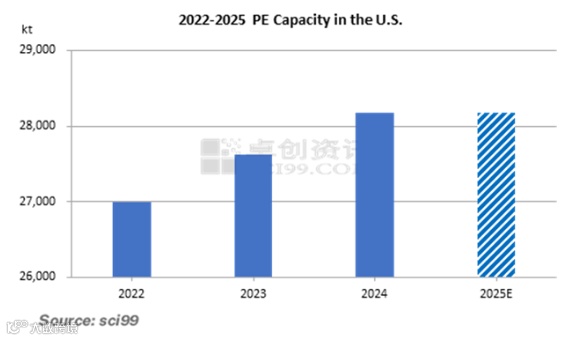
The total PE capacity in the U.S. reached 28,171kt/a in 2024, with the YoY growth significantly slowing down, adding only 550kt/a of new capacity. In 2025, there are no new units expected to be put into operations, further decelerating capacity growth.
The global PE market is still gravitating towards countries and regions like China, South Asia, Southeast Asia, and Africa. Owing to China’s rapid economic growth and its vast and diverse downstream application markets, China will continue to be a major driving force for global PE demand. Furthermore, considering the existing export advantages of the U.S. and changes in the international market share due to global supply chain adjustments, the overall supply of PE from the U.S. will remain at a relatively high level.
II. U.S. as China’s Top Import Trading Partner Impacts China’s Low-Price PE Market
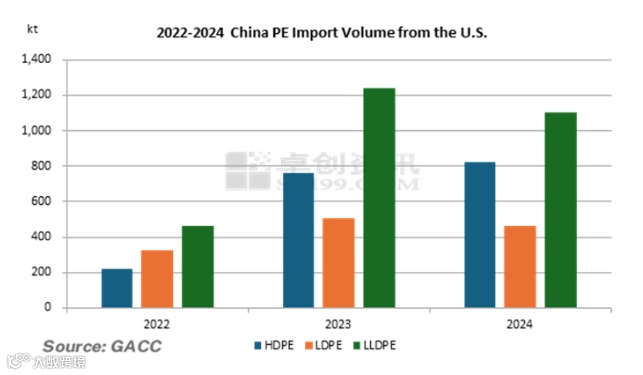
According to GACC, the PE import volume from the U.S. rose significantly from 2022 to 2023. Despite a decrease of 117.4kt in 2024, imports from the U.S. remained at the forefront among China’s trading partners, accounting for 17.24% of China’s total PE import volume.
Impacted by geopolitical situations, shipping costs, and the sluggish global economic recovery, PE market prices fluctuated downwards starting from Q3 2024. In 2025, influenced by Ramadan and supply shortages of some products in Southeast Asia, the demand in this region has risen swiftly, with more supplies from the Middle East and the U.S. flowing there. In contrast, with the gradual release of new capacity in China and an improvement in self-sufficiency rate, combined with the slow post-Spring Festival uptick in downstream demand, there’s some suppression of price increases. As of February 19, 2025, prices of LLDPE from the U.S. were in the range of $900-920/mt, equivalent to RMB 7,960-8,130/mt, with limited price spread between domestic and foreign markets. China’s traders make inquiries at low prices, but the supply is relatively constrained, thus supplies from the U.S. may remain at a moderately low level in the short term.
III. U.S. PE Exports Mainly Flow to China and South America
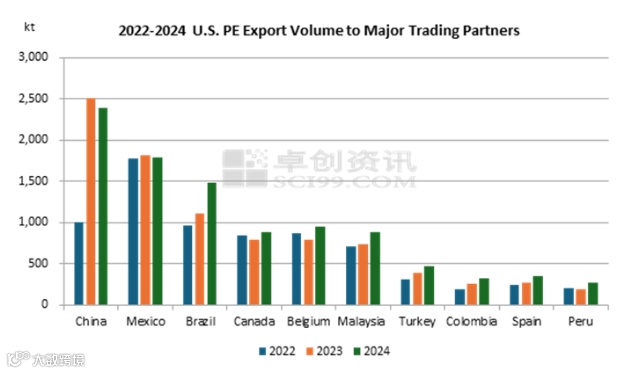
Source: ITC, SCI
China, South America, and Southeast Asia have become the U.S.’s top PE export destinations since 2023. In 2024, China took the top rank as the most important export market for PE from the U.S.
High inflation in American and European markets since 2023 has caused a downturn in the economies and low demand in those areas. On the other hand, proactive changes in macroeconomic policies have improved the performance of the Chinese market, raising hopes for China’s market demand. As a result, China has begun to become the main export destination for PE from the U.S.
In recent years, the economy of South America has been gradually recovering. Taking Brazil as an example, the sustained downstream demand has driven an increase in the demand for PE. Due to the geographical advantages, the quantity of PE that Brazil imports from the U.S. is on an upward trend. In 2024, Brazil’s PE imports from the U.S. reached 1,481.7kt, up 32.95% YoY.
With a 17.24% share, the U.S. remained the largest trading partner even though China’s PE imports from the U.S. fell by 117.4kt in 2024 due to geopolitical tensions and a delayed economic recovery. China’s PE import dependence degree remained at a comparatively high level of 34% after the U.S. imposed a 10% tariff on China, with only 0.15% of total exports going to the U.S. The actual effect of tariff policy on China’s PE market is negligible because the Sino-U.S. PE trade is nearly unidirectional and China’s export volume is small.

All information provided by SCI is for reference only, which shall not be reproduced without permission.
Please click "Read more" for the full article.