

Q2 NBR Price to Inch down After Up-then-Down Q1
Introduction: The NBR market price presented an up-then-down pattern in Q1 2025, shaped by peaking-then-declining feedstock costs, progressively increasing domestic output, and seasonally constrained downstream demand. As cost support and supply support shifted from strong to weak, the market completed this cyclical transition. For Q2, while planned maintenance at some units may constrain supply, demand appears unlikely to deliver a meaningful upside. It is expected that the market price of NBR in Q2 will mainly fluctuate repeatedly within a certain range, without an obvious one-sided market trend. The overall mainstream price may be lower than that in Q1.
In Q1, the market price of NBR rose and then fell, with the average price gradually declining. As of March 31, the average price of NBR in Q1 was RMB 16,305/mt, down 0.41% MoM and up 14.24% YoY.
Breaking down the quarterly performance, NBR market prices exhibited an upward trend in January. Throughout the month, the prices of key feedstock butadiene and acrylonitrile rose significantly, providing strong cost support. Additionally, market availability remained relatively tight during the first half of the month, further bolstering seller sentiment. However, as the Spring Festival fell earlier than usual, downstream factories began holiday preparations in the latter half of January. Given the elevated NBR prices, only factories with low inventory levels made modest purchases, resulting in overall weak demand that limited spot market transactions. This pattern persisted through the first half of February.
From late February through March, NBR market prices fluctuated downward. On the one hand, feedstock butadiene and acrylonitrile prices retreated, eroding cost support. On the other hand, the supply-demand imbalance intensified. On the supply side, newly commissioned capacity coupled with operating rate increases at existing units created market surplus conditions. Demand recovery, however, remained fragmented-while major downstream enterprises maintained sufficient orders and operating rates, small-to-medium enterprises struggled with weak orders and modest production levels. This bifurcation capped overall consumption growth, allowing the supply-demand imbalance to exert sustained downward pressure on the NBR market.
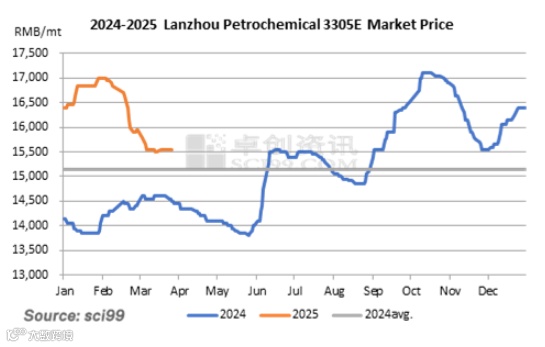
In Q1, NBR market prices rose and then fell mainly due to strong-then-weak costs and increasing supply.
Feedstock prices rallied and then declined, with cost-driven momentum weakening progressively.
Pre-Spring Festival supply tightness propelled both feedstock prices to seasonal highs, with post-holiday corrections emerging amid increased supply and slowly end demand recovery. As of March 31, the closing price of butadiene in the Jiangsu and Zhejiang markets was RMB 11,200-11,300/mt, a decrease of 11.42% compared with the highest point in January; the price of acrylonitrile in the secondary market in East China was RMB 9,000-9,100/mt, a decrease of 23.95% compared with the highest point after the Spring Festival. According to SCI, as of March 31, the production cost of NBR decreased by 14.58% compared with the highest point in January. The cost-driven logic of NBR shifted from strong to weak.
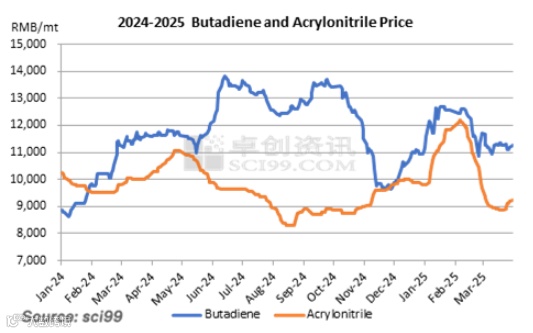
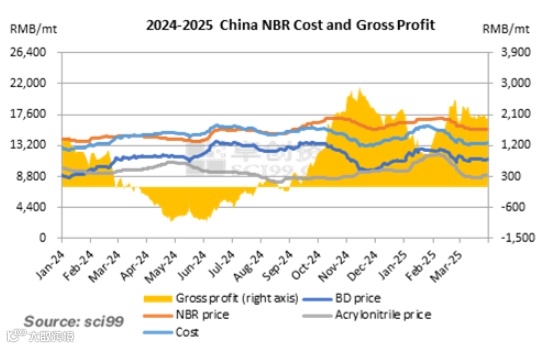
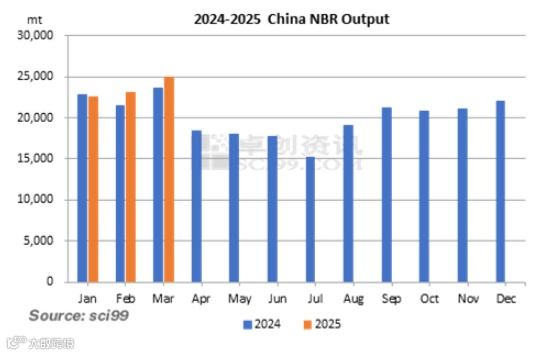
Imbalanced demand recovery and mounting supply pressure weigh on market fundamentals.
The widening supply-demand mismatch – characterized by sluggish demand recovery and progressively increasing supply – served as a key catalyst for NBR’s post-hike price decline. On the supply side, the spot availability in the market was tight following the delivery of previous orders, bolstering buyers’ sentiment. After the Spring Festival, the market supply gradually ramped up due to inventory accumulation and new unit commissioning. SCI data reveals NBR output rose 10.61% in Q1, up 10.61% compared with Q4 2024 and 4.09% higher than last month.
On the demand side, post-Spring Festival downstream resumption progressed at a relatively slow pace. According to SCI research, medium-to-large downstream factories gradually resumed production from February 4, small-to-medium factories restarted around February 7, and some small factories only resumed operations around February 12. According to the manufacturing PMI released by the National Bureau of Statistics, by the end of March, the Manufacturing Purchasing Managers’ Index reached 50.5%, up 0.3 percentage points from February, signaling continued recovery in manufacturing activity. However, the breakdown by enterprise size showed diverging trends: large manufacturers’ PMI stood at 51.2% (above the threshold), while medium and small enterprises registered 49.9% and 49.6% respectively (both below the threshold). Key sub-indices revealed mixed signals - the production index reached 52.6%, the new orders index 51.8%, and the purchasing volume index 51.8% by the end of March, collectively indicating improving manufacturing demand. However, both backlog orders and new export orders remained below the 50% boom-bust line, reflecting persistent weakness in demand sustainability. This slower-than-expected demand recovery exerted downward pressure on the NBR market.
In Q2, NBR market prices may fluctuate repeatedly, with the average price possibly declining.
Cost: In Q2, butadiene market prices are expected to decrease overall. Some units may take maintenance in April and May, supporting the bottom prices. However, the price will probably move down with the supply support weakening, thereby undermining the cost support to NBR.
Supply: Supply is predicted to contract due to the maintenance schedules for some NBR units, which will narrow the downside of market prices. Ningbo Shunze Rubber has a maintenance schedule in Q2, and PetroChina Lanzhou Petrochemical plans to conduct rotating maintenance from May to June (tentative sequence: 35kt/a unit, 15kt/a unit, and 50kt/a unit).
Demand: Demand in the manufacturing sector is likely to improve slightly. On the demand front, enterprises hold an optimistic stance toward future operations, with the manufacturing production and business activity expectation index maintaining a high level. The improvement in manufacturing demand will prop up the downstream consumption of NBR. However, considering the insufficient momentum in the construction market and challenges in the export trade environment, the increase in demand may be limited. Besides, as June approaches the summer season, downstream demand is expected to face potential contraction.
In conclusion, based on the fundamental expectation and seasonal characteristics, SCI predicts that NBR mainstream market prices will decline within a narrow range in Q2.
All information provided by SCI is for reference only, which shall not be reproduced without permission.
Please click "Read more" for the full article.