

Q1 2025 PP Average Price Edged Down with Softer Cost and Higher Supply
Preface: In Q1 2025, the cost support for PP prices weakened, and pressure from supply-demand fundamentals persisted, leading to weaker market performance compared to previous years. PP mainstream prices continued to trend downward accordingly.
Mainstream prices of PP declined continuously in Q1 2025 with strong supply and weak demand in a constant chasm.
PP mainstream prices inched down in Q1 2025, hovering at a historically low level. The average price of PP raffia in East China dropped by RMB 137.74/mt or 1.83% quarter-on-quarter to RMB 7,393.39/mt, but it rose slightly by RMB 13.80/mt 0.19% YOY. The highest and lowest prices in Q1 appeared respectively in early January and end of March.
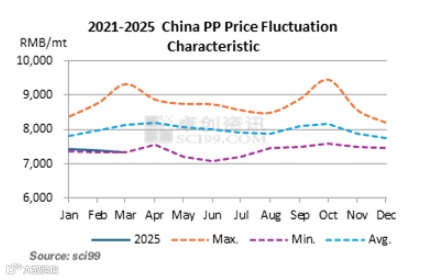
Regarding price drivers, first, crude oil prices increased at first but then lost ground in Q1 2025, and propylene prices were mainly on a downtrend, suggesting weaker cost support for PP prices. As for fundamentals, the supply pressure was relatively large due to high operating rates, in spite of limited capacity release. The demand for PP was poor because inadequate new orders and profits restricted the feedstock buying passion of downstream enterprises.
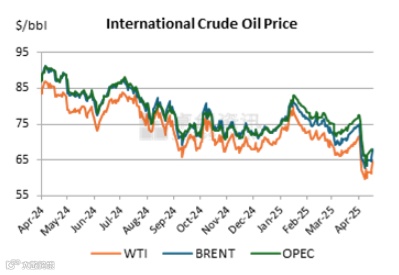
Crude oil values dropped after rising, cutting cost support for PP prices.
In Q1 2025, crude oil prices are expected to rise initially before declining significantly later. The early-stage price increase was driven primarily by intensified oil restrictions imposed by the U.S. on a European country. The subsequent downturn in oil prices stemmed from trade tensions following the return of Donald Trump to office, easing geopolitical conflicts, and an anticipated oversupply in the oil market. Currently, crude oil values are fluctuating within the $67-71/bbl. With oil mainstream prices trending downward overall, the cost-side support for PP prices weakened in Q1.
PP producers maintained high operating rates, driving up PP supply pressure.
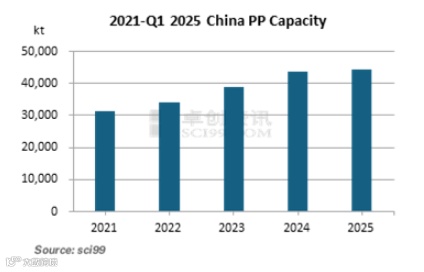
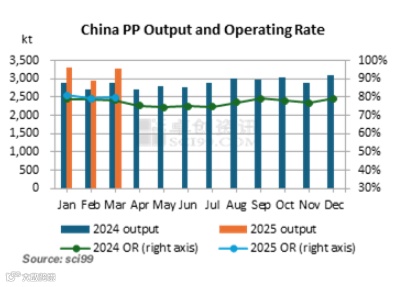
China’s PP capacity continued expanding in Q1 2025, with the second line of 500kt/a capacity at Inner Mongolia Baofeng Coal-based New Materials coming on stream. Fresh capacity in Q1 was lower than that in Q4 2024, but new capacity in December was gradually released, driving up supply in Q1 2025. Moreover, PP producers faced an improvement in profits as prices of raw materials such as crude oil lost ground, so they ran units at high operating rates. Therefore, China’s PP output rose by 12.13% YOY and 5.33% QOQ to above 9.521,4kt in Q1 2025. The quarterly average operating rate was 79.86%, up 1.87% QOQ and 1.22% YOY. Therein, the overall operating rate in February slid, but it remained higher than that in the same period of last year. In summary, the overall supply pressure was high, hardly forming support for the PP price.
Limited downstream demand release constrained PP price growth.
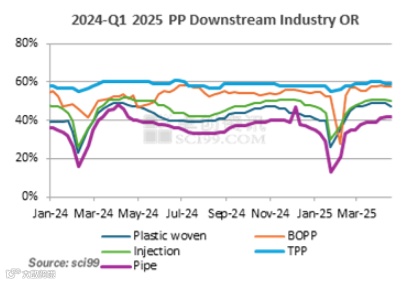
In Q1 2025, new orders at the major PP downstream factories performed moderately. In mid-to-late January, as the Spring Festival holiday approached, downstream factories gradually halted production, leading operating rates to drop to low levels. After the holiday, factories resumed operations, and operating rates rallied accordingly. By mid-February, most factories had significantly increased their operating rates. However, insufficient new orders restricted downstream operating rates nearing the end of February, and factories focused on digesting pre-holiday inventory of feedstock. In March, operational indicators for major downstream PP factories entered a seasonally stronger phase. With the arrival of the traditional peak season for production, downstream operating rates continued to rise. However, factories showed poor enthusiasm for restocking as new order volume fell short of expectations and factory profitability remained weak, limiting the demand for PP.
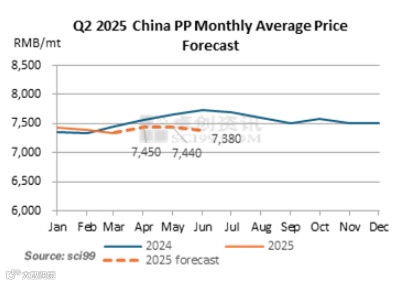
PP market prices are likely to rise at first but then drop in Q2 2025. China’s PP supply pressure is supposed to be eased in April due to the intensive maintenance, despite that there will be newly added capacity. As of April 17, the monthly average operating rates was 78.13% in April, down 2.19 percentage points from March. In PP downstream industries, operating rates are likely to stay high, and orders may improve, reflecting support for the PP demand. Currently, downstream plants and end users mainly adopt a wait-and-see stance because some export businesses were dampened by the changes in tariffs. Some end plants may curtail operating rates. For downstream plants, they maintain basic purchases of PP amid a dearth of confidence, even though PP prices are relatively low now. From May to June, PP supply is projected to swell on the back of capacity expansion, but maintenance may stay intensive. The downstream demand for PP may weaken with the demand slack season approaching. Additionally, end users may develop new overseas markets for exports. Although Sino-U.S. maritime trade is expected to cool down in the future, the pace of global layout by some domestic enterprises in China will be further accelerated. The order volume from China to other major countries and regions, such as Europe, Southeast Asia, Africa and other markets, is showing an upward trend. It is expected that in the future, some of the gap in orders to the United States can be made up by opening up new markets. Generally, soft macro environment may hinder deals in the PP market, and fundamentals may perform poorly, so mainstream prices of PP may inch down in Q2 2025.
All information provided by SCI is for reference only, which shall not be reproduced without permission.
Please click "Read more" for the full article.