

Jul PBR Imports Recover & Exports Remain High
Introduction: In July, China’s PBR import volume warmed up MoM, and the export volume remained high but edged down MoM. This passage will analyze the import and export changes in July and the reasons behind them.
In July, the PBR imports grew MoM and YoY.
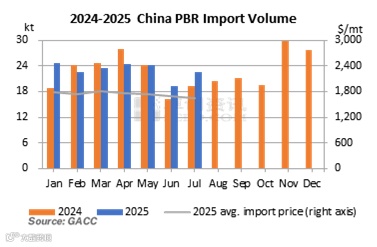
According to GACC, China’s PBR imports in July were 22,567.15mt, up 17.64% MoM and up 17.1% YoY. From January to July, the total PBR imports were around 161,186.22mt, up 3.76% YoY. From January to July 2025, the tire output edged up YoY. In July, China’s total output of all-steel tires was 12.5996 million pieces, up 10.97% YoY and up 2.37% MoM. From January to July, China’s total all-steel tire output was 82.6090 million pieces, up 4.86% YoY. In July, China’s total output of semi-steel tires was 53.946 million pieces, down 2.45% YoY but up 1.02% MoM. From January to July, China’s total semi-steel tire output was 373.7199 million pieces, up 1.53% YoY. Overall, the demand for PBR in July moved up MoM. The rise in tire output was driven by tire exports. As for the PBR industry, the production profits declined in July, dragging down the overall capacity utilization rate, which fueled the growth in imports for general PBR resources. However, as China’s new energy vehicle industry developed rapidly, China’s PBR resources of high-end grades were in a supply shortage and relied on imports.
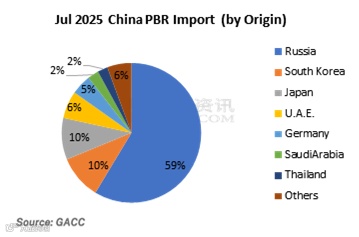
The proportion of the PBR imports from Russia increased. In July, the top 3 import trade partners of PBR were Russia, South Korea and Japan. Therein, the PBR imports from Russia were 13,232.88mt, up 78.34% YoY and accounting for 58.64% of the total, ranking first. Those from South Korea were around 2,292.73mt, down 25.44% YoY and accounting for 10.16% of the total, ranking second. Those from Japan were 2,174.41mt, down 1.77% YoY and accounting for 9.64% of the total, ranking third. The PBR imports from South Korea in July shrank somewhat MoM. Overall, the import structure was stable.
The PBR exports remained high.
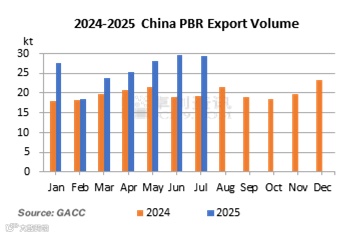
In terms of exports, according to GACC, China’s PBR export volume was 29,395.59mt in July, down 1.19% MoM but up 53.19% YoY. From January to July, the total PBR export volume was 182,207.89mt, up 33.97% YoY. In July, the PBR exports to Vietnam, Thailand, and Cambodia ranked top 3. Therein, the PBR exports to Vietnam were 9,164.44mt in July, accounting for around 31.18% of the total. Those to Thailand ranked second, which totaled 8,746.95mt, accounting for 29.76%. Those to Cambodia were 2,491.81mt, accounting for 8.48% of the total, ranking third. The PBR resources exported to Southeast Asia took up over 75% of the total. On the one hand, the demand in Southeast Asia was higher than that in China. On the other hand, in 2025, China’s PBR capacity and output both increased, resulting in a notable rise in supply. Yet, the increment in the overall PBR demand was limited in China. Therefore, against a larger supply-demand gap, PBR producers and traders explored overseas markets to balance production and sales. In addition, China’s tire enterprises accelerated the pace of establishing overseas plants, providing opportunities for China’s PBR exports.
Forecast:
Import: In August and September, China’s supply of general PBR is expected to be ample despite the turnarounds of some PBR units. Besides, August is still in the window period of China’s tire exports to the EU. With the end of the window period, the tire exports will likely drop in September, so the demand is likely to fall after rising. Therefore, China’s PBR imports are likely to grow first and then drop from August to September.
Export: There may be some uncertainties in the international situation. Attention should be paid to the tariff issue of tire exports in Southeast Asia. The local tire production pace is likely to remain stable. Besides, the EU’s demand for China’s tires is likely to transfer to Southeast Asia. The end of the window period for China’s tire exports to the EU may boost Southeast Asian tire exports to the EU, driving up the tire production willingness in Southeast Asia, which may indirectly bolster China’s PBR exports in August and September. Players are advised to pay attention to the influence of tariff policies on tire production in Southeast Asia. With the diversification of the destinations of China’s overseas tire plants, China’s PBR export destinations may also diversify, further underpinning the PBR exports.
All information provided by SCI is for reference only, which shall not be reproduced without permission.
Please click "Read more" for the full article.