

Q2, 2023 HDPE Price to Run Under Pressure
In Q1, 2023, China’s HDPE market price was relatively stable, and prices of various HDPE products fluctuated within a narrower range from Q4, 2022.
Taking the price of naphtha-based HDPE in East China as an example, the price of blow molding products averaged RMB 8,232.79/mt in Q1, 2023, down 0.07% from Q4, 2022. The average price of film and raffia products was RMB 8,379.51/mt and RMB 8,639.34/mt respectively, up 0.58% and 0.78% from Q4, 2022. That of pipe was and RMB 8,263.93/mt respectively, down 1.46% from Q4, 2022.
In early Q1, affected by the Spring Festival holiday, some producers proactively reduced their inventory before the holiday, so the overall inventory was at a low level. Prices of HDPE products were stable. After the holiday, market participants held a bullish sentiment, pushing up the HDPE prices slightly. After the Lantern Festival, affected by the macro environment, end orders underperformed compared with previous years. Some producers resumed production late after the holiday, and export orders in East China and South China declined notably, dragging down the operating rates at downstream enterprises. Therefore, prices of some HDPE products inched down.
As for the HDPE capacity, with the intensive commissioning of refining-chemical integration projects from 2019, China’s HDPE reached 16,460kt/a, up 11.52% Y-O-Y. In Q1, 2023, with the newly added capacity at PetroChina Guangdong Petrochemical, Sinopec Hainan Petrochemical and Shandong Jinhai Chemical put into production, the HDPE capacity rose by 1,100kt/a and the FDPE capacity increased by 1,400kt/a (including 400kt/a newly added capacity focusing on HDPE production). According to SCI, the newly added HDPE capacity will reach 2,200kt/a in 2023, up 13% Y-O-Y.
With the capacity expansion, the HDPE output also rose gradually, which reached 2,933.1kt in Q1, 2023, up 7.63% Y-O-Y, with the monthly output hovering at 890-1,030kt, up 30-120kt Y-O-Y. Therein, the output reached a peak of Q1 in March at 1,026.5kt. The output improved mainly due to the following reasons. Although the output loss due to unit maintenance increased by 26.85% Y-O-Y to 333.1kt in Q1, the output increment due to the release of the newly added 1,400kt/a HDPE capacity in Q1 was much larger than the output loss. Therefore, the overall output increased notably.
With China’s HDPE output rising gradually, the import volume showed a downtrend in recent years. In Q1, 2023, China’s HDPE import volume is estimated at 1,333.4kt, down 18.13% Y-O-Y. The monthly output hovered at 400-470kt, down 50-150kt Y-O-Y. Therein, the decline in March was notable, reaching 145.4kt. The import volume declined mainly due to the following reasons. First, China’s newly added capacity intensified the market competition, weakening importing appetites. Second, China’s market prices were at a low level, so overseas resources mainly flowed to other areas with higher profits.
According to NBS, the output of China’s plastic products was 11,168kt, down 7.4% Y-O-Y. In Q1, 2023, the downstream production declined slightly Y-O-Y, despite the recovering operating rates in March. As of the end of March, the operating rates of the HDPE raffia industry, film industry and injection industry declined by 3%-5% Y-O-Y. Meanwhile, downstream orders and export orders declined, giving thin support to the HDPE market. The inventory of finished products climbed, while downstream users mainly purchased on a need-to basis at low prices under capital pressure.
As for exports, China’s export volume of HDPE improved notably in Q1, 2023, up 12.68% from Q4, 2022 and 84.83% from Q1, 2022. However, the overall export volume was small, giving limited support to China’s market price. The major export destinations were the Philippines, Vietnam, India and Russia. The export volume increased mainly because China’s HDPE prices were at lows due to the continuous release of HDPE capacity, granting some export arbitrage opportunities.
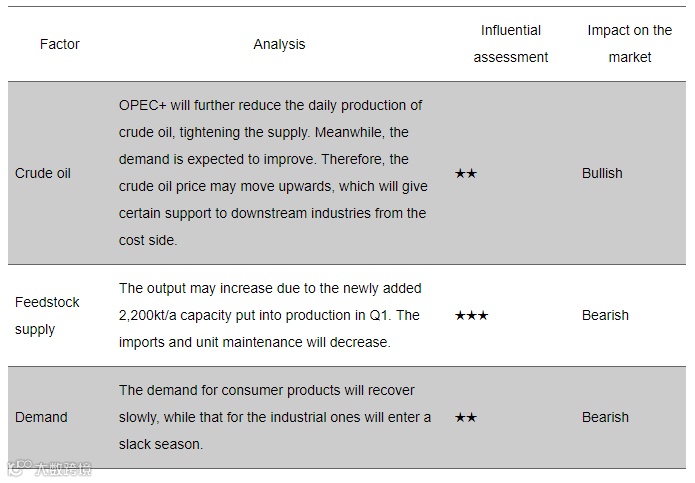
In Q2, the HDPE market price is estimated to fluctuate downwards mainly affected by the supply and demand fundamentals. The supply will exert increasing impacts on the price with the demand entering a slack season. Special attention should be paid to the output changes caused by operating rate adjustments due to rising costs amid recovering crude oil prices. The supply pressure brought by the newly added capacity may be alleviated by the operating rate reduction due to profits.
All information provided by SCI is for reference only, which shall not be reproduced without permission.
Please click "Read more" for the full article.