

What to Expect in Tissue Market After Anti-Involution Advocate
Introduction. Over the past five years, the supply-demand imbalance in the tissue market has intensified, persistently squeezing profits for both producers and downstream players. The market faces challenges of overcapacity and consumption upgrades. On July 28, the Guangdong Paper Industry Association initiated an "anti-involution" proposal, suggesting measures including standardizing market competition, optimizing capacity structure, strengthening innovation-driven development, and establishing a self-discipline mechanism. Despite lingering supply pressure and insufficient positive drivers in the short term, the potential refinement in market regulatory systems is expected to foster healthy market development in the long term.
Competitive pressure intensified due to growing supply-demand imbalance.
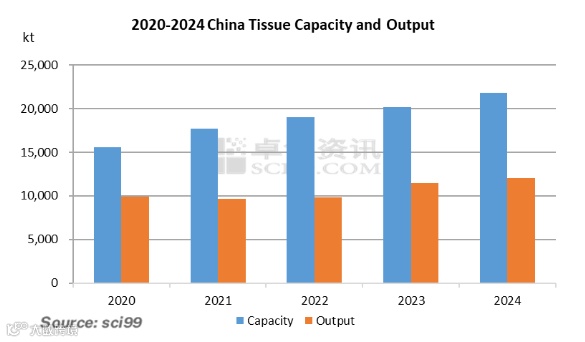
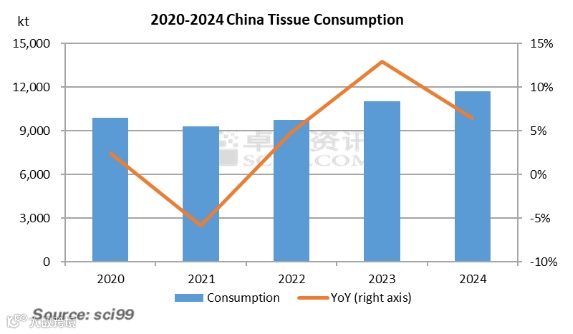
Between 2020 and 2024, the tissue market maintained an expansionary trend. Data shows stable growth in both capacity and output during this period. By end-2024, total tissue capacity in China reached 21,780 kt/a and total output reached 12,030kt. Consumption also continued growing, reaching 11,750 kt in 2024. However, the five-year compound annual growth rates were 8.69% for capacity, 4.46% for output, but only 3.98% for consumption. The supply-side expansion significantly outpaced demand growth, continuously intensifying market competitive pressure.
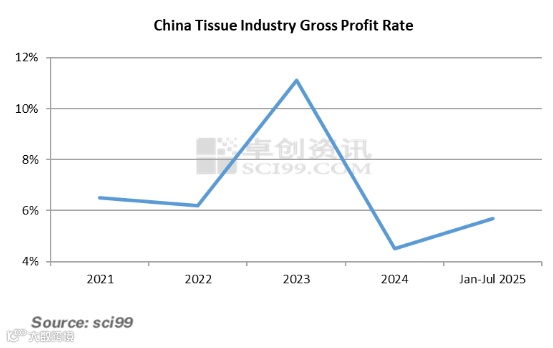
The supply-demand imbalance continues to reshape the tissue industry’s competitive landscape. In 2023, a surge in market pulp shipments to China caused significant wood pulp price declines, briefly lifting the gross margin to 11.07%. However, the margin fell back to 4.49% in 2024. Despite minor fluctuations during the wood pulp price downtrend in 2025, overall improvement was limited, indicating intensified market competition pressure compared to previous periods.
Survey data from sample tissue mills indicates declining gross profit margins for both toilet paper and facial tissues, with a more pronounced drop for toilet paper. This reflects widespread profitability deterioration in the tissue market. In the meantime, as medium and large-sized tissue mills enhance integration across the upstream-downstream chain, their advantages in cost control and channel development become more pronounced, continually squeezing the survival space for small and medium converting plants. The industrial and market restructuring, compounded by price competition, is accelerating industry consolidation and creating a more challenging competitive landscape. Overall, the tissue sector faces challenges of rising cost pressures and fiercer market competition, and players’ profitability is unlikely to see substantial improvement in the short term.
The tissue industry urgently requires transformation for high-quality development.
The tissue sector confronts double historic challenges: capacity expansion and demand iteration. Key current industry characteristics and issues are as follows. Firstly, against sustained pressure in the pulp and paper market, the monthly high-low price gap for pulp is narrowing. Monitoring data since 2024 shows the import HWP price gap narrowed from RMB 343.18/mt in July 2024 to RMB 102.89/mt in July 2025, a YoY contraction of RMB 240.29/mt. This trend indicates shrinking room for low-cost competition relying solely on cost advantages. Paper mills urgently need to build differentiated competitive edges by optimizing cooperation mechanisms and enhancing channel value.
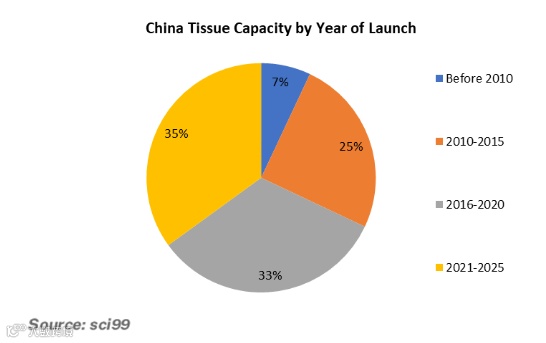
Secondly, regarding capacity structure, outdated capacity from expansion before 2015 still accounts for 32% of the industry’s total. These high-energy-consumption, low-utilization tissue machines partially fall behind the industry’s green development requirements and are subject to optimization through technical upgrades or closures and restructuring.
Thirdly, with relatively low industry entry barriers, homogeneous competition among numerous small and medium-sized tissue mills and converters is intensifying. On the supply side, affordable Chinese-made tissue-making equipment drives significant newly added capacity. On the demand side, consumption upgrades fuel growing demand for differentiated, high-quality products. This structural contradiction compels paper mills to achieve differentiation through product and technological innovation.
On July 28, the Guangdong Paper Industry Association released the industry’s first "anti-involution" initiative, outlining four development pathways. Standardizing market competition, optimizing capacity structure, strengthening innovation-driven growth, and building an industry self-discipline mechanism. This initiative not only fills the gap in self-regulatory mechanisms but will also propel the industry’s shift from price competition to value competition.
Short-term supply pressure persists, but "anti-involution" initiative to facilitate healthy industry development in the long run.
In July, despite improved macro sentiment following the “anti-involution” initiative, the tissue market still faced supply-demand pressure, leading to further price declines. On the demand side, traditional off-season effects weakened downstream converters’ procurement enthusiasm, slowing finished product shipments. On the supply side, some tissue mills offered promotions to reduce inventory. Both factors drove the tissue market price downward. Entering August, the industry gradually transitions to peak season, and downstream converters may start replenishing stock, potentially bringing marginal demand improvement. However, given ongoing supply pressure from newly added capacity, prices may hardly increase, with the August average likely around RMB 5,580/mt.
From an industry development perspective, driven by policy guidance and optimized market conditions, the tissue industry is undergoing profound transformation. On one hand, the competitive model is shifting from “price competition” to “value competition”, with tissue mills placing greater emphasis on product quality and value-added services. On the other hand, growing attention to green, healthy, and environmentally friendly concepts is accelerating innovation in raw materials and production process upgrades. Meanwhile, enhanced operational efficiency and innovative cooperation models inject new momentum into sustainable development, collectively propelling the tissue industry toward high-quality, sustainable development with a focus on long-term value creation.

All information provided by SCI is for reference only, which shall not be reproduced without permission.
Please click "Read more" for the full article.