

SCI View: China’s Early-Winter LNG Prices Defy Seasonal Strength
China’s 2025-2026 heating season is underway, yet LNG prices fell year-on-year in November. While heating demand is projected to rise this winter based on temperature forecasts and inventory data, the market is characterized by ample supply and substantial reserves, leading to a state of “overall abundance with localized, periodic tightness” that caps upside for LNG prices. The month-on-month price increase was primarily driven by stockpiling demand in late October and early November, with underlying consumption growth remaining tepid.
November LNG Prices Sank to Five-Year Low
LNG prices followed a pattern of rising then falling in November. SCI data shows the ex-works price was RMB 4,269/mt, down 2.94% year-on-year. Although this represents a 5.5% increase from the previous month, it marks the lowest November level in five years.
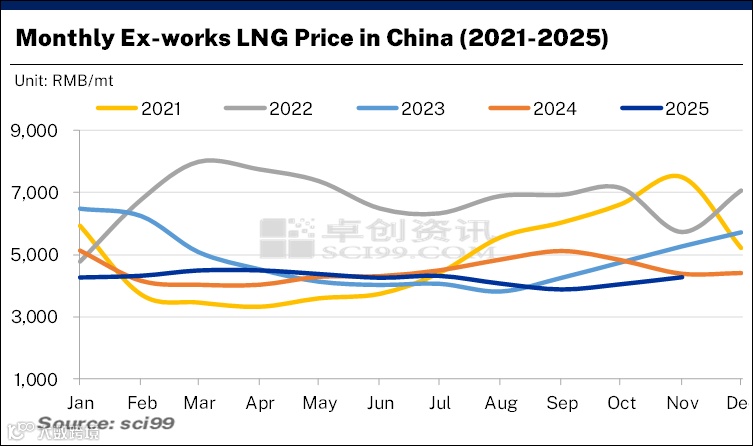
Demand: Support from city gas distributors replenishing inventories and receiving terminals optimizing tank levels from late October to early November was the core driver for the sequential price increase. In mid-to-late November, despite the heating season’s full start, ample resource reserves, short-lived cold spells, sufficient pipeline gas supply for city distributors, and weaker industrial demand compared to the September-October production peak kept a lid on prices. Increased LNG supply further pressured prices.
Supply: With the heating season starting, coastal LNG receiving terminals significantly raised imports to ensure domestic supply. Shipping schedule data indicates November arrivals totaled approximately 6.2 MMt, up nearly 13% from October. Simultaneously, CNPC’s feed gas supply to LNG plants increased. For example, feed gas allocated via auctions in western/northern regions reached 577 mcm in November, up over 14% from October. With both imported and domestic resources rising strongly, LNG supply remained ample.
Cost: Cost support continued to weaken. November LNG spot DES prices ranged between $10.46-$11.15/MMBtu, trending downward notably in the latter half. While auction results for CNPC’s feed gas to LNG plants rose in early November, briefly boosting upstream sentiment, limited demand led plants to cut prices to manage inventory, often operating at a loss. Consequently, feed gas costs faced downward pressure in a supplementary auction in mid-November, further eroding price support. Overall, costs for both imported and domestic resources fell noticeably in late November, exacerbating price declines in an oversupplied market.
2025/2026 Winter-Spring Outlook: Weather Rules Near Term, Supply the Long
1. Weather: Generally Warmer, Locally Colder
According to the “2025/2026 Winter Climate Trend Forecast” released by the National Climate Center in November, temperatures from December 2025 to February 2026 are expected to be above average across much of northern, eastern, central, and southwestern China, as well as in Xizang and southern Xinjiang. Notably, the high-altitude regions of southwestern China, including Xizang, may see temperatures 1-2°C higher than usual. In contrast, below-average temperatures are forecast for northeastern and western Inner Mongolia, most of Northeast China, and northern Xinjiang, with northeastern Inner Mongolia and northwestern Heilongjiang expected to be 1-2°C below normal.
Warmer trends have persisted for years in China, with cold spells typically localized. While most regions are expected to see average or above-average temperatures this winter, vigilance is needed for colder local conditions, particularly in northern provinces with centralized heating, which could significantly increase heating demand.
2. Storage: Gas Storage and LNG Terminal Inventories Above Previous Years
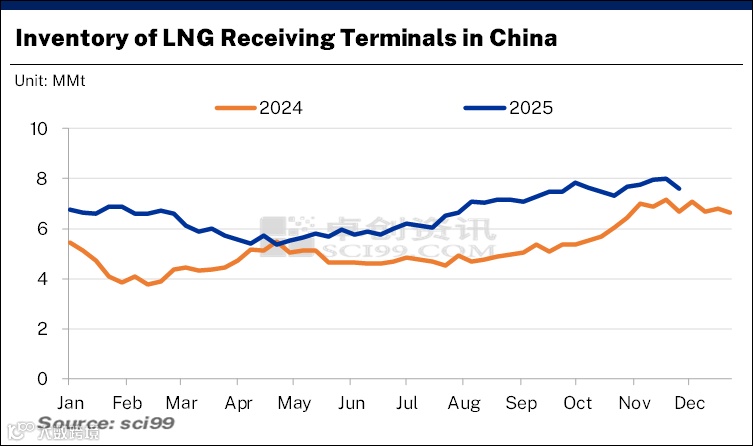
China’s peak-shaving facilities mainly include underground gas storage (UGS), LNG terminals, and LNG storage stations. In 2025, the working gas capacity of domestic UGS increased by about 4 bcm. Facilities like Hutubi, Liaohe, Dagang, and Zhongyuan storage complexes began withdrawal in early-mid November. For LNG terminals, inventory stood at 7.61 MMt as of November 28, 13.63% higher year-on-year. Regional LNG storage stations and some plants operating as storage also provide flexibility.
All information provided by SCI is for reference only, which shall not be reproduced without permission.
Please click "Read more" for the full article.