

Sep Chemical Market Anticipated to Keep Firm
Preface: In August, the chemical market continued to climb, with most products seeing large price rises. Temporary supply reduction, improved expectations for the macro environment and demand all contributed to the uptrend. Looking ahead to September, the chemical market is still anticipated to run under the support from macro environment improvement and high crude oil prices, but weakening fundamentals may restrict the extent of price rises.
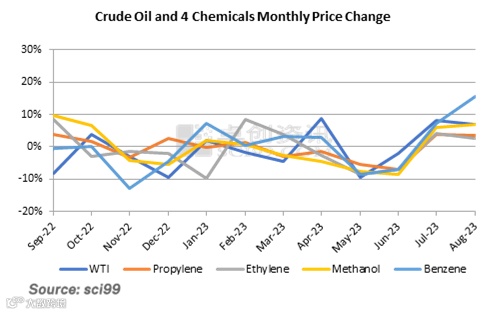
In August, most chemicals saw price rises. Among the 53 major chemicals that SCI monitors, 46 products saw rises in their monthly average prices, such as propylene glycol (20%), 2-EH (19%), crude benzene (17%) and coal-based benzene (16%). 5 products witnessed declines in their monthly average prices, such as DMC (-6%), MMA (-4%) and ABS (-1%).
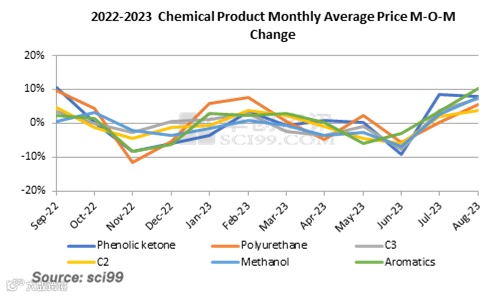
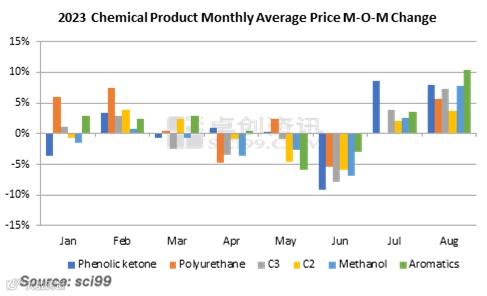
There were three major reasons behind the price rises of chemicals in August. First, Saudi Arabia’s oil production cuts buoyed international crude oil prices despite later declines due to drags from the strengthening of the US dollar and expected Fed rate hikes. The monthly average price of WTI crude rose by 6.8%, providing cost support to chemicals. Second, the periodical stockpiling and higher operating rates at some downstream plants consumed more feedstock chemicals. Meanwhile, consumption policies boosted market sentiments. Third, the supply of some products was tight because of intensive unit maintenance, such as oxo-alcohols, propylene glycol and phenolic ketone.
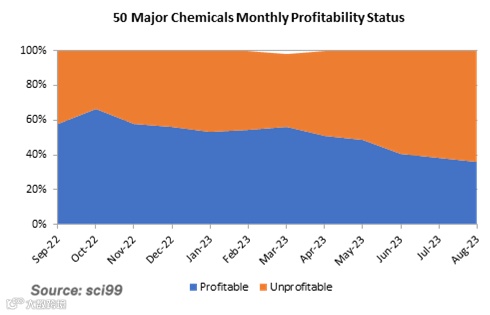
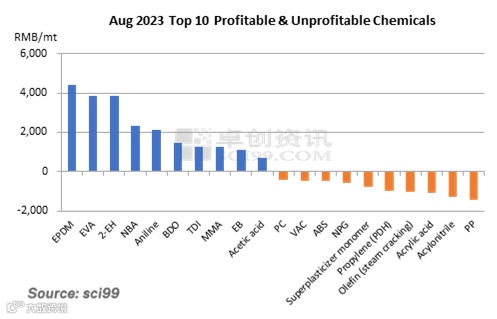
In August, the number of chemicals with negative profits increased. Among the 50 chemicals that SCI monitors, the proportion of chemicals with negative profits rose gradually from March, and it reached about 64% in August. Boosted by high oil prices, the prices of most upstream products advanced persistently, while the new orders at downstream producers were limited, slackening the cost transmission. As a result, the profits of most midstream and downstream products shrank further.
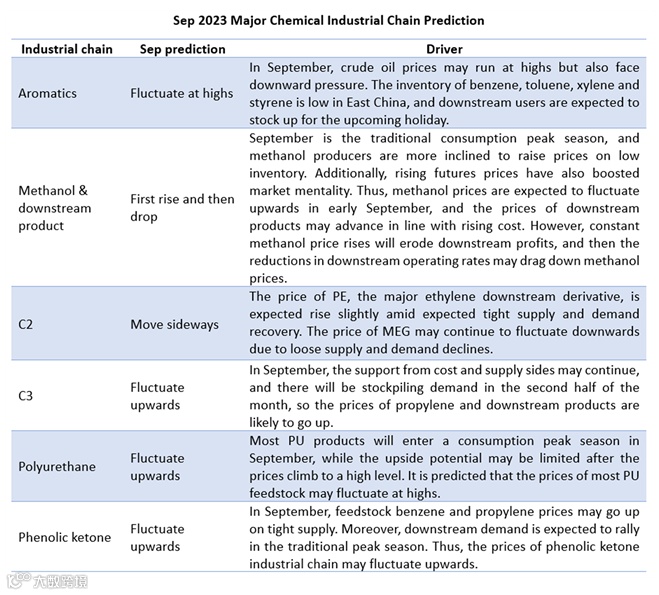
September forecast: The chemical market is likely to further go up in September, but there is also some resistance. For one thing, the macro environment is expected to improve, and China’s domestic economy recovery continues. For another, crude oil prices are predicted to run at highs. However, the relatively weak end demand may curb downstream buying, and some restocking demand has been released when the prices were low, so downstream demand may be not as strong as expected in the traditional peak season. Supply changes will still be a key to the pricing in some periods.
Global economic recovery has remained weak on the whole.
In August 2023, the global manufacturing PMI was 48.3%, up 0.4 pct M-O-M and rising for two consecutive months. However, the index stays at a low level of around 48%, indicating that the global economic recovery is still weak and demand still tends to shrink. As for different regions, Asian manufacturing PMI was 50.7%, up 0.2 pct M-O-M. The US manufacturing PMI was 47.6%, up 1.2 pct M-O-M. European manufacturing PMI was 44.7%, down 0.1 pct M-O-M. African manufacturing PMI was 49.4%, up 0.3 pct M-O-M.
China’s economy has maintained sustainable and steady recovery.
In August 2023, China’s manufacturing PMI was 49.7%, up 0.4 pct from the previous month and rising for three successive months. The expected index of production and business activities, the purchasing volume index, and the inventory index of raw materials in the PMI all rose to varying degrees, suggesting that business confidence has improved and production and operation activities have signs of recovery. At the same time, it should be noted that the problem of insufficient demand is still prominent. The PMI new order index, the PMI new export order index and the PMI production index were 51.9%, 50.2% and 46.7%, up 1.7 pct, 0.7 pct and 0.4 pct respectively.
International crude oil prices may encounter downward pressure.
There are two major bearish factors: Market participants hold different attitudes to the macro environment. It is expected that the interest rate may rise in November. Moreover, the dollar strength may weigh down the international crude oil prices. With the consumption peak season coming to an end, the crude oil stock may rise. However, the crude oil production cut may give support to the international crude oil market.
End demand keeps improving, but the support from fundamentals may weaken.
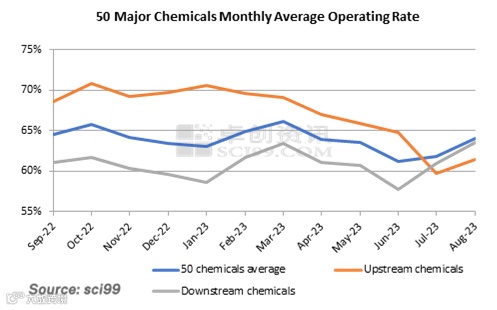
Among the 50 major chemicals that SCI monitors, the monthly average operating rate rebounded to 64.03% in August, up 2.16 percentage points M-O-M. The operating rates of downstream chemicals continued to rallied, indicating the constant improvement of end demand and demand expectation. The operating rates of upstream products also rose somewhat, so market supply increased gradually.
Although September is a traditional consumption peak season for chemicals, the improvement in downstream demand is more an expectation. However, the profits of most chemicals are thin or even negative, so the overall production positivity is not high. In addition, the support from former supply tightness has diminished gradually. Therefore, the overall supply-demand fundamentals of the chemical market may weaken.
All information provided by SCI is for reference only, which shall not be reproduced without permission.
Please click "Read more" for the full article.