

PBR Price Rebounds After Falling Driven by Supply in Q4, 2023
Keywords: PBR, Reverse the previous rally, Demand falling
Snapshot: In Q4, 2023, the overall PBR price trended down, reversing the rally of Q3. Yet, bolstered by the decrease in supply, the PBR price rebounded in end-Q4, and the average price was higher from 2022. In Q1, 2024, the supply and demand may remain weak, so it may be difficult for the PBR market price to show a unilateral trend.
The PBR price rebounded after falling in Q4, 2023.
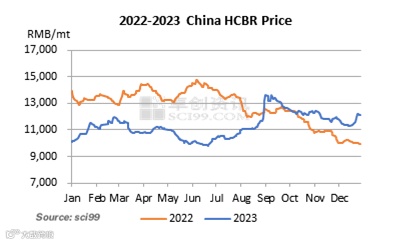
In Q4, 2023, the PBR price increased after dropping. Overall, it reversed the previous rally of Q3. As of end-December 2023, the HCBR 9000 price in North China closed at RMB 12,100/mt, down RMB 550/mt from end-Q3. In Q4, the average price was RMB 11,949.19/mt, up 3.43% Q-O-Q and up 9.79% Y-O-Y. In Q4, the PBR price mainly showed a downtrend, but the overall price was higher compared to the same period of 2022.
From October to November 2023, the PBR price mainly slid, affected by the expected restart of the units at Nanjing Yangzi Petrochemical and Rubber and PetroChina Sichuan Petrochemical. Therein, the unit at Nanjing Yangzi Petrochemical and Rubber has a capacity of 100kt/a, and that at PetroChina Sichuan Petrochemical has a capacity of 150kt/a. In the wake of the restart of these two units, the PBR monthly output was expected to rise by over 15kt, obviously driving up the PBR supply. Players were cautious about the increment in the future demand. Their bearish sentiments led to a notable fall in the prices of synthetic rubber futures, and the market price of spot PBR reversed the previous rally accordingly. With the PBR price falling, the industrial profits changed from positive to negative. Changes in cost had a stronger impact on the PBR price, foreshadowing the rebound in the PBR price in December.
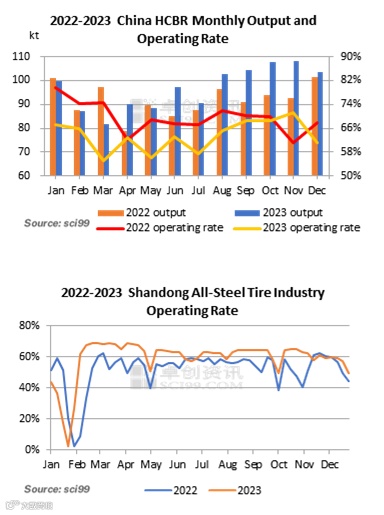
In December, the PBR price rebounded notably. First, affected by the demand slack season, the operating rate of the downstream all-steel tire industry showed a downtrend, while the PBR supply saw a larger decline. Therein, the PBR units at Sinopec Maoming Company and Heze Kexin Chemical were shut down on December 13 as scheduled. The units at Sinopec Qilu Company and Zhejiang Petroleum & Chemical were shut down unexpectedly. Thus, the operating rate of the PBR industry decreased from 72.51% in end-November to 58.69% in end-December, a decline of around 14 percentage points. Bolstered by supply, the PBR price rebounded in end-Q4 of 2023.
Major events in December 2023:
1. On the morning of December 23, 2023, the PBR unit at Sinopec Qilu Company was shut down. At present, the 170kt/a butadiene unit at Sinopec Qilu Company was gradually restarted. The downstream matching HCBR unit was shut down on the night of December 24, 2023, and the matching ESBR unit ran at an operating rate of around 70%. At present, the operating rate of the ESBR unit is rising.
2. On December 30, a fire broke out in Qingdao bonded rubber warehouse. According to SCI, this warehouse involved about 80 lots of 20# natural rubber warehouse receipts.
3. In the week of December 27, it was heard that some tire enterprises in Dongying, Shandong province planned to cut production by 30%-50%, drawing public attention. According to SCI, since the beginning of December 2023, some all-steel tire enterprises lowered their operating rates affected by the industry slack season. Up to the week of December 27, the operating rate fell to 50%-70%.
Under the background of unexpected events in mid- and late December, the overall operating rate of the PBR industry fell from 70% in early December to around 50%, down around 20 percentage points. As of end-December 2023, China’s PBR capacity totaled 1,832kt/a. Except for long-term offline units, there is 620kt/a of PBR capacity under maintenance at present, accounting for around 34% of the total capacity. Currently, among the HCBR units at Sinopec, only the 100kt/a unit at Nanjing Yangzi Petrochemical and Rubber runs normally, and the other HCBR units are all under maintenance. The units at PetroChina are all under normal production. As for private units, there are 300kt/a of PBR capacity remaining offline. The overall operating rate of the PBR industry hit a low, driving up the PBR price. Yet, the actual rebound of the PBR price was weaker than expected, mainly due to the drag from demand.
With demand falling, the periodical changes in supply led to changes in the market price.
Supply: Affected by the intensive maintenance of units, the operating rate of the PBR industry dropped notably in December 2023, but the PBR output increased significantly in Q4. In Q4, 2023, the HCBR output was 319.4kt in total, up 7% Q-O-Q and up 10.94% Y-O-Y. With ample supply, the upper end of the PBR price faced pressure. Yet, when the price fell, the release of maintenance news also bolstered the bottom of the PBR price to some extent.
Demand: In Q4, 2023, the operating rate of the tire industry showed a downtrend. With the impact of slack season strengthening, the pressure of China’s all-steel tires for replacement gradually increased, weighing on the tire enterprises which occupied a large share of the replacement tire market. More enterprises suspended or cut production. Besides, with sales slowing down, the inventory of finished tire products rose notably. To control the inventory growth, some tire enterprises upgraded their equipment or shut units for maintenance, dragging down the operating rate. With the operating rate falling, downstream tire enterprises purchased PBR on rigid demand and held bearish sentiments in the future market. They negotiated inquiries and dealings at low prices, putting some pressure on the PBR price.
In Q1, 2024, the supply-demand imbalance may be still the main pressure on the rebound in the PBR market price.
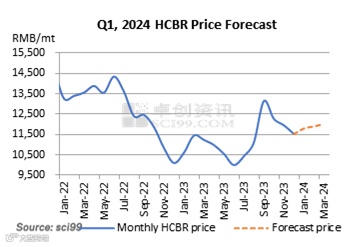
In Q1, 2024, the PBR price is expected to mainly edge up, lacking the basic conditions for a unilateral market. The supply of Chinese-made PBR is expected to increase. The units at Sinopec Qilu Company, Sinopec Beijing Yanshan Company, Zhejiang Petroleum & Chemical, Heze Kexin Chemical and Shandong Yihua Rubber & Plastic Technology are all scheduled to be restarted after mid-January 2024. The unit at Sinopec Maoming Company may be restarted on January 26, 2024. It is projected that China’s total PBR output in Q1, 2024 may rise by 2% Q-O-Q, providing an ample supply. In terms of demand, the Spring Festival holiday will be in Q1, 2024, so the operating rate of the tire industry may hit a new low in February 2024. Yet, the replenishment demand before the holiday may drive up the PBR price in a certain period. The increment in the overall demand is likely to be smaller than that in supply, curbing the support from demand. The upper end of the PBR market price may not rise to the level in the past years. To conclude, SCI reckons that the PBR monthly average price in Q1 of 2024 will possibly edge up based on the fundamentals and seasonal characteristics, but the upper end of the price may face pressure. The decrease in a certain period can not be ruled out. SCI predicts that the HCBR 9000 market price in North China is expected to linger at RMB 11,500-12,500/mt in Q1, 2024.
All information provided by SCI is for reference only, which shall not be reproduced without permission.
Please click "Read more" for the full article.