

PP Prices Rally After Drops in Q1 with High Cost and Soft Fundamentals Mixed
Preamble: In Q1, 2024, higher crude oil prices and PP futures prices bolstered the market sentiment and drove up PP prices, even if the performance of PP supply-demand fundamentals hindered the PP market. In Q2, it is projected that newly added capacity will increase, and closed units that underwent maintenance are planned to resume production gradually, reflecting higher supply pressure in the PP market. Meanwhile, the PP market may enter the small demand slack season. Therefore, the supply glut is likely to be more noticeable in Q2, 2024.
High cost and sluggish demand in a struggle, arousing a V-shaped trend of PP price
The mainstream market prices of PP dropped at first and then rallied in Q1, 2024, which hovered at a medium-to-low level in the past five years. For specific price changes, PP prices declined from RMB 7,455/mt in early January to RMB 7,275/mt in early February, but then prices stabilized at RMB 7,565/mt in mid-to-late March and ended at RMB 7,455/mt in Q1, 2024. The average price of PP raffia in East China was RMB 7,389.59/mt in Q1, 2024, down 2.10% Q-O-Q and down 4.81% Y-O-Y. That of PP copolymer was RMB 7,543.28/mt in Q1, down 1.57% Q-O-Q and down 5.10% Y-O-Y.
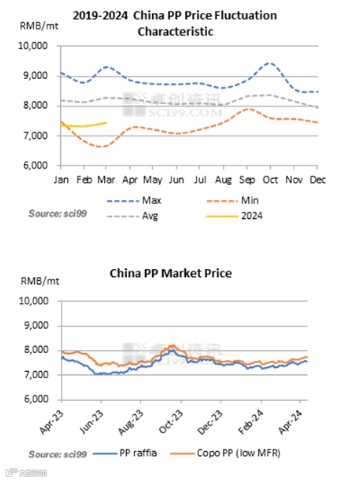
The price changes can be roughly divided into two stages. PP prices went down before the Spring Festival holiday, as PP supply mounted up with weakened maintenance intensity, but its downstream consumption was limited. Downstream processors lowered operating rates because of the medium-to-high inventory of finished products and their stronger intention of recouping funds before the holiday. Near the holiday, PP market prices spiraled upwards as the PP futures prices stabilized, and there was bullish news from the macroeconomic environment. But deals of PP remained insipid because downstream stockpiling came to an end with the approaching. After the holiday, PP prices realized an increase on the back of high crude oil values and PP futures prices, but the price upward range was constrained by slow inventory consumption, stemming from limited work resumption in the downstream industry. At the same time, downstream processors faced limited improvement in new dealings and poor profits, so they had soft buying appetite for high-priced raw materials. That dragged PP prices down again.
On the whole, the PP market was mainly affected by supply and demand patterns, feedstock prices, macro environment and market sentiment.
Less-than-expected orders hindered PP downstream industry operating rate.
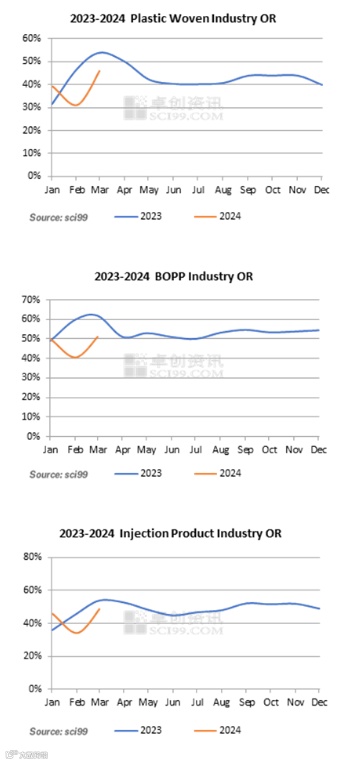
In terms of the demand side, major downstream enterprises witnessed mediocre fresh orders from end users. Thus, they entered the Spring Festival holiday earlier in the second half of January and restarted production late after the holiday. Nearly 38% of enterprises resumed business on February 24 or later. In summary, the overall PP market demand was sluggish from medium-to-late January to February. In March, end orders at downstream enterprises improved slightly, and the consumption of finished product inventory was a little slow. Correspondingly, downstream operating rates climbed but stayed at a same or lower level than the same period of last year.
PP exports surged with a brightened overseas market.
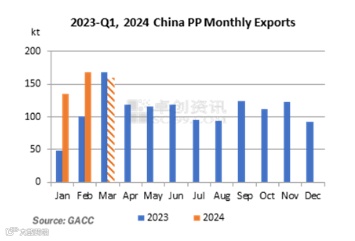
For PP export, it is expected to realize a Y-O-Y increment in Q1. According to GACC, China’s PP export volume was 135.2kt in January and 168.7kt in February. During the two months, overseas PP supply tightened because of geopolitics and routine maintenance in the Middle East, which promoted overseas PP prices to advance. This created an opportunity for China’s PP export business. Besides, China’s producers and traders intended to propel exports to ease their domestic sales pressure, while the overseas demand in some areas began to revive. Therefore, a remarkable rise was seen in PP exports from January to February. In March, some closed units were restarted, and the overseas PP demand in some areas weakened because of Ramadan, so overseas buyers became wary about purchasing. In addition, high ocean freights became a hindrance to the export business in China. Hence, it is predicted that China’s PP export volume will slide in March.
Delayed startup of new unit and more maintenance eased PP supply pressure.
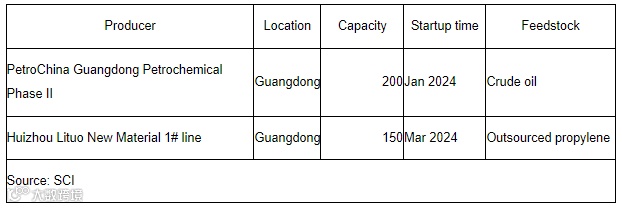
China’s PP capacity continued to expand in Q1, while the capacity expansion in the PP industry slowed down, with the startup time of some units delayed. Two units with total capacity of 350kt/a were put into use, respectively at PetroChina Guangdong and Huizhou Lituo. The capacity growth rate reached 0.90%. The effect of newly added capacity on PP supply weakened. Furthermore, the unit maintenance intensity was strengthened, leading to a Q-O-Q decline in PP output. PP output was 8,491.2kt in Q1, up 9.77% Y-O-Y but down 0.50% Q-O-Q.
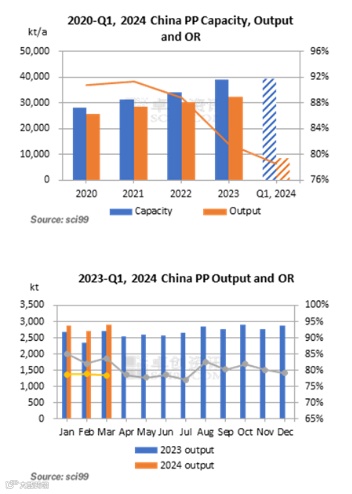
In China, the capacity expansion in the PP industry slowed down in Q1, 2024, as the startup time of some units was delayed. Two units with total capacity of 350kt/a were put into use, respectively at PetroChina Guangdong Petrochemical and Huizhou Lituo New Material. China’s PP capacity realized 39,240kt/a accordingly. The effect of newly added capacity on PP supply weakened.
Q1, 2024 China PP Newly Added Units
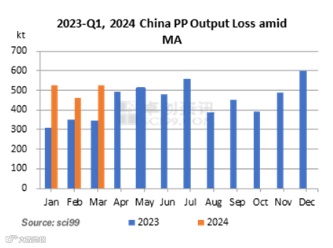
The average operating rate was nearly 79% in Q1, falling by 1.7 percentage points Q-O-Q and nearly 5 percentage points Y-O-Y. It was mainly because of projected and accidental unit maintenance. The latter was mainly caused by poor profits and high inventory pressure at producers. Crude oil, methanol and propylene prices performed strongly, and profits from diversified feedstock-based PP production underperformed, especially crude oil-based profits. Moreover, the demand improvement was less than expected, leading to high inventory pressure on PP producers. As a result, more units were shut down, and the restarting of previously closed units was postponed. The output loss rose by 2% Q-O-Q and 50% Y-O-Y, and the maintenance peak appeared in March with an output loss of around 528kt.
Import arbitrage economics unworkable
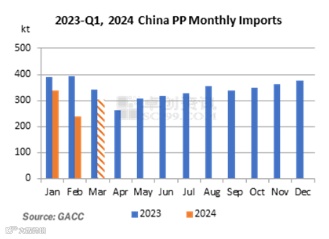
In Q1, 2024, China’s PP imports registered a Y-O-Y drop of 22%. According to GACC, import volume was 336,7kt and 239.1kt respectively in January and February 2024. In Q1, overseas PP supply was tight with intensive unit maintenance, and import arbitrage economics was unworkable. Besides, China’s PP market prices stood at a global low. Especially in February, overseas suppliers showed weaker enthusiasm in providing quotations to China, as the domestic demand weakened notably during the Chinese New Year, and China’s PP market prices stood at a global low. Thus, it was hard for PP imports to grow. In March, the import arbitrage window may stay closed, even though the exchange rate of RMB against USD slid from 7.10 to 7.09. Overseas suppliers preferred to sell goods to other regions instead of China for more profits. Traders ordered goods gradually from overseas markets as China’s PP demand revived slightly and prices ramped up, but the purchase of imported goods may be on a hand-to-mouth basis. PP import volume is estimated to rise marginally in China.
Feedstock prices were mixed but stayed high, buoying PP prices from the bottom.
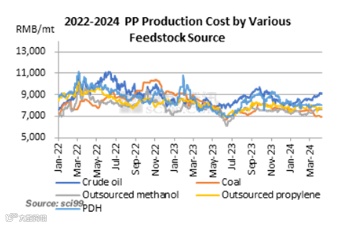
PP production profits based on diversified feedstock sources showed ups and downs in Q1, 2024. Coal-based PP production profits sometimes turned positive, while other feedstock-based ones were always negative. The average profit from crude oil-based PP production was RMB -1,109.98/mt in Q1, 2024, down 4.3% Q-O-Q, as crude oil values appreciated with geopolitics. Coal-based PP production profits averaged RMB -345/mt, up 36.63% Q-O-Q because coal prices dropped with deficient market demand. But the overall profits were minus. Besides high feedstock cost, PP prices slightly trended downwards in Q1, and downstream users showed insipid demand for PP. Differentiated profits are supposed to bring more challenges and opportunities for PP producers in the future.
The overall fluctuation range of PP prices was limited in Q1, 2024. Besides supply-demand fundamentals, the macro environment also influenced the PP market. Specifically, the domestic reserve requirement ratio reduction in January, the renovation of urban villages, the construction of affordable housing and the first important meeting of 2024 held in Beijing have supported the PP market. However, the U.S. CPI exceeded anticipations and expectations for the Fed’s interest rate cut weakened, which weighed down the commodity markets and players’ confidence.
Macro environment: loose domestic policy in China and weak overseas market
The overall fluctuation range of PP prices was limited in Q1, 2024. Besides supply-demand fundamentals, the macro environment also influenced the PP market. Specifically, the domestic reserve requirement ratio reduction in January, the renovation of urban villages, the construction of affordable housing and the first important meeting of 2024 held in Beijing have supported the PP market. However, the U.S. CPI exceeded anticipations and expectations for the Fed’s interest rate cut weakened, which weighed down the commodity markets and players’ confidence.
All information provided by SCI is for reference only, which shall not be reproduced without permission.
Please click "Read more" for the full article.