

China Benzene Industry Chain Supply-Demand Imbalance Intensifies in 2024
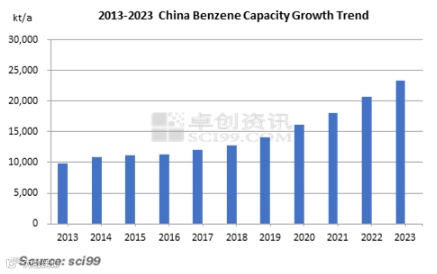
In recent years, with the successive launch of new large-scale refining & chemical projects, the capacity of benzene in China has increased sharply. At the same time, the downstream industries also entered a stage of vigorous development. In 2023, the integrated production of refining and chemical industry is nearing its end, and the growth rate of benzene capacity has declined from its peak of 14.94% to 7.88%. However, the production enthusiasm in downstream sectors remains strong, and industrial contradictions are gradually becoming prominent.
Benzene capacity surges in the craze for integrated refining and chemical complex
In the past five years, China's benzene capacity has shown a leapfrog growth, with a compound annual growth rate of 12.83%. This round of concentrated production is taking advantage of the national “14th Five-Year Plan” and the layout of the large-scale refining and chemical industry, and China’s benzene capacity has doubled. At the same time, leading refining and chemical projects such as Hengli Petrochemical, Zhejiang Petroleum & Chemical, and Shenghong Petrochemical have emerged
In recent years, large capacity and high capacity concentration ratio have become new features of China’s benzene industry. Currently, the existing benzene capacity has reached 23.35 million mt/a. Zhejiang Petroleum & Chemical’s total capacity is 2.77 million mt/a, ranking first in the national benzene capacity and accounting for 11.86% of the total capacity in China. In 2023, the capacity at the top 10 enterprises totaled 9.965 million mt/a, accounting for 42.68% of the national total capacity.
Supply-demand imbalance will intensify in 2024.
In 2024, the new project of Yantai Yulong Island Petrochemical is in the debugging, the possibility of achieving stable operation within the year is relatively low. Therefore, the new benzene capacity for the year will all come from the reforming and cracking units, involving limited capacity increase of about 840kt/a (including approximately 18.4kt/a at Yulong Island Petrochemical).
In terms of downstream sectors, the significant expansion of styrene capacity has increased the proportion of styrene in the downstream industries of benzene from 41.68% in 2019 to 48.60% in 2023, firmly ranking as the largest downstream industry of benzene. The proportion of the CPL industry fluctuates limitedly, while the proportion of the phenol and acetone industry is 15.26%. In 2024, the styrene industry plans to add five new units, involving capacity of 1.87 million mt/a. Nine new sets of CPL units are planned to be put into operation, involving capacity of 1.59 million mt/a. Only the two downstream industries will consume an additional 2.9083 million mt of benzene, far exceeding the expected new benzene capacity of 1.84 million mt/a. With the continuous supply shortage in the benzene industry, the profits in the industry chain will still be concentrated in the upstream benzene sector in the medium to long term. Therefore, high-priced feedstock will continue to squeeze the survival space of small downstream enterprises, further reducing their market share.
Supply and demand mismatch becomes the main tone in the future.
From 2024 to 2028, the CAGR of oil-based benzene capacity and output is estimated to be 3.09% and 3.70% respectively. In the next few years, downstream industries may be still in capacity expansion, and imported benzene is still an important supplement. Therefore, the overall import volume in 2024 may continue to stay at a high level, which is predicted to be 3,400kt or so. The total supply in 2024 is estimated at 30,743.9kt. By 2028, the import volume is projected to grow to 3,800kt. First, the output of benzene seems hard to be uplifted by adjusting the operating rate as it is mainly produced as a byproduct. Second, new entrants mostly have matched downstream units, and the downstream capacity growth is significantly higher than that of benzene. The supply tightness may not be changed in the short run. The total supply is expected to reach 32,411.9kt in 2028, with a CAGR of 3.02%.
It is expected that the downstream consumption of benzene will reach 27,500kt in 2024, up 8.16% Y-O-Y, but the growth rate is estimated to drop by 0.49%. By 2028, the downstream consumption of benzene may reach 31,800kt, with the five-year CAGR declining by 6.34% to 4.58%.
In the next five years, China’s styrene capacity will expand further, and the capacity growth rate will slow down at first but then increase again. Meanwhile, the integration between upstream and downstream units will be an important trend of China’s styrene capacity growth. North China will cover 38% of the newly added styrene capacity, and North China will be the region with the highest newly added capacity. Therefore, market competition in North China will be fiercer. South China will be the region with second highest newly added styrene capacity, covering 31% of the total new capacity. East China will have a proportion of 12%. East China will continue to have short supply of styrene, so the regional arbitrage will still exist.
The second largest downstream industry of benzene will be the CPL industry. China’s CPL capacity will continue to increase from 2024 to 2028, but the CPL capacity growth rate will slow down gradually. China will continue to have an oversupply of CPL, and the integration between upstream and downstream units will improve in the CPL industry. China’s CPL capacity increased rapidly in recent years, and some old CPL units stopped production. Meanwhile, some new entrants have been seen in the CPL industry in recent years. Therefore, the CPL industry also has fierce competition. SCI predicts that the newly added CPL capacity in China will decline after 2026.
Based on the current development status of the industry, the expansion of China’s benzene capacity will significantly slow down in 2024 and even in the next 2-3 years, while the downstream production speed will still maintain a high speed in the next 2-3 years. Simultaneously, in light of China's substantial styrene and CPL capacity base, several outdated, backward, and regionally disadvantageous firms are progressively being eliminated. Integration, clustering, and large-scale processes are being steadily completed by China's benzene industrial upgrading and optimization.
All information provided by SCI is for reference only, which shall not be reproduced without permission.
Please click "Read more" for the full article.