

H1, 2024 China Synthetic Rubber Exports Rise by Nearly 33%
Snapshot: From 2019 to 2023, China’s export volumes of various types of synthetic rubber all registered upward trends. In H1, 2024, China’s export volume of synthetic rubber was nearly 390kt, up around 33%. Therein, the export volumes of SBR, PBR, IIR, IR, NBR and SBS all increased to different degrees.
According to GACC, China’s synthetic rubber exports were around 390kt in H1, 2024, up around 33% Y-O-Y. Therein, the PBR exports took up around 31% of the total synthetic rubber exports, ranking first. The exports of SBR and IIR accounted for around 26.37% and 19.42% respectively, ranking second and third. The IR exports saw the largest Y-O-Y increment in the proportion of the total exports, which was around 2.5 percentage points. From the perspective of trade partners, synthetic rubber exports to Thailand accounted for 28% of the total, ranking first. The other trade partners included Vietnam, India, Indonesia, South Korea, etc. Therein, China’s synthetic rubber exports to Southeast Asia took up over 70% mainly due to the changes in the international situation and the notable capacity start-up and expansion of downstream consumption industries in Southeast Asia. Nevertheless, China was still an important consumer of synthetic rubber.
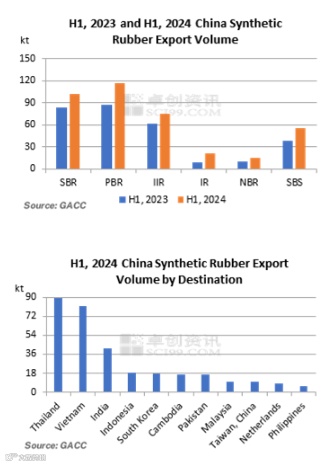
According to GACC, China’s synthetic rubber exports to Thailand were around 89.2kt, up around 27.25% Y-O-Y. Those to Vietnam were around 81.2kt, up around 46.84% Y-O-Y. Those to India were around 41.5kt, up around 45.1% Y-O-Y. Thus, the exports to Vietnam witnessed the largest Y-O-Y growth. From the perspective of China’s synthetic rubber export trade partners in 2019, the exports to Thailand and Vietnam occupied the first and the second places. Since 2022, those to India have stayed top 3. Yet, those to a certain Middle East country have been out of the top 10 since 2021 in the wake of a notable decline.
Since 2014, China’s tire enterprises have been active in building plants overseas. Southeast Asian countries including Thailand and Vietnam, with rich natural rubber resources, have undertaken the main capacity of China’s overseas tire plants. However, the synthetic rubber capacity in Thailand is only 247kt/a, including 75kt/a ESBR capacity, 100kt/a SSBR capacity, and 72kt/a PBR capacity. There is no synthetic rubber unit in Vietnam. The first overseas plants of China’s leading tire enterprises including Zhongce Rubber Group, Guangxi Linlong Tire, Qingdao Sentury Tire, Double Coin Tyre, Jiangsu General Science Technology, and Prinx Chengshan Tire were all built in Thailand, while those of Sailun Group, Guizhou Tyre and Shandong Jinyu Tire were built in Vietnam. As the local synthetic rubber output failed to meet the demand, the export dependence degree was high. In the past years, there were still many overseas plant projects for China’s tire enterprises, and China’s leading conveyor belt enterprises also had plans of building plants. It is projected that China’s synthetic rubber exports to Southeast Asia are likely to continue to rise.

All information provided by SCI is for reference only, which shall not be reproduced without permission.
Please click "Read more" for the full article.