

Dec Chemical Market Expected to Remain Under Pressure
Introduction: China’s chemical market fluctuated downwards in November, meeting players’ expectations. International crude oil price declines and weak supply-demand fundamentals both dragged down the market. In December, the chemical market may continue to fluctuate under downwards pressure, with weak demand and export pressure expected to be the leading influencing factors.
The major influencing factors for the chemical market in November were as follows: 1. Impacted by the geopolitical disturbances, international crude oil prices fluctuated heavily within the month, with the average price of WTI crude dropping by 2.49% MoM. 2. The chemical market supply-demand fundamentals remained weak. The supply of most products stayed loose, and only some propylene downstream products saw supply reductions due to unit maintenance. Market demand maintained differential improvement on the back of pro-growth policies, but the real estate industry still underperformed, lending limited support to the prices of related chemicals.
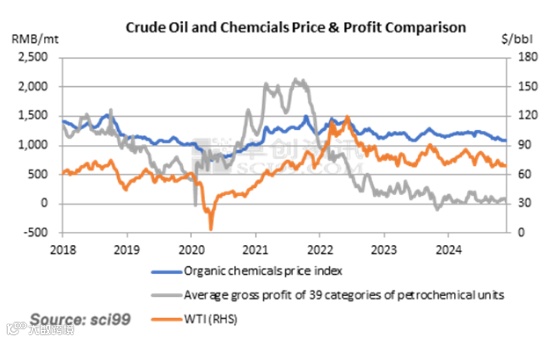
Forecast: It is predicted that the chemical market may continue to fluctuate under downward pressure in December. The pace of the Fed’s interest rate cuts is expected to slow down, and the global economy is anticipated to maintain a weak and steady recovery. The Chinese economy continues consolidating the foundation for a positive recovery. In December, international crude oil prices are expected to move sideways, with limited changes in average prices. The chemical market is projected to face loose supply, and weak demand and export pressure are expected to be the leading influencing factors. Close attention should be paid to the potential economic, financial and other systemic risks that may affect the market.
1. The Fed’s interest rate cut expectation continues in parallel with the downward pressure on the global economy, and China’s domestic policies of stable growth have been implemented successively, indicating a positive macro environment for chemical products.
In October 2024, the global manufacturing PMI was 48.8%, the same as last month and hovering near 49% for four consecutive months, which means that the global economy has maintained a weak and stable recovery. Based on the performance of the U.S. domestic economy and labor market data, the Fed may slow down the pace of interest rate cuts in the future or reduce the extent of interest cuts. High interest rates continue to exert pressure on commodity prices.
China's manufacturing PMI came in at 50.3% in November, up 0.2 percentage points from the previous month. Among the major sub-indexes, the new orders index, the expected index of production and business activities, and the purchase volume index advanced significantly, while the production index mounted steadily, and the four major indexes reached a near 7-month high. Market supply and demand accelerated growth while maintaining stability. New growth drivers and the consumer goods manufacturing industry grew rapidly. Large enterprises performed steadily, and small & medium-sized enterprises made improvements. The economy further established a steady and positive upturn.
Looking ahead to the fourth quarter, factors such as geopolitical conflicts, trade frictions and high debt remain uncertainties hindering the global economic recovery.
2. Oil prices are expected to keep rangebound, giving limited boost to chemicals.
International crude oil prices are predicted to move sideways, with WTI crude prices hovering around $70/bbl in December. As the Middle East ceasefire agreement is about to be reached, the regional situation may generally stabilize. The Fed is expected to continue cutting the interest rate, but the decline is anticipated to slow down, leading to higher U.S. bond yields and weighing down crude oil prices. Saudi Arabia may extend the cuts on oil production, underpinning oil prices. The influences of U.S. crude oil inventory buildup and weakened demand are limited.
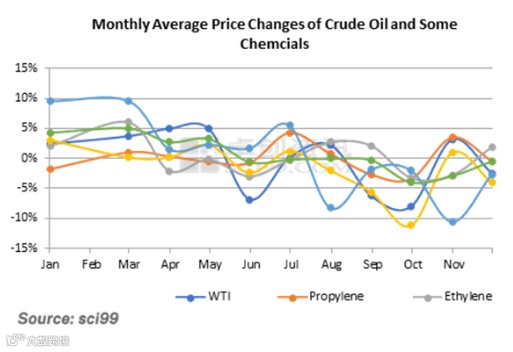
3. The inventory index stayed at a high level, and the supply in the industry remained loose.
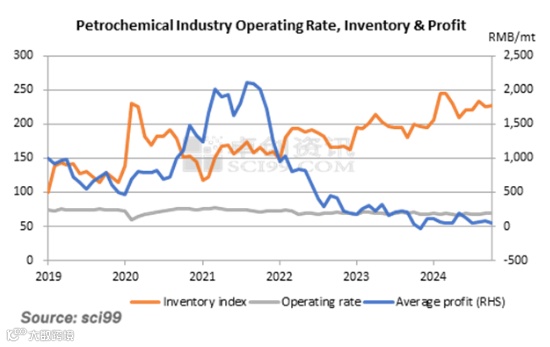
In November, the chemicals inventory index was at a high level, reflecting the relatively severe imbalance between supply and demand, and low profits also dragged down the enthusiasm for production. In November, end-user demand saw differentiated improvement. Meanwhile, the decline in crude oil prices alleviated the cost pressure of chemicals, and the profits of some chemicals were repaired slightly, but the release of new capacity and conventional production kept the supply high. On the one hand, inventory continued to grow, but on the other hand, the industrial operating rate was elevated.
In December, the chemical industries generally will enter the slack season for demand. The production of most upstream units is expected to change little, but the operating rates of middle and downstream units are projected to decline, so the imbalance between supply and demand is likely to exist. In the case of weak expectations in crude oil and chemicals markets, the industrial profits may stay at a low level.
All information provided by SCI is for reference only, which shall not be reproduced without permission.
Please click "Read more" for the full article.