

2025 PX Profits and Prices to Face Headwinds
In 2024, although no new PX unit came online, existing enterprises maximized their operating rates, resulting in a high-level growth trend of effective supply. The downstream PTA industry is still in its second phase of concentrated expansion, maintaining a steady growth in overall demand for PX. However, the supply-demand balance for PX in 2024 fluctuated significantly, providing weak support for PX prices. Coupled with the cost pressure in 2024, PX market prices trend weaker. Meanwhile, the profitability of long-process PX units also experienced compression. In 2025, the PX price may fluctuate at lows due to its weak cost and the ongoing imbalance in supply and demand, which may lead to a continuous weak trend for PX prices.
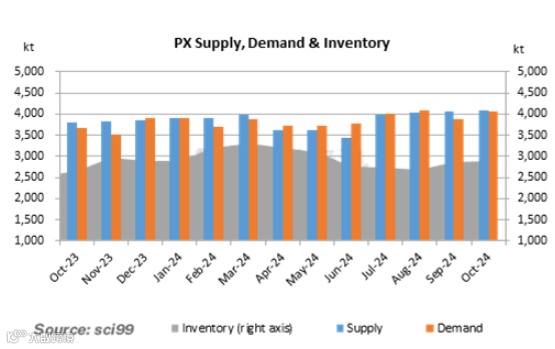
2024 PX supply increases steadily while the growth of demand slows down.
In 2024, the growth rate of PX capacity is only 0.46%, while the output growth rate is expected to reach 12.27%. Under the influence of national industrial restructuring and further optimization of the market structure, China’s PX industry enters the end of its capacity expansion cycle. In 2024, there were no new projects with only Hengli Petrochemical’s capacity expanding to 5,200kt/a. However, against a backdrop of high PX demand and tight supply, the capacity of existing units has significantly improved and the national PX output is expected to reach 37,390kt. The annual capacity utilization rate will be 84.96%, increasing by 8.94% YoY.
Total PX consumption in 2024 is projected to be 46,750kt, up 12.62% YoY. China’s PTA industry has entered a new development cycle with the elimination of outdated capacity and upgrading of production processes, driving PX demand back to a rapid growth track. However, due to so many PTA units came online in 2023, the volume of new PTA units in 2024 decreased. Affected by processing fees, planned and unplanned unit changes are frequent, leading to a slight slowdown in demand growth. Additionally, the imbalanced development of PX and PTA industries and unstable unit changes led to significant fluctuation in the supply-demand balance throughout 2024.
2024 PX market weakened with narrowed profit margins in long process.
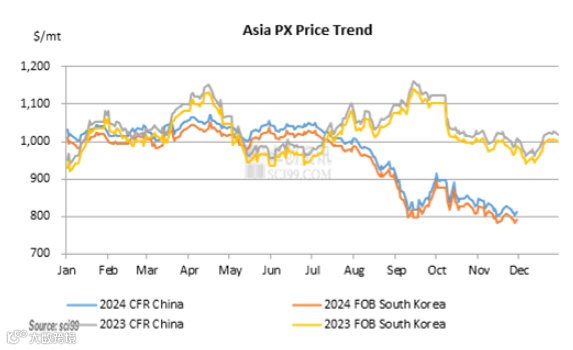
In 2024, influenced by the fluctuating and declining crude oil prices, PX prices also exhibited a downward trend. Additionally, due to increased periodic pressure from the fundamentals, the profit margins for long-process operations significantly narrowed. The PX price in 2024 moved sideways first and then fell notably, and finally fluctuated. In the first half of 2024, the PX price moved sideways, on one hand, the crude oil prices provided cost momentum; On the other hand, the supply and demand were imbalanced caused of strong expectations and weak reality. In Q3, the PX price declined notably mainly due to the noticeable drop in crude oil prices and the insipid demand for blend oil. In Q4, the PX price fluctuated because of the commencement of annual contract negotiations, which led to increased caution among players. Based on CFR China prices, as of November 29, the annual average price was $974.47/mt, decreased by 9.28% YoY, and $44.53/mt lower than the end of 2023. The highest price was recorded in mid-April at $1070/mt, while the lowest was in mid-November at $802/mt.
Throughout most of 2024, the PX integrated units were profitable. The favorable profit was firstly due to the advantages of the “refining-chemical-polyester” full industrial chain development model. This model has advantages in terms of reducing unit consumption and avoiding risks associated with cost fluctuations. Secondly, the profit performance of the by-product benzene was passable, with the PX-Brent spread remaining above the break-even line in 2024. However, since August, due to the co-movement of the commodity market, the PX price decline exceeded that of crude oil, pushing the price spread to near the break-even line and setting a new low for nearly three years. As of November 29, the annual average PX-Brent price spread was $381.98/mt, decreased by 12% from the 2023 average and $70.78/mt lower than the end of 2023.
Multiple Risk Factors are in the 2025 PX Market.
Firstly, on the cost side, PX prices are highly related to crude oil prices. The crude oil price’s attributes are diverse, with its financial aspect heavily influenced by economic cycles, fiscal, and monetary policies; its commodity aspect influenced by supply-demand dynamics; and its political aspect influenced by Middle Eastern and Eastern European situations. Macroeconomically, players need to eye on the Federal Reserve’s monetary policy. Industrially, players need to focus on the supply-demand relation in Saudi Arabia and the U.S., and so on. Additionally, there are also factors like financial risks, production policies of major oil-producing countries, geopolitical conflict and the U.S. sanctions on certain regions. In 2025, international crude oil prices may fluctuate upward first and then drop, with Brent crude trading mainly between $69-84/bbl, leading to weak PX cost support in the short term.
……
All information provided by SCI is for reference only, which shall not be reproduced without permission.
Please click "Read more" for the full article.