



Tariff Standoff May Lead to Lower U.S. Ethane Prices Despite Increased Costs
Starting January 1, 2025, China reduced the import tariff on ethane from 2% to 1%. However, the tariff reduction has not significantly impacted the landed price or import volumes of ethane, as these are primarily influenced by supply and demand dynamics in the U.S. ethane market. Following the recent imposition of additional tariffs, the expected rise in import costs may dampen China's enthusiasm for purchasing ethane. To ensure smooth export channels, U.S. ethane prices are likely to decline, offsetting the additional tariff costs.
On April 3, 2025, the U.S. announced a 34% tariff on all imports from China. In response, China declared countermeasures to safeguard its legitimate interests. On April 4, China announced that starting from 12:01 PM on April 10, 2025, it would impose an additional 34% tariff on certain U.S. imports, including ethane (HS code 29011010).
I. Impact of Substitute Prices Outweighs Tariff Adjustments
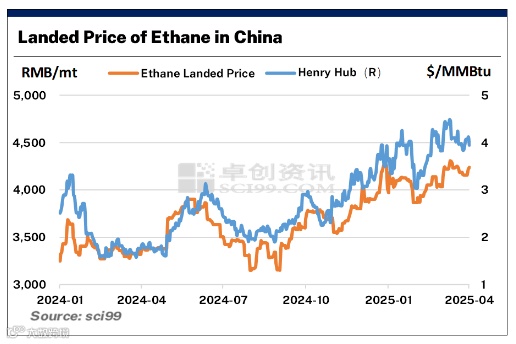
In March 2025, the landed price of ethane in China showed an upward trend with fluctuations. According to SCI, the average landed price of ethane in China in March 2025 was RMB 4,206/mt, an increase of 4.44% month-on-month and 26.01% year-on-year. Although China reduced the import tariff on ethane from 2% to 1% starting January 1, 2025, the price of imported ethane has continued to rise. Currently, the U.S. is China's primary source of ethane imports, and its price fluctuations are closely tied to supply and demand dynamics in the U.S. market. As a byproduct of natural gas, ethane production is heavily influenced by changes in the natural gas market. In the first quarter, the natural gas market remains in a traditional peak season with high demand and prices. As a result, U.S. ethane is either reinjected into natural gas to meet demand or sees its price supported by higher natural gas prices, leading to an overall upward trend in ethane prices.
II. Limited Import Growth Despite Tariff Reduction Due to Transportation Constraints
Ethane transportation requires specialized vessels and port facilities, making transportation capacity a key factor influencing import volumes. Currently, there are approximately 29 Very Large Ethane Carriers (VLECs) in operation, and even with increased import demand following the tariff reduction, significant growth in import volumes is constrained by transportation capacity. Additionally, building new vessels takes 2–3 years, meaning transportation capacity is unlikely to improve in the short term. From the perspective of port reception capabilities, importing ethane requires low-temperature storage tanks, vaporization facilities, and pipeline networks. Currently, only a few ports in China are equipped to receive ethane. Building new receiving stations is capital-intensive (single-project investment may exceed RMB 5 billion) and time-consuming (3–5 years), making it a bottleneck for imports in the short term. According to statistics, China imported 453,000 tons of liquefied ethane in January 2025, an 8.81% year-on-year increase but a 7.03% month-on-month decrease, with an average import price of RMB 3,581.19 per ton, a 6.98% year-on-year increase and a 5.33% month-on-month increase. In February 2025, imports fell to 438,000 tons, a 21.52% year-on-year decrease and a 3.31% month-on-month decrease, while the average import price rose to RMB 3,754/mt, a 7.93% year-on-year increase and a 13.66% month-on-month increase. This shows that import volumes have not significantly increased despite the tariff reduction, largely due to transportation constraints.

III. U.S. Ethane Prices May Decline Despite 34% Tariff Increase
On April 4, 2025, the Tariff Commission of the State Council of China announced that starting from 12:01 PM on April 10, 2025, an additional 34% tariff would be imposed on U.S. imports, including ethane, in addition to the existing 1% tariff implemented on January 1, 2025, bringing the total tariff to 35%. The tariff increase will directly raise the landed cost of imported ethane, weakening its economic viability. Coastal ethylene projects reliant on imported ethane may face cost pressures, leading to reduced import volumes. Some companies may turn to alternative feedstocks like propane or reduce production capacity utilization.
However, U.S. ethane prices may decline to offset the tariff-driven cost increase. The U.S. is currently the only country with large-scale ethane production, and China is the only market with significant ethane reception capacity. Given the U.S. reliance on China as its primary buyer, U.S. ethane exports face significant challenges under the new tariff policy. To maintain export channels, U.S. ethane FOB prices are likely to decline. Market feedback suggests that U.S. suppliers and Chinese buyers may share the cost impact of the tariffs. The decline in U.S. ethane spot prices may exceed the increase in Asian landed prices. Therefore, despite the 34% tariff increase, the landed price of imported ethane may not rise significantly, and the decline in import volumes is expected to be limited.
All information provided by SCI is for reference only, which shall not be reproduced without permission.
Please click "Read more" for the full article.
