

PE Prices Weaken After Fluctuations on Supply-Demand Constraints
Introduction: In early-to-mid March, China’s PE market showed a weak trend after fluctuations. The supply side provides short-term support for the PE market with the co-existence of maintenance and the newly added capacity. However, long-term prospects remain under pressure due to enduring bearish factors. The demand growth lacks momentum, with subdued purchasing enthusiasm held by downstream producers due to slow improvement in their operating rates. It is expected that the PE market may remain in a stalemate and show a tendency toward weaker performance.
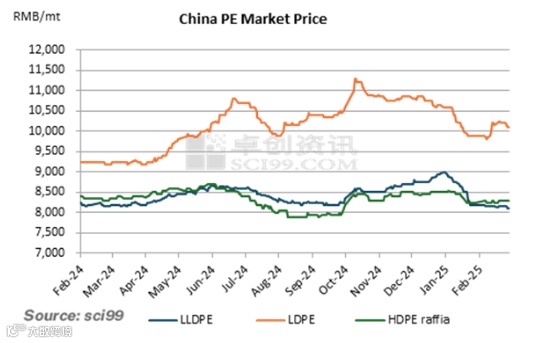
In early-to-mid March, China’s PE market price experienced a downward trend following fluctuations. As of March 13, the mainstream prices in China’s LLDPE market were in the range of RMB 8,040-8,600/mt, a change of RMB 10-100/mt when compared to the same period last month. Specifically, the average price in North China was RMB 8,195/mt, up 0.24% MoM and 0.8% YoY. East China recorded an average price of RMB 8,325mt, indicating a modest MOM growth of 0.12%, coupled with a YoY decrement of 0.48%. South China observed an average price of RMB 8,250/mt, which decreased by 1.2% MoM and 2.08% YoY.
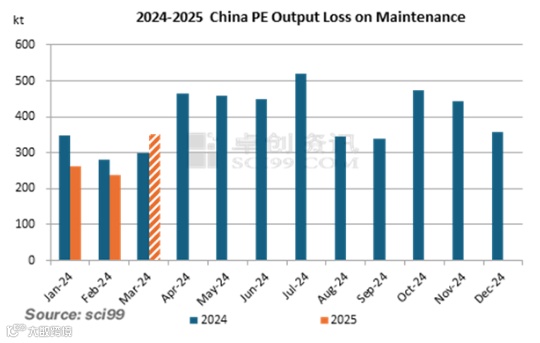
In terms of supply, both the introduction of new capacity and the output loss caused by unit maintenance are market focus. Inner Mongolia Baofeng Coal-Based New Materials’ 550kt/a capacity is planned to be put into operation in March-April, and a Shandong-based producer is set to start a 250kt/a unit in early April. As for output loss, an increase is projected in the units being involved in maintenance in the short term. The number of units being newly involved in overhaul plans is anticipated to rise after an initial dip. Pucheng Clean Energy Chemical’s PE unit is scheduled for an overhaul in March, and more units are anticipated to go into overhaul in April and May, pushing the output loss to a medium level of the year. However, with the release of new capacity, the output loss due to maintenance may impact supply by different degrees. Overall, while increased output loss may temporarily support prices, the release of new capacity may offset some of this support, thus exerting downward pressure on market prices in the long term.
On the demand side, although a slow improvement has been seen in downstream operating rates, the tepid rebound in demand, coupled with a constrained progression of new orders and relatively stable feedstock prices, have tempered downstream purchasing enthusiasm. The delivery of pre-priced and pre-sold resources has also thickened the atmosphere of wait-and-see. Although March typically heralds a peak season for the agricultural film industry, the demand in this sector has not surged accordingly, with orders being generally moderate and mostly consumed within the region. Despite the prospect of increased orders for watermelon greenhouse films, the overall order volume may be lower than that in past years. Producers in the agricultural film industry are not keen on substantial restocking, thus offering limited support to the PE market.
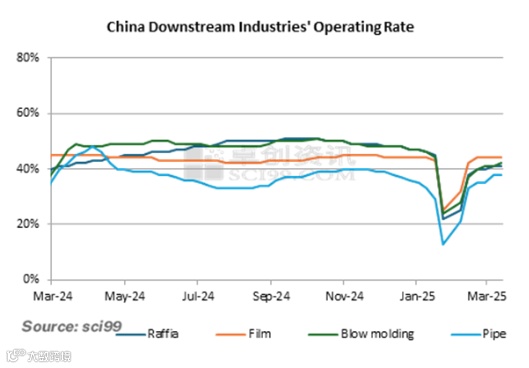
Overall, in the short term, the PE market may struggle to break free from a stalemate, likely continuing to show signs of weakness. Although the output loss due to maintenance may rise, the release of new capacity and a slight increase in imports are expected to exert pressure on the market price from the supply side. On the demand side, the overall operating rate of the agricultural film industry is envisaged to further increase with higher demand for watermelon greenhouse films. In other downstream industries, despite a mild improvement in the operating rates, given the ample feedstock inventory, some producers may only purchase feedstock based on rigid demand, which may lend limited support to the PE market.
All information provided by SCI is for reference only, which shall not be reproduced without permission.
Please click "Read more" for the full article.