

SBR Price to Ebb in Mid-to-Late Jan After Unexpected Rebound in Early Jan
Introduction: Up to January 10, China’s SBR market price closed at RMB 14,750/mt, up 1.03% from December 31, 2024 and up 22.41% YoY. The main reason for the rise in the SBR price was the uptrends in the cost and the prices of synthetic rubber futures. The SBR price is expected to edge down in mid-to-late January 2025.
In early January, China’s SBR market price rebounded beyond expectations. Up to January 10, China’s SBR market price closed at RMB 14,750/mt, up 1.03% from December 31, 2024, and up 22.41% YoY. The main reasons for the rise in the SBR price were as follows. First, the feedstock butadiene price rose by RMB 1,100/mt or over 10% in five working days, driving up the SBR price. Second, the price of synthetic rubber futures trended up. The highest price of the main contract rose to RMB 13,750/mt, boosting the SBR market atmosphere, so the market price of spot SBR climbed accordingly.
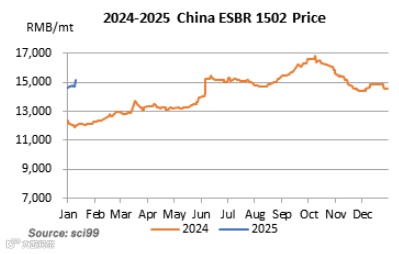
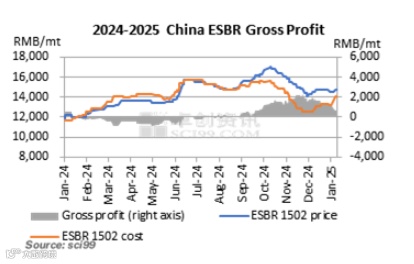
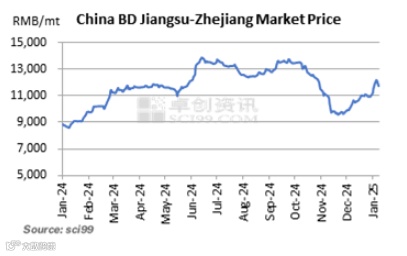
The feedstock butadiene price picked up beyond expectations, fueling the SBR price.
As the actual butadiene supply underperformed, the butadiene price perked up strongly. In early January, Sinopec’s EXW price of butadiene rose by RMB 1,100/mt to RMB 12,000/mt in five working days, and the market price rose to a high since November. The main reason for the rise in the butadiene price was that the actual supply of butadiene in China was lower than expected. Specifically, the operating rate of the butadiene unit at Shandong Yulong Petrochemical dropped significantly compared with early January. The butadiene unit at Fujian Refining & Petrochemical and the matched butadiene unit of the small-scale ethylene project at Sinopec-SK (Wuhan) Petrochemical Company failed to be restarted as scheduled. The other butadiene producers with outside sales faced passable sales pressure, and there were limited spot butadiene resources available. Besides, most imported resources are expected to arrive at ports intensively in mid-to-late January, and the arrival of some imported resources may be delayed. Thus, limited imported butadiene resources arrived at ports in early January, failing to supplement China’s butadiene supply. As the rise in supply underperformed, the butadiene price perked up, driving up the SBR price.
In mid-to-late January, the SBR price is predicted to drop.
SCI reckons that the SBR price is expected to move down in mid-to-late January, but the decrement may be minor. The SBR price may linger at RMB 14,000-14,800/mt. The cost is likely to wane somewhat, and the supply-demand fundamentals of SBR may drag down the SBR price. Attention should be paid to the influence of macro factors and the holiday arrangement at downstream application industries before the Spring Festival.
Cost: The feedstock butadiene price is likely to move down. In early January, the butadiene price rose rapidly, squeezing the profits of downstream industries, especially the PBR industry. Some private PBR producers sourcing butadiene from the market lowered their operating rates. Yet, as the butadiene inventory at most downstream users is not high, downstream users may stock up on some butadiene before Spring Festival. Overall, the demand is likely to weigh on the butadiene market atmosphere, but it may fail to drag down the butadiene price notably. The imported butadiene resources will possibly arrive at ports, supplementing China’s butadiene supply. Besides, some butadiene units under maintenance are expected to be restarted in succession. Thus, there may be more spot resources available for outside sales. The support from supply for the butadiene price is likely to weaken. Without new factors, the butadiene price is likely to ebb in mid-to-late January, but the decrement may be minor, curbing the uptrend in the SBR price.
Supply: The SBR output is expected to continue to rise in January, up around 6% MoM. The operating rates of the SBR units at PetroChina Jilin Petrochemical, PetroChina Fushun Petrochemical, and PetroChina Lanzhou Petrochemical may continue to be maximized. The relocated 220kt/a SBR unit at Shen Hua Chemical Industrial was fed into feedstock on January 2 and may maintain one-line production in January. The old 170kt/a unit is expected to operate at the same time. The other units may run normally during the Spring Festival holiday. Overall, the SBR supply is likely to increase in January.
Demand: The Spring Festival holiday is in January when China’s tire enterprises may suspend production for holidays. According to SCI, small-to-medium-scale all-steel tire enterprises may start holidays from January 15 to January 26, and small-to-medium-scale semi-steel tire enterprises are likely to suspend production for holidays after January 20. Thus, the tire output is expected to drop notably in January, which may even hit an annual low. Overall, the all-steel tire output is expected to decrease by over 40% YoY, and the semi-steel tire output may decline by around 18% YoY. With the supply rising and the demand falling, the supply-demand fundamentals of SBR are predicted to weigh on the SBR price in January.

All information provided by SCI is for reference only, which shall not be reproduced without permission.
Please click "Read more" for the full article.