

2024 Styrene Industry Chain Data Retrospect
In 2024, the styrene industry chain gained more and lost less due to the supply and demand structure. The construction of new units was lower than expected. More downstream units came online than upstream units, however, restricted by profit loss, the downstream output increased limitedly. Supported by the old-for-new policy and robust export demand, end demand saw a periodic improvement, boosting the styrene industry chain.
2024 Styrene Industry Chain Data
The benzene downstream consumption volume may increase by 16.49% YoY.
The benzene consumption volume has increased continuously in the last five years, especially in 2024. According to SCI, the compound annual growth rate (CAGR) of benzene consumption volume over the past five years attaches to 12.76%. The consumption volume in 2024 may increase by 16.49% YoY. The robust growth in benzene consumption has been supported by the continuous release of new capacity in various downstream sectors, especially in the fields of styrene, CPL, phenol, and others in the recent two years, significantly boosting domestic benzene demand and positively impacting benzene prices. However, as multiple downstream sectors enter a profit loss phase, the pace of new capacity investment is expected to slow down, leading to a decline in demand for benzene. Nevertheless, the increment of benzene supply is also expected to be limited due to upstream refining capacity constraints, potentially maintaining a tight supply situation in the future.
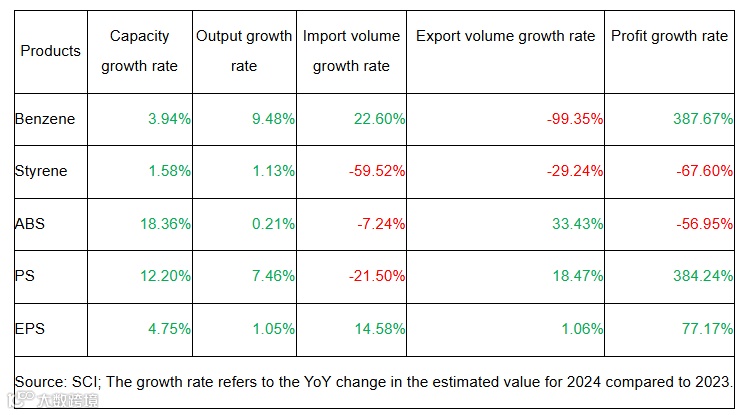
The styrene output may increase by 1.13% YoY.
In the past five years, the Chinese styrene industry has evolved into an oversupplied market due to rapid capacity expansion, with output transitioning from rapid to slow growth. According to SCI, the CAGR of styrene output attaches to 13.32%. However, in 2024, the growth rate of China’s styrene output dropped to 1.13%, which is the lowest in five years. Firstly, the annual new capacity addition involved only one enterprise with a capacity of 470kt/a, which started production in October and contributed minimally to output increase. Secondly, due to industry profit losses, there was an increase in long-term shutdowns and reduced operating rates of units, limiting output growth. The slight increase in output also supported the relatively strong styrene prices within the year. Over the next five years, the total supply of styrene in China is expected to maintain a growth trend, but the supply growth rate may first decline and then rise. The decrease in growth rate is mainly due to styrene still being in the capacity expansion phase with significant competitive pressure. Later, as the expansion phase in both upstream and downstream sectors conclude, competitive pressure may ease, potentially leading to a slight increase in growth rate and a corresponding impact on prices.
2024 ABS capacity growth rate may attach to 18.36%.
Over the past five years, driven by the extension and supplementation of the petrochemical industry chain, China’s ABS capacity has continued to expand. In 2024, the growth rate of China’s ABS capacity is projected at 18.36%, the highest among the industrial chain capacity growth rates, but it has decreased from 2023. According to SCI, the decline in growth rate is mainly due to the decrease in profit. 2024 is the worst year for profits in the past five years. Given the weakened supply-demand relationship and the increased pressure of industry profit losses, some construction enterprises have adjusted their actual production schedules, leading to delays in the commissioning of some units and thus providing periodic bottom support for domestic ABS prices. The ABS industry’s profitability also experienced a periodic recovery in Q4 2024. New capacity is expected to expand intensively in 2025-2026, and although the output growth rate is anticipated to lag behind capacity growth due to various factors, the ABS industry is still expected to face significant supply pressure, which may also suppress future prices.
2024 PS industry profitability growth rate is expected to reach 384.24%.
From 2020 to 2024, the apparent gross margin of PS experienced a process of contraction followed by a slow recovery. Fluctuations in industry costs and profits disturbed the production willingness of PS manufacturers, leading to a gradual increase in supply changes, which impacted PS prices. Benefiting from export dividends, China’s PS industry profitability reached a peak in 2020, with an average gross margin of RMB 1,722/mt for GPPS and RMB 3,200/mt for HIPS. Since 2021, new domestic PS projects have been commissioned sequentially, and due to the mismatch between supply and demand growth rates, the industry’s profit has gradually declined. In 2024, the industry’s profitability improved under the background of supply support. With fewer losses and more profits, the profit growth rate of the GPPS industry is expected to reach 384.24%. However, the industry’s profitability may contract again as capacity is redeployed in the future.
2024 EPS capacity may increase by 4.75% YoY.
From 2020 to 2024, China’s EPS industry has been in an expansion period due to the upgrade of medium and large enterprises and the trial production of new enterprises. Influenced by factors such as the replacement of capacities, the capacity growth rate of China’s EPS industry was relatively flat from 2020 to 2021. From 2022 to 2023, driven by acceptable profit and incremental demand, China’s EPS capacity growth rate accelerated again. Entering 2024, the pace of new capacity addition slowed down due to factors like intensified industry competition and a slowdown in demand growth, with an expected capacity increase of 4.75% for China's EPS industry. Over the next five years, China’s EPS industry will remain in expansion. Under industry competition pressure, market players may focus more on changes in the market center and whether profitability can be maintained.
Looking ahead to 2025, the tight supply of the benzene industry is expected to ease with the commissioning of large production units. However, the styrene downstream sector remains in a period of rapid capacity expansion. Given the optimistic outlook for the economic environment and the boost to end demand from policies, the increase in downstream demand is likely to benefit the styrene market next year. Consequently, the annual price spread between styrene and benzene in 2025 is anticipated to slightly improve compared to 2024. However, competition in the styrene downstream sector may remain fierce and sustained profit improvement is not expected.
All information provided by SCI is for reference only, which shall not be reproduced without permission.
Please click "Read more" for the full article.