

Will Uptrend Continue After PBR Price Rebounds in H1 Dec
Introduction: In H1 of December, the PBR price rebounded slightly, up around RMB 500/mt from the end of November. In the short term, there may be no new favorable factor in the cost sides, and fundamentals are likely to curb the upper end of the PBR price.
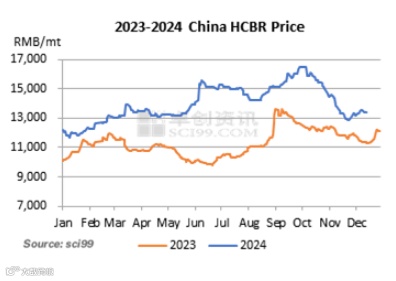
In H1 of December, the PBR price rose slightly.
According to SCI, as of December 17, the market price of HCBR 9000 closed at RMB 13,400/mt, up around RMB 500/mt or 3.88% from the end of November. The average price in December moved up by 15.03% YoY. In December, the feedstock butadiene price halted its fall and rebounded, boosting the synthetic rubber market atmosphere. Besides, the PBR price was over RMB 3,000/mt lower than the natural rubber price, underpinning the PBR price. Thus, the PBR price rebounded in this period.
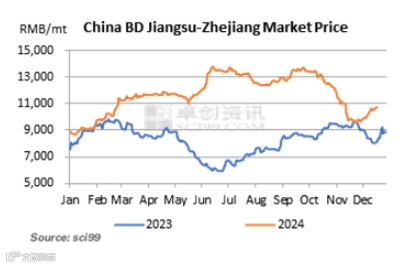
The feedstock butadiene price climbed as the output release of new capacity underperformed.
In December, China’s butadiene market price fluctuated upwards. As of December 17, the market price of butadiene in the Jiangsu-Zhejiang market was RMB 10,750/mt. The EXW prices of the butadiene for merchant sales also perked up. As the butadiene price in November fell more rapidly, the profits of most downstream industries recovered, resulting in a rise in the operating rates of downstream industries. Therefore, the butadiene price stopped falling bolstered by demand. After that, the newly started unit ran at a lower load, while the downstream demand remained high. Most butadiene suppliers for outside sales faced passable sales pressure. Thus, the butadiene price rose slightly.
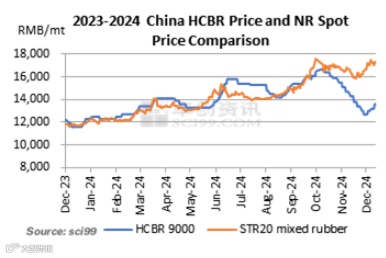
The price spread between natural rubber and PBR enlarged, underpinning the PBR price.
In terms of the natural rubber market, China’s inventory remained low. The continuous rainfalls in southern Thailand hampered the output of field latex. Thus, the high feedstock price bolstered the natural rubber price. At the same time, the macro atmosphere improved, boosting the natural rubber market. As for the PBR market, all PBR units resumed normal production except for long-term shut units with the recovery in profits and the end of maintenance. The rigid demand weakened seasonally, so downstream plants mainly conducted planned procurement of PBR. Dealings in the market were limited, and sales at traders were under pressure. At present, the operating rate at all-steel tire enterprises in Shandong was 57.22%, down 2.71 percentage points from the end of November and down 2.07 percentage points YoY. The operating rate of the PBR industry was 75.36%, up 4.92 percentage points from the end of November and up 4.55 percentage points YoY. Overall, the natural rubber price hovered at highs, driving up the PBR price.
Forecast:
Fundamentals: In the short term, most PBR units are likely to run normally. The unit at Shandong Wintter Chemical was shut down temporarily on December 15 and may be restarted soon. Overall, the operating rate of the PBR industry is expected to stay high. As for the demand, the operating rate of the all-steel tire industry is likely to rebound slightly as the enterprises under unit maintenance may resume production. At the same time, the operating rate of the semi-steel tire industry is expected to remain stable supported by the delivery of export orders and reasonable inventory. Overall, the fundamentals will possibly trend flat.
Cost: China’s butadiene market may be range-bound in the short term. In terms of supply, the operating rate of some butadiene units is expected to warm up. Yet, the spot supplement of butadiene may be limited in the market. Sales pressure on producers may be not high, underpinning the butadiene price from the supply. In the Asia market, it may be hard to see low-priced butadiene resources. Backed by import costs, traders in East China may be reluctant to sell at lows. In terms of demand, the operating rate of downstream units may remain high. Thus, the rigid demand is anticipated to shore up the butadiene price. Yet, downstream users may be cautious about buying high, so the increment in butadiene price is likely to be limited.
Natural rubber: China’s natural rubber market may fluctuate at highs in the short term. As seen from the supply, at present, the producing areas in China have ushered in a halted period of rubber tapping work gradually. However, overseas producing areas have experienced a production peak season. In the short run, rainfalls in South Thailand may lead to sluggish output release of new field latex. However, in producing areas of Northeast Thailand and Vietnam, the output of new field latex may be released steadily, weakening the support from the supply. As seen from the demand, amid seasonal demand slack season, downstream tire enterprises may be reluctant to purchase high-priced feedstock. The rigid demand is likely to be insufficient. Most downstream users may adopt a wait-and-see stance and restock when the natural rubber price is lower. In the short term, the natural rubber price may fluctuate at highs. Players should pay attention to the status of rainfall in South Thailand as well as the influence of the macro environment on the commodity market.
In summary, in the short term, China’s PBR market price may be stable-to-falling. The butadiene price is expected to trend sideways, affecting the PBR price limitedly. In terms of fundamentals, most PBR units are likely to run normally, triggering a rise in the supply, but the demand may weaken seasonally. Thus, the fundamentals may fail to bolster the PBR market. At the same time, the natural rubber price is predicted to hover at highs without new drivers. Therefore, the PBR market price is expected to mainly trend sideways and is more likely to dip.
All information provided by SCI is for reference only, which shall not be reproduced without permission.
Please click "Read more" for the full article.