



Tariffs Reshape China Wood Pulp Market Structure
Introduction: The Sino-US tariff policy may become one of the main drivers for the imported wood pulp spot market in China. For SWP, due to the short-term tight global supply, the policy will have an immediate effect on supporting pulp prices. Although there are no US brands in the deliverable pulp grades, market expectations may support the spot market price. For HWP, current pulp prices are in a downward phase, with weak impacts from overseas maintenance, production shifts, and external market news. The tariff policy may accelerate the decline in China's imported HWP market prices through sentiment. The Sino-US tariff policy will also promote the restructuring of China's wood pulp market. It is expected that the market structure will head towards a new balance amidst constant adjustments, potentially returning to fundamentals by the end of 2025.
Event Background: On April 3, 2025, the US announced a series of reciprocal tariffs on global trading partners, and the reciprocal tariff on Chinese goods was 34%, effective April 9. Combined with two consecutive 10% tariff hikes on Chinese exports to the US since February 2025, the cumulative US tariff increase on Chinese goods has reached 54% in 2025.
After the US announced reciprocal tariffs, China quickly responded and imposed an additional 34% tariff on all US-made goods as retaliation. On April 9, tariffs from both were further raised to 104% and 84% respectively.
Tariffs will most apparently affect SWP due to China’s high import dependency
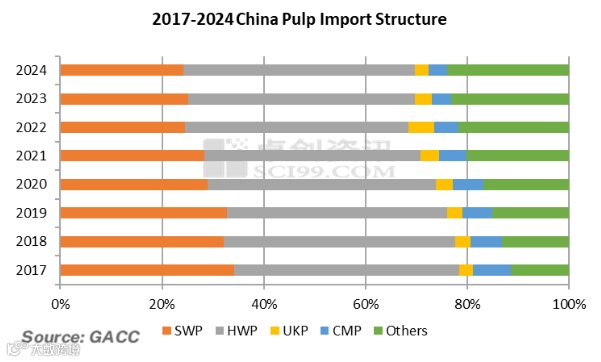
China heavily relies on wood pulp imports, and the dependency on imported SWP is particularly high at almost 100%. From 2017 to 2024, HWP and SWP were the main imported pulp types, accounting for 87.54%-91.63% of the total. According to customs data, HWP accounted for 49.80%-59.72% of China's wood pulp imports, while SWP accounted for 31.44%-38.66%. Due to relatively sparse forest resources, China’s import dependency for SWP and UKP is high, whereas it is lower for HWP and CMP.
Reduced SWP Imports from the US Can Be Offset by Canada and Finland
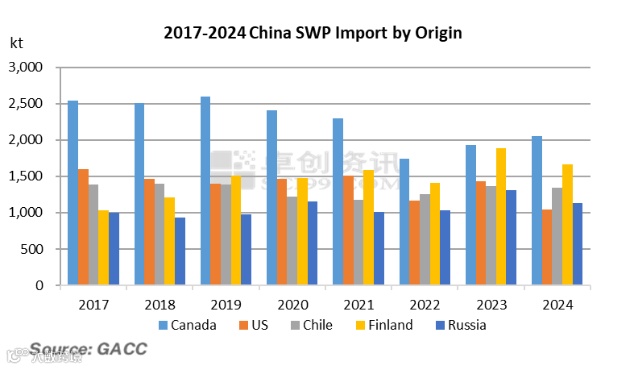
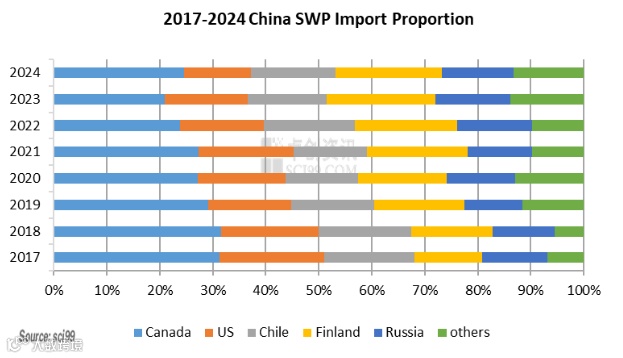
Import data shows that from 2017 to 2024, the top five SWP import partners were Canada, Finland, the US, Chile, and Russia, accounting for 86.14%-94.48% of total SWP imports. Imports from the US peaked at 1,598.1kt in 2017 and hit a low of 1,042.5kt in 2024, showing a downward trend. The import volume from Canada ranged from 1,738.7–2,594.9kt over the past eight years, and that from Finland fluctuated upward over the same period, rising from 1,036.1k mt in 2017 to 1,884.3k mt in 2024.
After the first round of Sino-US trade dispute, China imposed countermeasures against US tariffs in 2019, adding a 5% tariff on US-made SWP. In consequence, the SWP impot volume from the US imports fell by 4.31% to 1,397.2k mt in 2019 and continued to decline in the following years. However, the SWP import volume from Canada and Finland rose by 3.46% and 25.14% respectively YoY in 2019, effectively offsetting the reduced supply from the US.
Sino-US Tariff Policy May Raise China's Imported SWP Market Prices, but Finland's Market Share Could Also Increase
The US along with Canada and Finland were China's main SWP import partners. Since 2019, imports from Canada and Finland and their market share have increased, while the share of US-made SWP declined due to high prices and unstable production in the US.
During this round of tariff dispute, the price of US-made SWP will likely rise significantly due to additional tariffs, further restricting pulp trade between the US and China. Meanwhile, the US's additional tariffs on the EU (including Finland) may also boost Finland's SWP exports to China. Canada was exempt from tariffs, so it will adjust its SWP supply to China based on its own supply-demand and cost conditions, with no direct impact.
Brazil is China’s Primary HWP Import Partner, with Minimal Impact from the US
China’s top five HWP import partners from 2017 to 2024 were Brazil, Indonesia, Chile, Uruguay, and Canada, accounting for 90.64%-97.48% of total HWP imports, indicating a highly concentrated import structure.
Brazil has consistently ranked as China’s top HWP import partner over the past eight years, with imports rising from 4,759kt in 2017 to 8,789.5kt in 2023. In contrast, the imports from the US accounted for only 0.24%-2.53% of China’s total HWP imports, indicating negligible influence from the US on China’s HWP imports. Also, the US’s newly imposed 10% reciprocal tariff on Brazil may raise Brazilian pulp prices in the US market, increasing costs for the US paper industry. If US downstream paper mills reduced purchases, this could lead to a redirection of Brazilian HWP to China. However, since February 10, 2025, China’s imported HWP prices have been on a fluctuating downtrend. In the short term, this tariff policy may weaken the competitiveness of Brazilian HWP in the spot market from the sentiment side. Meanwhile, increased domestic HWP supply at lower prices could further accelerate the decline in China’s imported HWP spot prices. In the long term, some pulp mills in South America plan to shift to dissolving pulp production or conduct maintenance, and slower transactions following Brazil’s March price hikes suggest that future shipment volumes, cost pressures, and actual pulp mill deliveries may help mitigate the downward pressure on China’s imported HWP spot prices.
Sino-US Tariff Policy’s Impact on Pulp Prices Varies Slightly
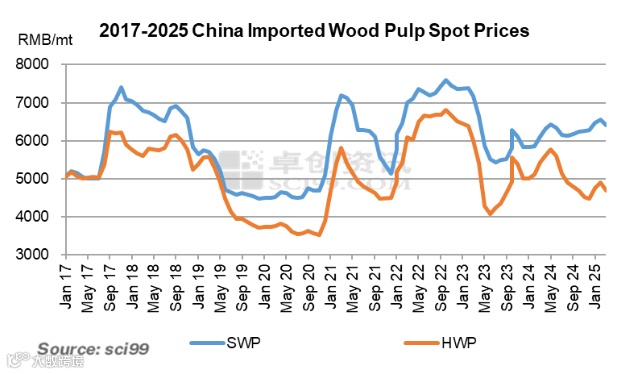
Historically, China’s pulp market has started to show signs of oversupply since 2018, coupled with slowing economic growth due to the Sino-US trade frictions, leading pulp prices into a downward trend. By September 2019, prices had nearly fallen to pre-2016 levels and continued declining. This suggests that Trump’s escalating tariff policies may have contributed to a global trade slowdown, negatively impacting the trading momentum of China’s imported SWP and HWP spot markets. The current tariff policy is expected to have short-term sentiment impacts, serving as a frequently cited factor in market negotiations and triggering a chain reaction, potentially influencing price trends within certain cycles alongside other factors.
This tariff adjustment may become a major driver for imported wood pulp spot prices in 2025. For SWP, due to tight global supply, the policy could provide bullish support. Although no US brands are included in the designated list for futures delivery at Shanghai Futures Exchage, the tariffs and consequential tightening in supply may affect futures prices. For HWP, current spot prices are already on the decline, with minimal impact from overseas maintenance, production shifts, and external market news. The tariff policy may accelerate the downtrend in China’s imported HWP market prices through sentiment factors. Additionally, attention should be paid to the co-movement between SWP and HWP prices and the broader economic slowdown caused by Trump’s tariff policies, which could further dampen demand growth and weigh on pulp prices.
Sino-US Tariff May Accelerate Structural Optimization in China's Wood Pulp Market
In recent years, China's wood pulp market has gradually expanded its capacity through the continuous launch of new wood pulp production lines. By 2025, HWP capacity accounted for 82.26% of China's total wood pulp capacity. Currently, some domestic HWP producers supplied stable volumes for market sales In March, domestic HWP producers increased output while cutting prices, and the trading for imported HWP decelerated, reflecting further optimization in the supply structure. In April, Shandong Huatai Paper plans to launch a new 700kt/a HWP production line, further boosting domestic HWP supply and enhancing the market's risk resilience.
China's SWP capacity represents 10.01% of its total wood pulp capacity, with only Huanggang Chenming Paper regularly producing bleached SWP, while other lines focus on UKP, dissolving pulp, and fluff pulp. Additionally, China has 2,480kt/a of bamboo pulp capacity, which can also partially substitute imported SWP. Recent market anecdotes suggest that some domestic dissolving pulp and HWP production lines may potentially shift to SWP production in the future, which would help alleviate supply gaps in the imported SWP market. Furthermore, since the US tariff policy affects Europe, the SWP supply from countries like Finland may increase shipments to China, potentially leading to further structural optimization in China's SWP market.
In conclusion, the Sino-US tariff policies will accelerate the restructuring of China's wood pulp market. Thanks to earlier strategic integration of pulp and paper production, domestic pulp is gradually replacing some imported volumes. After market adjustments, a new equilibrium is expected to emerge, with pulp prices gradually aligning with the fundamentals by the end of 2025.
All information provided by SCI is for reference only, which shall not be reproduced without permission.
Please click "Read more" for the full article.
