

Interpretation of PBR, SBR, NR Market Similarities & Differences
Introduction: PBR is usually used in tire production together with natural rubber and SBR, and there is a certain proportion of substitution. Therefore, the prices of PBR, SBR, and NR are related to each other, and the profits of tire production also affect the formula adjustment at tire enterprises. Since Q4 2024, the prices of PBR and SBR have been fluctuating downwards, while the NR price has trended at highs.
Price spread analysis between PBR and related products
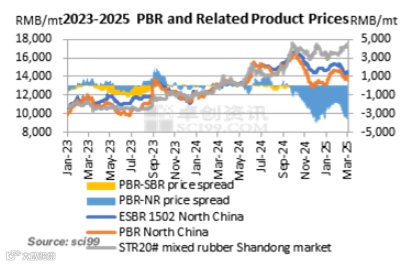
In Q1 2025, the price spread between PBR and SBR narrowed, while that between PBR and NR enlarged. As of March 6, the price spread between PBR and SBR was RMB 500/mt, changing by RMB 725/mt, and that between PBR and NR was RMB 3,625/mt, changing by RMB 3,800/mt. For similar downstream applications, the price spread changes are mainly caused by differences in supply.
The prices of SBR and PBR rose and fell together, but the price spread narrowed. Since October 2024, the price spread between SBR and PBR has enlarged first and then narrowed. After October 2024, private PBR units were restarted intensively driven by the recovery in profits, resulting in a notable rise in supply. Besides, a 150kt/a new PBR unit in northern regions was expected to go into production, so there were more low-priced spot PBR resources in the market. Thus, the PBR price fluctuated downwards. At present, the PBR price is still affected by the ample supply. However, the overall operating rate of the SBR industry was stable. The price spread between SBR and PBR enlarged. Entering 2025, the new SBR unit at Shen Hua Chemical Industrial went into production, so the influence of private SBR resources on the market increased. Suppliers faced higher sales pressure. Thus, the price spread between SBR and PBR narrowed. Considering the current fundamentals of PBR and SBR, the price spread between PBR and SBR is not expected to continue to narrow in the short term.
The price trends of NR and PBR diverged, and the price spread enlarged. Since October 2024, the price spread between NR and PBR has been expanding. The NR inventory remained low and piled up slowly. In February, with the production suspending areas enlarged in Thailand, the supply pressure of new field latex was limited. The decrease in feedstock output bolstered the NR price. Besides, the arrival of shipments underperformed, so the port inventory piled up slowly, strongly driving up the NR price, and enlarging the price spread between NR and PBR. Based on the current fundamentals of NR and PBR, the price spread is not likely to narrow in the short term.
Changes of the cost and profits of all-steel tire production
The low profits of all-steel tire production stimulate the changes in the feedstock formula. According to SCI, the total production cost of all-steel tires (12R22.5, clockwise tread pattern, 65kg) was estimated at RMB 995.15/mt in February, up 2.58% MoM and up 10.09% YoY. (Remarks: As for the underlying data, the feedstock NR price selects the duty-paid price of STR20# mixed rubber in Shandong market, the price of SBR selects the market price of ESBR 1502 in North China, the price of PBR selects the market price of PBR in North China, the price of carbon black selects China’s carbon black market price, and the price of 12R22.5 clockwise selects the market price of all-steel tires in China, etc. All use the monthly average price as of the 28th of the month. The tire price adopts the first-level mainstream wholesale price in the market, which is higher than the actual EXW price. At the same time, the cost calculation model of all-steel tire products of SCI is established by investigating all-steel tire enterprises, determining the material ratios, fixed costs, etc., which only represents the general level of the industry.)
The price spread between PBR and related products may narrow limitedly.
In the short term, there may be limited PBR and SBR units to take maintenance units, and the operating rates will possibly remain high, so the supply is expected to drag down the PBR and SBR prices. From the perspective of NR market seasonality, March is the seasonal downturn in global production areas, so new field latex output may be scarce, and the feedstock prices will likely remain strong. As the new field latex supply pressure is likely to be limited and cost support may still exist, the NR price is anticipated to trend at a high level. Attention should be paid to the external macroeconomic policies and domestic production areas. The influence of the rubber tapping expectations may suppress the high point of March prices. Therefore, on the whole, the price trends of NR, PBR, and SBR may continue to diverge in March. Yet, in H2 of March, bolstered by the slight rebound in cost, the prices of PBR and SBR are expected to rise somewhat. Thus, the price spread between natural rubber and synthetic rubber is likely to narrow somewhat. In addition, the production and sales in the tire market are likely to underperform with low profits, so tire enterprises may show a higher interest in adjusting the feedstock formula, which will possibly accelerate the price spreads narrowing. Limited by the low substitution ratio, the influence of tire feedstock formula adjustment may fail to offset that of supply differences.
All information provided by SCI is for reference only, which shall not be reproduced without permission.
Please click "Read more" for the full article.