

Imbalance Capacity Layout of SM Industry Chain
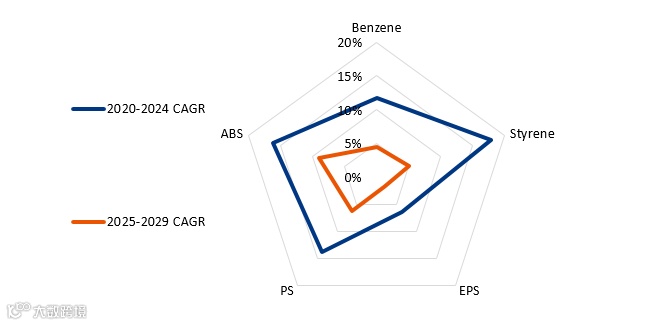
Over the past five years, the benzene-styrene-ABS/PS/EPS chain has accelerated capacity expansions, with most products (excluding EPS) achieving over 10% CAGR. Styrene and ABS led growth at over 15% CAGR. The next five years will see slower capacity growth. The capacity regional distribution may be disproportionately, particularly concentrated in North China (including Shandong)—intensifying supply-demand imbalances and regional competition.
The benzene-styrene industrial chain has entered a growth rate shifting period. In the next five years, the CAGR of capacity will drop to 4-8%, with the ABS sector taking the lead and EPS lagging behind, exacerbating the differentiation.
As of now, the domestic integrated refining and petrochemical process has entered a stage of in-depth development, characterized by large-scale, high-end, and green features, but it also faces challenges such as overcapacity and homogeneous competition. Over the past five years, factors such as the continuous decline in operating rates and profits of various products in the benzene-styrene-ABS/PS/EPS chain, as well as the slowdown in end-demand growth, have disrupted the market. Consequently, the growth rate of new capacity in the industrial chain is expected to decline significantly in the next five years.
The CAGR of capacity for the industry chain in the next five years will mostly range from 4% to 8%, with ABS having the highest CAGR of approximately 8%, followed by PS, styrene, and benzene with CAGRs of 7%, 5%, and 4% respectively, and EPS with a mere 2%. This is a significant decline compared to the 10%-18% CAGR of products in the industrial chain over the past five years.
Newly commissioned refining and petrochemical projects in China have clustered in coastal regions, a trend also evident in their distribution over the past five years. East China accounts for 33%-71% of capacity, holding a significant position; particularly in the styrene downstream ABS and PS industries, which rely on the vertical extension of the industrial chain from upstream refining and petrochemical bases and the coastal concentration of downstream end-demand manufacturing industries such as home appliances, daily necessities, and toys, its capacity share in East China exceeds 50%. The South China region (including Fujian) follows, with a regional share mostly around 20%. The North China region (including Shandong) ranks third, with varying capacity shares across different segments of the industrial chain, generally exhibiting a high share of intermediate product styrene and low shares of upstream and downstream segments.
Over the next five years, the commissioning timelines and capacity of new projects across the styrene industrial chain may remain uneven. Regional arbitrage opportunities are expected to persist, particularly for upstream products like benzene and styrene. In 2025, new benzene and styrene-related projects will concentrate in North China, South China, East China, and Northeast China, with North China hosting the most significant capacity additions. Shandong Yulong Petrochemical’s integrated complex (benzene + styrene + ABS) stands out as a key vertically coordinated project in North China, while most other units in the region remain non-integrated. Benzene capacity expansions will primarily involve brownfield expansions at existing producers, whereas styrene and downstream ABS/PS/EPS projects will predominantly feature new greenfield developments.
From 2025 to 2029, regional distribution patterns of cumulative new capacity will shift markedly compared to 2025. Downstream ABS and PS projects may continue clustering in East China—the dominant consumption hub—accounting for nearly 50% of total additions. Benzene capacity growth may be distributed more evenly across East China, South China, and North China. For styrene, North China will maintain its lead in capacity share, with combined additions in East China and South China still trailing behind. Given the logistical constraints of liquid chemicals like benzene and styrene—compared to the easier transportation of solid plastic pellets (ABS/PS/EPS)—regional supply-demand imbalances are likely to create actionable market opportunities.
All information provided by SCI is for reference only, which shall not be reproduced without permission.
Please click "Read more" for the full article.