

Pulp-paper Co-Movement Weakens as Demand Suppresses Prices
Intro: In May, the pulp market saw more declines than gains despite the minor rebound in the middle of the month backed by the tariff agreement. The cultural printing paper demand was persistently bearish, and the improvements in macro environments and paper mills’ price hike attempts failed to promote market trading. As paper prices stepped down, the co-movement between pulp and paper prices weakened. In June, the pulp price may still face downward pressure, but the cultural printing paper price is expected to stabilize as publishers start to pick up previously ordered volumes. It is estimated the pulp and paper price co-movement to remain at relatively low levels.
Macro boost hard to materialize, and cultural printing paper prices continue to decline
In mid-May, China and the US jointly released a preliminary trade agreement after the meeting in Geneva, and the tariff disputes entered an easing phase. This positive development in the macro facilitated a resumption of export business in coastal regions, but printers mainly delivered previous volumes, while new orders were restricted by rising shipping freight. In late May, given the anticipated pick-up of tender orders by publishers, some paper mills announced price hikes scheduled in end-May or early June, but traders were generally bearish about future market demand and showed little interest in building stocks. As traders prioritized destocking, cultural printing paper prices continued to decline. SCI data suggests the monthly average price of 70g high-white uncoated woodfree paper was RMB 5,200/mt, and that of 70g off-white grades was RMB 4,918/mt, down 2.91% and 2.40% respectively MoM.
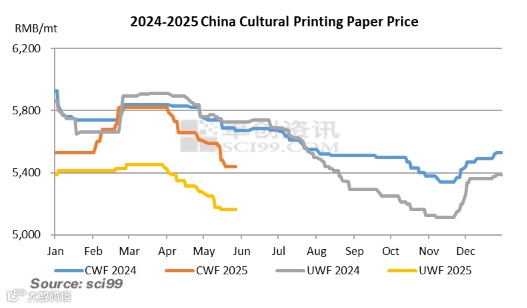
Pulp and paper price co-movement decreased
Due to persistently low paper prices and ineffective profit recovery, paper mills showed limited acceptance of high-priced pulp raw material and continuously attempted to press down pulp purchasing prices. Despite a mild rebound in pulp prices in mid-May bolstered by the tariff agreement, the paper producer inventory failed to drop apparently, so paper mills were still relatively inactive in buying pulp, which restricted the price rebound. As of late May, the imported HWP monthly average price was RMB 4,212/mt, down 6.09% MoM.
Overall, both pulp and paper prices went down in May. Restricted by its own supply-demand imbalance, the favorable macro development failed to create a boost in the cultural printing paper market, but the pulp price rebound was swift driven by the futures market trend. As a result, the pulp and paper price co-movement decreased, and the correlation coefficient between uncoated woodfree paper and imported HWP prices was -0.40, down 0.54pp MoM.
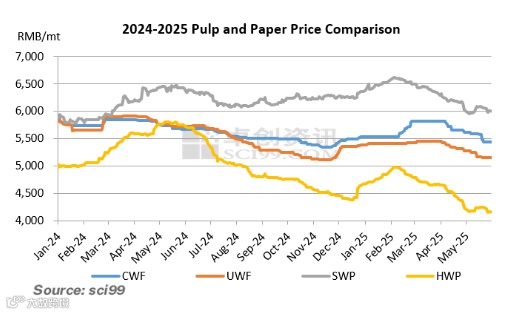
Pulp and paper price gap may widen in June, leading to weaker price co-movement
In June, publishers are expected to pick up the cultural printing paper volumes ordered previously, lending some support to paper prices. Besides, the market sentiment may improve somewhat as paper mills attempt to raise prices. However, considering the lingering influence of the demand off-season, downstream printers may receive limited new orders, which may hinder the price hikes by paper mills and traders. Thus, it is estimated that the cultural printing paper price will likely stabilize in June with limited implementation of price hikes. As for the pulp market, the pulp price may be subdued by sluggish demand during the industry offseason and the competition from Chinese-made market pulp.
In conclusion, due to the potential decline in pulp prices in June and stable cultural printing paper prices, the gap between pulp and paper may widen, leading to lower price co-movement.
All information provided by SCI is for reference only, which shall not be reproduced without permission.
Please click "Read more" for the full article.