

China PVC Market Review in H1 & Outlook for H2 2025
Introduction: In H1 2025, the average price of PVC powder showed a downward trend. Although short-term rebounds occurred in some periods, supported by macro events and improved supply-demand fundamentals, the average price of PVC powder gradually shifted downward. In H2 2025, insufficient domestic demand may drive an increase in exports YoY, but the gradual commissioning of new PVC capacity will likely further intensify market supply pressure, and the supply-demand fundamentals of PVC powder are expected to remain under pressure.
China’s PVC prices showed weak performance in H1 2025.
The PVC powder market prices fluctuated downward in H1 2025. Affected by multiple internal and external factors, the average price dropped. China’s domestic PVC demand was soft, while new PVC units were put into operation. Market players held bearish sentiments toward the market. As of June 30, the average price of SG-5 in H1 2025 was RMB 4,939/mt, down 11.23% YoY.
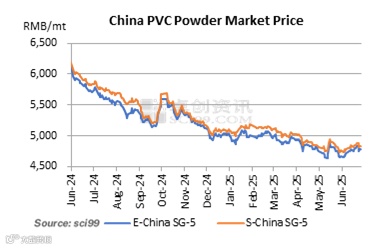
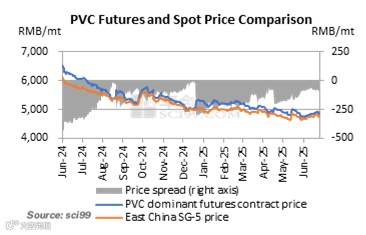
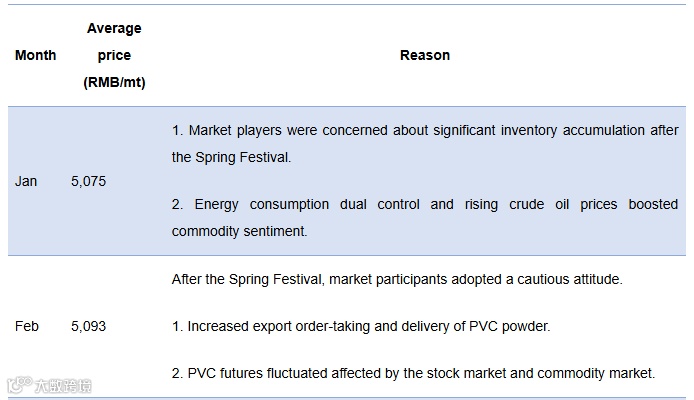
National SG-5 Self-Delivery Average Price in H1 2025
The supply-demand fundamentals of the PVC powder market gradually improved in H1, as increased exports dragged down the social inventory. However, the periodic improvement in PVC fundamentals failed to reverse the overall pattern of oversupply. Expectations for weak PVC fundamentals and lower cost support weighed on market transactions. Thus, PVC powder prices fluctuated downward in H1, and the industry chain faced significant operational pressure.
PVC exports increased, dragging down the social inventory gradually in H1.
PVC social inventory shrank gradually in H1, indicating improved fundamentals. PVC social inventory entered a seasonal inventory accumulation phase in February due to the Spring Festival holiday. Starting from March, inventory changes differed from 2024: warehouse inventory in East and South China began to decline sequentially from March, and plant inventory also decreased.
As of June 26, the warehouse inventory in East/South China and the plant inventory at sample producers was around 926kt, a decrease of 388kt from the highest point in H1 (1,314kt) and nearly 200kt lower than the same period last year.
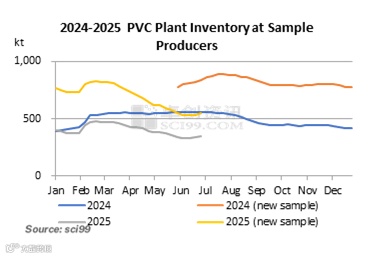
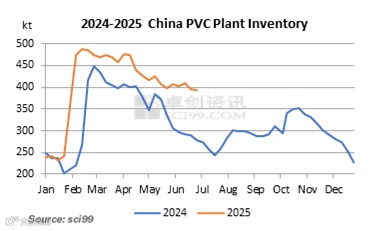
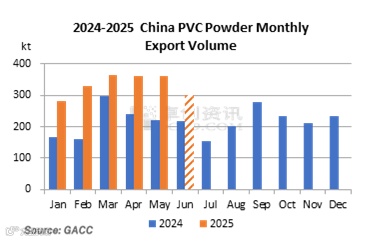
The inventory decline in H1 was mainly driven by increased exports. Inventory changes reflect the result of supply-demand gaming. China’s PVC output increased, and domestic demand was lukewarm in H1, but the notable increase in exports supported the gradual decline in social inventory.
Supply: PVC powder output in H1 was 11,900kt, nearly 140kt higher than the same period last year. The spring maintenance intensity of PVC powder in H1 2025 was lower than that in 2024, and the chlor-alkali/PVC powder integration operation remained profitable for most of the time, so chlor-alkali units ran steadily. In addition, 500kt/a PVC units at SP Chemical were put into operation, while the 300kt/a PVC unit at Shaanxi Jintai Chemical came online.
Demand: China’s domestic PVC demand showed a flat performance in H1, with increased exports offsetting insufficient domestic demand. The real estate recovery process was slow in H1, providing limited support to domestic demand. China’s domestic consumption in H1 is estimated at 10,120kt, down 70kt YoY. On the export side, PVC powder exports increased significantly in H1, with total exports from January to May 2025 being 1,698.5kt, up 610.2kt or 56.07% YoY. The export growth was mainly due to low prices. PVC producers and traders actively promoted sales with the increase in foreign demand.
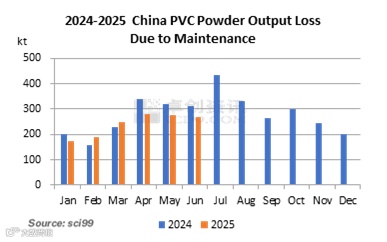
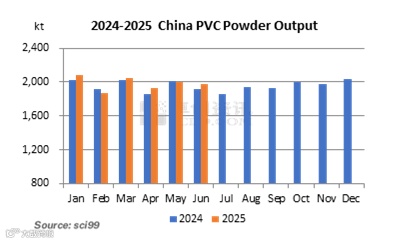
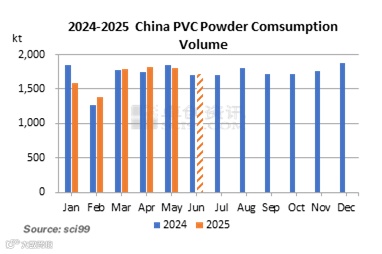
In H1 2025, PVC fundamentals had a limited influence on the market price. In H1, the fundamentals of PVC powder gradually improved, but the market’s trading focus was not on the current fundamental situation. Against the backdrop of oversupply in the PVC powder market, its attribute as a short-position allocation was relatively prominent. The market’s trading logic was driven by three factors: first, the oversupply pattern of PVC powder coupled with weak expectations (sluggish domestic demand + 1,700kt/a of planned new capacity on the supply side); second, the expected downward trend in the cost of chlor-alkali products (overall high operating rates on the supply side, sustained profitability of integrated plants + expectations of declining coal prices and electricity prices); third, market players held bearish sentiments toward the market amid lower expectations for macro policies. Expectations surrounding fundamentals and the cost side became the main market drivers, while changes in the macro environment brought certain fluctuation to the market.
Outlook for the Second Half of 2025
In H2, a significant increase in domestic demand is unlikely. The slow recovery of the real estate sector may remain the most prominent reality on the demand side of China’s commodity market. Although exports will likely provide some support, newly added capacity on the supply side will possibly continue to exert pressure on the market. The current oversupply situation in the PVC market can hardly improve significantly, and the weakness in fundamentals may continue to suppress the market.
Macroeconomic aspect: As uncertainties persist, market players hold bearish sentiments.
In H2, macro policies are expected to remain stable. Monetary policy will likely continue to maintain a prudent and flexible tone, and fiscal policy will possibly continue to play a positive role. However, overseas risks still carry uncertainties. The continuous escalation of trade conflicts and geopolitical events may exacerbate global economic uncertainties, dampening market confidence. The macroeconomic situation in H2 2025 is still far from optimistic.
Supply side: New capacity is planned to be released.
1,700kt/a PVC units are planned to be put into operation in H2 2025. Among them, from July to August, units with a total capacity of 1,400kt/a may have a trial production successively.
Low profit margins suppress supply elasticity. However, the supply-demand mismatch in the caustic soda industry may not be significant. The caustic soda market will likely still maintain a certain profit margin in H2. The integrated profit at chlor-alkali producers will still fluctuate around the cost line, supporting PVC units to run steadily.
Demand side: Insufficient domestic demand support, while export prices may hover at lows.
The real estate market will likely underperform in H2, and demand related to the real estate sector may be lukewarm. China’s domestic demand for PVC powder will likely continue to be weak. On the export side, sacrificing price for higher export volume is likely to continue in H2. India’s BIS certification for PVC powder has been postponed until December 24, 2025. Although factors such as India’s anti-dumping measures, the rainy season, and the ocean freight may disrupt the export market in H2, domestic market prices will still operate at a low level. The price advantage of exports still exists. Moreover, demand in Southeast Asia, Africa, Central Asia, the Middle East, and other regions is expected to continue to increase. Therefore, PVC exports in H2 are still promising.
Overall, in H2 2025, the fundamental pressure on the PVC market will likely continue. The commissioning of PVC units will likely prop up output. However, China’s domestic demand may remain weak, and exports will continue to sacrifice price for higher volume. Export volume will likely increase YoY, but with certain uncertainties. The growth rate of exports in H2 may slow down compared with H1. In terms of the macro-economy, the pressure on China’s economic growth may remain, and tariff disruptions may still have a certain impact on the market. The macro-economy will likely exert pressure on the commodity market. Therefore, the downward trend of PVC powder is still hard to reverse in H2. However, due to the fluctuations in crude oil prices, the expectation of further domestic easing policies, and the support from the cost side, phased upward price trends are not excluded.
All information provided by SCI is for reference only, which shall not be reproduced without permission.
Please click "Read more" for the full article.