

Will PBR Price Uptrend Continue in H2 Aug?
Introduction: In H1 of August, the PBR market price mainly trended up, supported by bullish macro factors and fundamentals. In H2 of August, the support from fundamentals will likely weaken, while the macro environment may be still the main driver for the PBR price variation.
In H1 of August, China’s PBR market price mainly trended up.
In H1 of August, the PBR price mainly trended up. According to SCI, as of August 14, the market price of HCBR 9000 in North China closed at RMB 11,550/mt, up RMB 250/mt or 2.2% from the beginning of August.
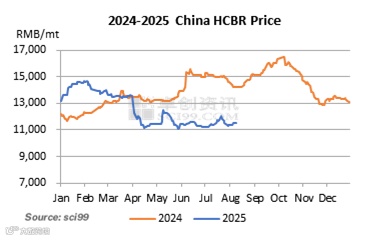
In H1 of August, the PBR price trended up, mainly driven by the bullish macro factors and fundamentals. As for the macro environment, the influence of the “anti-involution” policy intensified, boosting the commodity market sentiments. Thus, the prices of rubber futures moved up accordingly. Besides, there were frequent rainfall warnings in the major production areas of natural rubber, and the geopolitical issue between Thailand and Cambodia had not been totally solved. In addition, the market was cautious about the expected release of natural rubber strategic reserves. Thus, the natural rubber price went up, bolstering the synthetic rubber prices. In terms of fundamentals, 3 PBR units with a total of 290kt/a capacity began to take maintenance in early August, so the operating rate of the PBR industry fell by 6 percentage points. The output losses caused by maintenance in H1 of August are expected to reach around 13kt. Regarding the demand, the operating rates of the all-steel tire and semi-steel tire industries mainly trended flat MoM. Buyers received PBR on rigid demand and were cautious about negotiation at high prices. Tire enterprises showed weak interest in purchasing feedstock. Thus, the dealing price of spot PBR faced headwinds in rebounding.
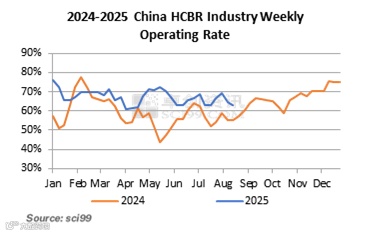
The PBR supply tightened as some PBR units took maintenance, bolstering the rise in the PBR price.
In H1 of August, the maintenance of PBR units was relatively concentrated. The fall in the PBR supply underpinned the price uptrend. The PBR unit at Sinopec Maoming Company began to take maintenance on August 6 and was restarted on August 15. The unit at Zibo Qixiang Tengda Chemical began to take maintenance on August 1 and was restarted on August 17. The unit at Shandong Yihua Rubber & Plastic Technology was shut down on June 30 and was restarted on August 12. The other units ran normally. In the week of August 14, the operating rate of China’s HCBR units fell to 62.91%, down 6.41 percentage points from July 31. The demand changed limitedly. The supply tightening bolstered the price uptrend.
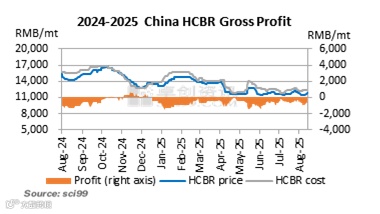
The PBR industry continued to face profit losses as the cost increased.
In H1 of August, the profit losses at PBR producers expanded, underpinning the bottom of the PBR price. The sales pressure at butadiene producers for outside sales was not high, and the volume of imported butadiene arriving at the port was not large, supplementing the spot supply limitedly. Without significant supply pressure, traders mainly maintained firm butadiene prices and showed weak interest in selling at lows. Thus, the butadiene market price mainly trended up. In H1 of August, the profit losses at PBR producers lingered at RMB 400-900/mt, higher than those in July. The cost bolstered the bottom of the PBR price.
In H2 of August, the PBR fundamentals may weaken, curbing the growth in the PBR price.
Macro environment: The bullish macro factors will likely continue to drive up the PBR price. The impact of the “anti-involution” policy on the industry is expected to be long-term and sustainable, as the policy is implemented. In addition to capacity reduction, China is also continuously introducing tools to promote domestic demand. The simultaneous implementation of capacity reduction and consumption promotion is expected to boost the commodity futures market, which may drive up the PBR prices.
Cost: The cost may continue to fuel the PBR price. In H2 of August, some imported butadiene resources may arrive at ports in East China. Besides, there will likely be butadiene resources available from the new unit in Northeast China. Thus, the total butadiene supply is expected to grow. Yet, the uncertainties in the new unit and the unit shutdown at PetroChina Fushun are expected to lead to a decline in the total butadiene resources available in North China market. Therefore, the supply may slightly bolster the butadiene price. With the restart of the downstream units, the rigid demand will likely underpin the bottom of the butadiene price. Yet, downstream users may still show weak interest in purchasing butadiene at high prices, curbing the growth in the butadiene price. Overall, the butadiene market price is expected to mainly trend sideways in H2 of August. The supply-demand gap of the butadiene industry may narrow somewhat, so the butadiene price is more likely to rise, bolstering the PBR price.
Fundamentals: The fundamentals are likely to weaken, dragging down the PBR price. In terms of supply, the PBR units at Sinopec Maoming, Zibo Qixiang Tengda, and Shandong Yihua have resumed normal production. The unit at Xinjiang Lande is scheduled to take maintenance for 10 to 15 days. Overall, the PBR supply in H2 of August will likely rebound notably compared with that in H1. As for demand, the market is tepid at present, and actual dealings are weak. The tire market is expected to improve somewhat driven by the seasonality, but the improvement may be limited. Dragged by the high inventory, some tire enterprises may cut production. Besides, due to force majeure, the operating rate of the downstream non-tire rubber product industry in Beijing-Tianjin-Hebei region is likely to be affected from late August to early September, which may weaken part of the bullish expectations of the consumption peak season. Overall, there may be uncertainties in the demand recovery, while the supply is expected to increase. The weakened fundamentals may fail to bolster the PBR price.
In summary, in H2 of August, the PBR price is likely to continue to climb, but the increment may be limited. The influence of “anti-involution” policies will likely continue to underpin the PBR price, but the fundamentals may weaken, curbing the upper end of the PBR price. In the short term, although some imported butadiene resources are expected to arrive at ports and new butadiene units may come on stream, the supply growth is expected to fail to offset the output losses caused by the unit maintenance at PetroChina Fushun. The cost may bolster the PBR market. Some PBR units are about to be restarted, weighing on the trading sentiments in the market. As for the demand, the operating rate of the tire industry is likely to edge up. However, there may be uncertainties in the operating rate of non-tire rubber product industries in Beijing-Tianjin-Hebei region, dragging down the market trading sentiments. Thus, fundamentals are expected to weaken.
Risk notice: The continuous typhoons in major natural rubber production areas will likely curb the natural rubber production in Q3, driving up the natural rubber price. Besides, there may be uncertainties in the tariff issue. Attention should be paid to the influence of the tariff issue on the commodity market sentiments.

All information provided by SCI is for reference only, which shall not be reproduced without permission.
Please click "Read more" for the full article.