

Sep HWP Market in Stalemate, Changes Expected in Oct
Introduction: In H1 of September, the pulp market lacked effective boosts in supply and demand dynamics. Low profits in downstream paper production dampened the enthusiasm for pulp procurement. Additionally, the slight downtrend in pulp futures has restricted the price hike of imported HWP spot price, with market transactions showing signs of stalemate. Looking ahead to October, the insufficient improvement in supply and demand fundamentals for the pulp market, coupled with continued pressure on downstream paper profitability, suggests that market prices may continue to decline. However, support from the cost factor and the product’s financial attributes may limit the extent of the decline.
HWP price hikes narrowed in early September
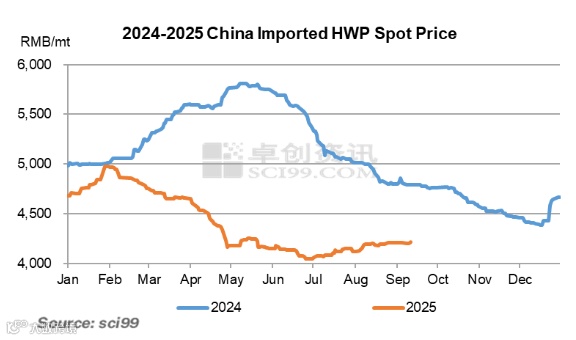
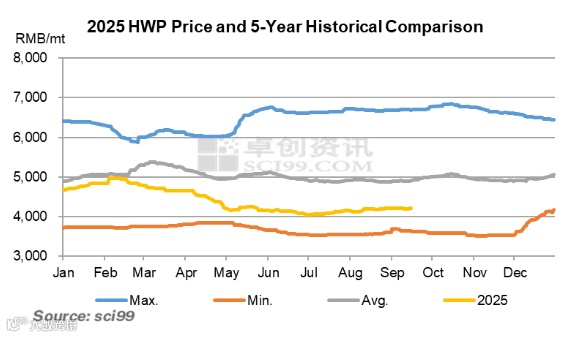
As of September 17, the average spot market price for imported HWP in China was RMB 4,215.07/mt, up 0.44% MoM but down 12.04% YoY. Reviewing the trends of imported HWP over the past five years, the average price in September mostly showed an upward trend. Boosted by the increase in offers from both overseas and major domestic HWP producers in August 2025, the average spot market price edged up in early September. However, the market lacked effective support from supply and demand fundamentals. Coupled with persistently low gross margins for downstream paper, paper mills were less motivated to procure pulp materials. Additionally, the arrival cost of market pulp shipments was lower than the spot price, and pulp futures turned slightly bearish. As a result, the average price increase for imported HWP narrowed.
In terms of price volatility, as of September 17, 2025, the seasonal fluctuation range of imported HWP prices narrowed compared to the same period in 2024. According to SCI data, as of September 17, the price difference between the highest and lowest prices for imported HWP in September 2025 was RMB 11.84/mt, narrowing by RMB 54.06/mt compared to the same period in 2024, indicating that market transactions had entered a stalemate.
Insufficient improvement in pulp market supply and demand in September
The pulp market is expected to face challenges in supply and demand imbalance in September, with the supply-demand gap likely to widen, posing a downside risk to pulp prices. On the supply side, based on wood pulp shipments from major producing countries to China in July, sample exports of wood pulp to China increased by 10.21% MoM. It is estimated that wood pulp imports in September will increase by 11.21% MoM. Due to the production restarts at Chenming and the ramp-up of new capacity launched earlier, total supply is expected to increase by 5.35%. On the demand side, September is traditionally the peak season for the paper industry, and with the release of new capacity by tissue producers, demand is expected to rebound slightly by 2.32%. The supply-demand gap is projected to widen by 4.57pp compared to August, restricting further price increases for pulp.
Declining paper gross profit rates drag pulp prices in September
In September, the prices of most downstream paper grades fluctuated weakly, and profitability improvements were limited. As of September 17, the average monthly gross profit rate for downstream coated paper, uncoated woodfree paper, ivory board, and wood pulp tissue declined by 3.51pp, 2.69pp, 0.22pp, and 0.004pp, respectively, compared to August. Traders showed low enthusiasm for pulp procurement, which weighed on pulp prices.
Pulp market may break the stalemate trend in October, affected by multiple factors
On the supply side: New domestic pulp capacity may continue to increase in October, dragging down the price trend. A 350 kt/a HWP capacity is expected to be launched in September or October, coupled with the stable production at other newly added capacity earlier this year, pulp output will continue growing in October. Import HWP contract purchases remained stable in August, supporting import volumes for October. It is estimated that domestic pulp imports will increase slightly MoM in October. Overall, domestic pulp market supply in October may increase by 6.14% MoM, posing a downside risk to pulp prices.
On the demand side: the pulp demand is expected to remain stable in October, but low profitability may weigh on pulp prices. New capacity in October is mainly concentrated in the tissue sector, while cultural printing paper and ivory board will mainly see output from previously started-up capacity. Therefore, total demand may increase by 2.20% MoM, providing a buffer against pulp price declines. However, the limited profitability improvement due to overcapacity in the base paper industry may conversely drag down pulp prices.
Cost wise: Ring overseas offers increase future cost pressure, which may support spot prices. Imported HWP overseas offers are raised by $20/mt in August. The theoretical arrival cost in October has increased by 3.98% MoM. Increased cost pressure may strengthen spot sellers’ attitudes to hold prices, potentially supporting the spot price of imported HWP.
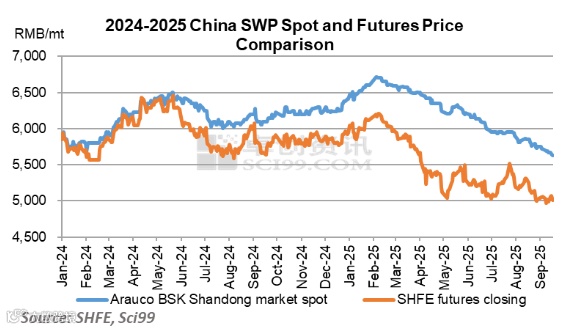
Sentiment side: The price trends of the main pulp futures contract and the offset printing paper futures contract at SHFE are uncertain. Traders hold divergent expectations, continuously affecting the periodic daily prices of softwood pulp, thereby weighing on the price trend of imported HWP.
In summary, with weak momentum for supply-demand improvement in the pulp market in October, the persistent low profitability of the downstream paper industry will continue to drive pulp prices downward. However, cost factors will provide some support to spot prices. Coupled with the uncertainty in pulp futures prices, the decline in imported HWP prices may be relatively limited at around 1.23%.
All information provided by SCI is for reference only, which shall not be reproduced without permission.
Please click "Read more" for the full article.