

PE Market Prices Fluctuate in Early Aug
Introduction: In early August, China’s PE market prices experienced fluctuations. Prices showed a mixed picture with increases, decreases, and stability, but the overall fluctuation range narrowed, reflecting a lack of clear market direction. Traders adjusted offers based on prevailing market conditions, while downstream producers purchased feedstock on a need-to basis. Most market participants adopted a wait-and-see stance, exhibiting low purchasing enthusiasm, and the actual dealing prices were negotiable.
Price: Divergent Performance Across PE Varieties in Early August
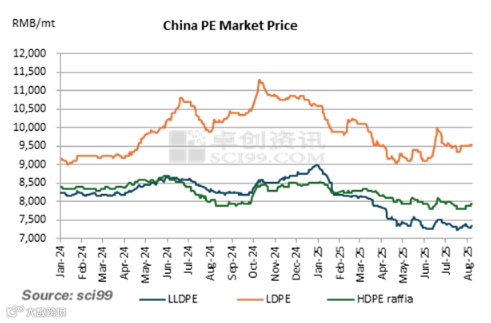
China’s PE market prices fluctuated within a narrow range at the start of August. As of August 7, the mainstream price in the domestic LLDPE market ranged between RMB 7,180/mt and RMB 7,700/mt, with fluctuations varying between RMB 20/mt and RMB 100/mt. The mainstream price of LDPE stood between RMB 9,300/mt and RMB 9,850/mt, fluctuating by RMB 20-70/mt. Prices of most HDPE varieties continued to decline, with changes ranging from RMB 10/mt to RMB 100/mt. Overall, PE prices presented a mixed picture of gains, losses, and stability, but the amplitude of these fluctuations narrowed, highlighting the market’s lack of definitive guidance. Traders set prices reactively, while downstream producers purchased feedstock on a need-to basis. The majority of market players adopted a cautious approach, with subdued purchasing interest, and concluded deals based on negotiation.
Cost: Crude Oil Declines Weaken Cost-Side Support
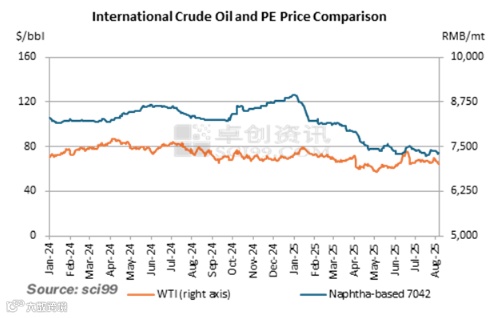
With the bearish news in early August, crude oil closing prices witnessed consecutive declines followed by a significant drop below key support levels, which released pessimistic market sentiment and weakened support from the cost side. Looking ahead, oil prices are expected to remain under pressure with weak adjustments, facing significant difficulty in rebounding. The average price of U.S. crude oil is estimated at around $64/bbl, fluctuating within a range of $62-65/bbl. Should the U.S.-Russia negotiations proceed smoothly, the potential lifting of the U.S. sanctions would likely alleviate market concerns about supply disruptions from a certain European country, further pressuring crude oil prices and sustaining a weak trend. Key risks include the breakdown of the U.S.-Russia talks and Saudi Arabia halting its production increases.
Supply: Reduced Maintenance Coupled with New Capacity Adds Pressure
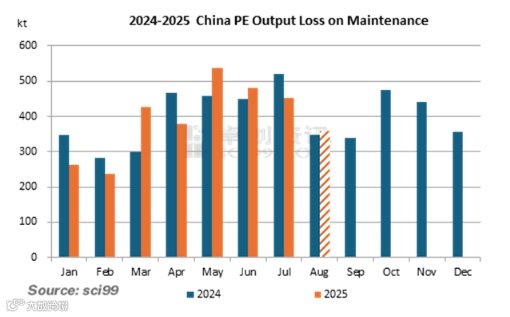
On the supply front, China’s domestic PE supply in August is still expected to increase. On one hand, SCI data indicates the peak maintenance period is gradually concluding, with fewer units being newly involved in maintenance in August and maintenance-related output loss hitting a relatively low level for the year. On the other hand, although the start-up schedule for ExxonMobil’s Huizhou PE unit has been delayed, PetroChina Jilin Petrochemical’s Phase II project maintains its planned August commissioning. Coupled with continuously increasing import volume, supply pressure is intensifying. Considering the impact of new capacity and the expected reduction in the output loss due to unit maintenance, the overall supply-side pressure is trending stronger, exerting a drag on the PE market price.
Demand: Partial Improvement Offers Limited Market Support
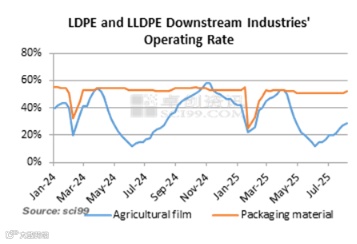
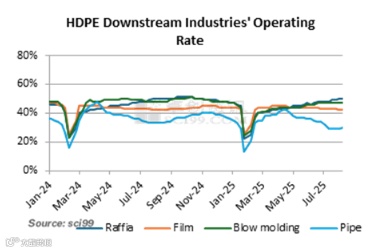
Regarding demand, with the approach of the seasonal peak demand period ("Golden September and Silver October"), downstream demand is slowly improving in some sectors. Taking agricultural film as an example, orders are being continuously received. Large-scale producers are gradually ramping up operating rates to high levels. However, order intake at small and medium-sized producers remains subpar, leading to slower increases in their operating rates. Some feedstock ordered earlier arrived at warehouses during the week, but regarding spot goods, agricultural film producers adhered to feedstock procurement on a need-to basis. In other downstream industries, new order intake is expected to be limited in the short term, and producers’ operating rates may see little change. Although production suspensions during high-temperature periods have ended in some regions, demand in most areas remains sluggish. While operating rates see slight increases at individual producers, the overall improvement is limited. Downstream producers currently exhibit strong caution and low purchasing enthusiasm. They continue to procure feedstock mainly based on rigid demand, making small replenishments when prices dip, offering limited support to the PE market.
Forecast: PE Market to Move Upward in August amid the Tug of War Between Supply and Demand
Although cost-side support for the PE market weakens in August, the current market trajectory is primarily dictated by supply-demand fundamentals. On the supply side, the peak period for unit maintenance is ending, and previously idled units are gradually restarting, increasing market supply pressure. On the demand side, while there is some expectation for improvement, downstream producers remain cautious, mostly purchasing feedstock based on orders, resulting in relatively insufficient support from the demand side in the short term. Consequently, the supply-demand imbalance persists. Although prices are likely to fluctuate in the short term, later in the month, accompanied by phased improvement in demand, the market price may experience a slight recovery. However, the price increase is expected to be relatively modest.

All information provided by SCI is for reference only, which shall not be reproduced without permission.
Please click "Read more" for the full article.